

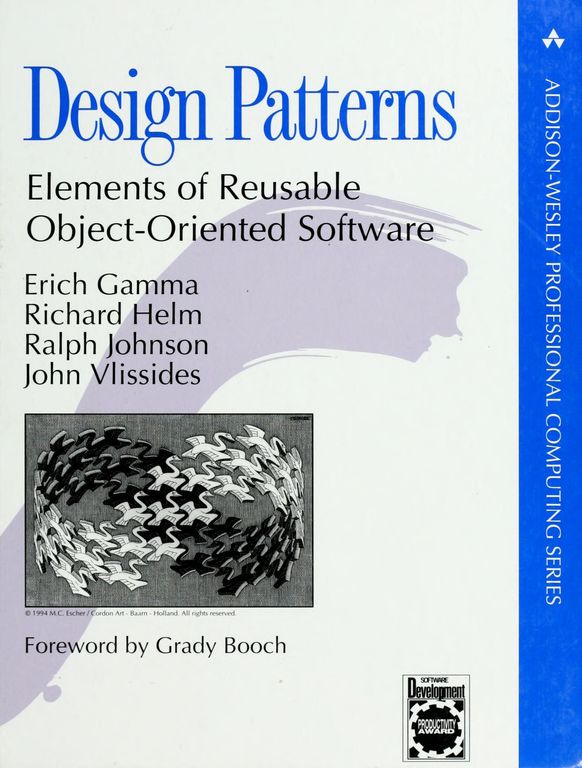
Design Patterns
Elements of Reusable Object-Oriented Software
Introduction
Nova: Imagine this: it's 1994. The web is barely a year old. Java hasn't been released yet. And four software engineers publish a 395-page book that will go on to sell more than half a million copies in over a dozen languages. That book is Design Patterns: Elements of Reusable Object-Oriented Software. Today, three decades later, developers around the world still talk about the Singleton, the Factory, the Observer. But here's the wild part: the whole concept of software design patterns didn't even originate in computer science.
Nova: It came from architecture. Actual buildings. In 1977, a professor named Christopher Alexander published A Pattern Language, a catalog of 253 patterns for designing towns, buildings, and even individual rooms. One of his patterns was called Window Place and it proposed that every room needs a comfortable spot near a large window. Not a luxury, he argued, but a necessity to resolve the natural tension between wanting comfort and wanting light.
Nova: Exactly. Erich Gamma, Richard Helm, Ralph Johnson, and John Vlissides took Alexander's insight that experienced designers arrive at similar elegant solutions independently and asked: what are the recurring problems in software design and what do the best solutions look like? The result became one of the most influential books in the history of software engineering. I'm Nova.
The Surprising Origin Story
Before the Book: From Buildings to Bytes
Nova: So let's rewind. The story of this book actually starts in 1987, at the OOPSLA conference in Orlando, Florida. That's the big object-oriented programming conference. Kent Beck and Ward Cunningham stood up and gave a talk called Using Pattern Languages for Object-Oriented Programs. They had been sent a copy of Christopher Alexander's architectural pattern book by a friend and it clicked: what if we did this for software?
Nova: Absolutely. Beck went on to create Extreme Programming, Cunningham invented the wiki. But at that moment in 1987, they were presenting five patterns for user interface design. Things like Windows Per Task, Few Panes Per Window, Short Menus. They had identified another twenty to thirty patterns and were planning a full catalog of a hundred to a hundred and fifty.
Nova: They didn't. But they did something arguably more important: they systematized it. The real catalyst was Erich Gamma's doctoral thesis in 1991 at the University of Zurich, titled Object-Oriented Software Development Using the Example of ET++. He met Richard Helm at a birds-of-a-feather session at OOPSLA 1990, where they discovered their shared passion. Ralph Johnson and John Vlissides joined soon after.
Nova: Yes! August 1993. Kent Beck and Grady Booch invited a group of pattern enthusiasts to a cabin in the Colorado mountains. They called themselves the Hillside Group, and they hammered out the foundations of what would become the GoF book. The Hillside Group still exists today as a nonprofit that sponsors pattern conferences.
Nova: Exactly. And the timing was perfect. C++ was the dominant object-oriented language, Smalltalk was influential, and object-oriented programming was exploding. But here's the ironic twist: Java, the language most people associate with GoF patterns today, didn't even exist yet. It was released in 1995, a year after the book.
Creational, Structural, and Behavioral
The 23 Patterns: A Guided Tour
Nova: So what's actually inside this book? The GoF cataloged 23 design patterns and organized them into three categories: Creational, Structural, and Behavioral. Five creational, seven structural, and eleven behavioral.
Nova: Right. And here's why that matters. In most object-oriented languages, you create an object with the new keyword, and that locks you into a specific concrete class. Tight coupling. The creational patterns are essentially five different strategies for avoiding that tight coupling. Singleton says only one instance, period. Factory Method delegates creation to subclasses. Abstract Factory creates families of related objects. Builder constructs complex objects step by step. And Prototype clones existing objects instead of using new.
Nova: That's a great analogy. Now, structural patterns deal with composition: how do you assemble objects into larger structures? The Adapter, for instance, is like a travel power plug converter. It lets two incompatible interfaces work together. Composite lets you treat a single object and a group of objects the same way. Decorator wraps objects to add behavior dynamically. Facade gives you a simplified front door to a complex subsystem.
Nova: Behavioral patterns are about communication and responsibility. How do objects talk to each other without becoming entangled? Observer is classic: it's the publish-subscribe model where multiple objects get notified when one changes state. Strategy lets you swap algorithms at runtime. Command encapsulates a request as an object so you can queue, log, or undo it. Iterator lets you traverse a collection without exposing its guts.
Nova: It is! And that's actually one of the most fascinating things about this book. Many of these patterns have been absorbed so deeply into languages and frameworks that we don't even think of them as patterns anymore. They're just how things work. In Java, foreach loops are Iterator. In C#, events are Observer. The Spring framework is practically a living museum of GoF patterns: Factory, Adapter, Strategy, Template Method, Proxy, they're all in there.
Nova: Exactly. And that's the highest compliment a design idea can receive.
The Deeper Philosophy
Two Principles That Changed Everything
Nova: Beyond the 23 patterns themselves, the book's first chapter contains two principles that fundamentally changed how developers think about code. The first: program to an interface, not an implementation.
Nova: It means your code should depend on abstractions, not concrete classes. If you write code that says I need a List, not I need an ArrayList, you can swap out the implementation later without changing anything else. The client code never has to know what specific type it's dealing with.
Nova: Perfect analogy. The second principle is even more provocative: favor object composition over class inheritance. The authors argued something quite radical for 1994: developers overuse inheritance.
Nova: Right, and the GoF called inheritance white-box reuse because the subclass can see the parent's internal details. They warned that inheritance breaks encapsulation. A change in the parent class can cascade down and break every subclass. Instead, they championed object composition: black-box reuse, where you assemble behavior at runtime by plugging objects together through well-defined interfaces.
Nova: Exactly. That's the Strategy pattern in action. The GoF also introduced the concept of delegation: an extreme form of composition where a sender passes itself to a delegate. The key insight was that composition creates relationships at runtime, not at compile time. Your system becomes more flexible.
Nova: Not at all. They said inheritance still makes sense when you're adding functionality to existing components and reusing most of the old code. They also warned that dynamic, highly parameterized software is harder to understand than more static software. It's always a trade-off. The book is nuanced that way. It doesn't give you dogma. It gives you a vocabulary for thinking about trade-offs.
Criticism and Evolution
The Controversies: Patterns as Language Failures
Nova: Here's where things get spicy. Not everyone loves the GoF book. In fact, some of the smartest people in software have been its harshest critics.
Nova: Got it in one. Paul Graham, the founder of Y Combinator and a noted Lisp advocate, wrote something that still gets quoted today. He said: When I see patterns in my programs, I consider it a sign of trouble. The shape of a program should reflect only the problem it needs to solve. Any other regularity in the code is a sign that I'm using abstractions that aren't powerful enough.
Nova: That's the critique. Peter Norvig, the director of research at Google, demonstrated that 16 out of the 23 GoF patterns are either simplified or completely eliminated in Lisp or Dylan. When your language has first-class functions, closures, and macros, many of these patterns just dissolve into the language itself.
Nova: It's a legitimate point, but I think it also misses something. The patterns describe problems, not just solutions. Even if the implementation becomes trivial in a more expressive language, knowing that you're facing a Factory or an Observer situation helps you reason about the design. The pattern gives you a name for what you're doing.
Nova: Very much so. In a fascinating 2009 interview with InformIT, fifteen years after publication, Erich Gamma revealed that the authors had discussed how they would refactor the book. Gamma wanted to remove the Singleton pattern entirely. He felt it had been overused and often misapplied. But the other three authors didn't agree, so it stayed.
Nova: They identified several patterns that deserved inclusion: Dependency Injection, which has become absolutely central to modern software architecture. Type Object. Null Object. Extension Object slash Interface. These emerged after the book's publication and became just as important as the original 23.
Nova: That intellectual humility is actually written into the book itself. In the preface, the authors say they didn't understand the whole book on the first writing and that readers shouldn't expect to understand it on the first reading either. They called it a catalog, not a finished doctrine. A record of our thoughts on design, not the final word.
Why GoF Still Matters in 2024 and Beyond
The Living Legacy
Nova: So here we are, thirty years later. The book has been translated into thirteen languages. It's sold over half a million copies. In 2005, the authors received the ACM SIGPLAN Programming Languages Achievement Award. And developers still get asked in job interviews: name a few design patterns other than Singleton.
Nova: That's the fascinating paradox. The book is simultaneously dated and timeless. The code examples are dated. The design problems they describe are timeless. When you use a modern framework like Spring or. NET or Angular, you're swimming in GoF patterns whether you realize it or not. Understanding the patterns helps you understand why the frameworks are designed the way they are.
Nova: That's a lovely comparison. Or like studying music theory instead of just playing songs. You can be a good developer without knowing the patterns, but knowing them gives you a deeper architectural intuition. The authors themselves said in the preface: the book is not for novice object designers. It assumes you already have experience and are ready to think at a higher level of abstraction.
Nova: The book's own Reader's Guide suggests starting with eight: Abstract Factory, Adapter, Composite, Decorator, Factory Method, Observer, Strategy, and Template Method. Those are the gateway patterns. But if I had to pick the ones that show up everywhere in modern systems, I'd say Strategy for pluggable behavior, Observer for event-driven architecture, Factory for dependency management, Adapter for integrating APIs, and Composite for tree structures like UI components or file systems.
Nova: Singleton is controversial because it's both a creational pattern and a global state management pattern, and global state is dangerous. Modern dependency injection frameworks handle the one instance problem much more cleanly. That said, understanding why Singleton is problematic teaches you something important about software design.
Nova: That's exactly it. The book's greatest gift is not the 23 patterns. It's the shift in mindset. It taught an entire generation of programmers to think like architects. To recognize recurring problems, to name them, to discuss them with a shared vocabulary, and to apply proven solutions while understanding the trade-offs. That way of thinking transcends any specific language or era.
Conclusion
Nova: So let's bring this home. Design Patterns by the Gang of Four is not a book of code recipes. It's a book that changed the conversation. Before 1994, every development team was inventing their own solutions to the same problems in their own private language. After 1994, the entire industry could say Strategy pattern or Observer pattern and everyone immediately understood.
Nova: The book's origin story is almost as remarkable as its content. The idea traveled from Christopher Alexander's architecture studios in Berkeley to a mountain cabin in Colorado to the OOPSLA conference in Portland, and from there into millions of lines of code around the world. A pattern language for buildings became a pattern language for software.
Nova: Don't read it cover to cover. Use it as a reference. Start with the eight patterns the authors recommend. Read the first chapter carefully, especially the two principles about interfaces and composition. And most importantly, don't memorize the patterns. Learn to recognize the problems they solve. When you're designing software and you feel that familiar tension, that sense that there should be a cleaner way, you'll start seeing which pattern fits. That's when the book becomes a conversation partner, not just a catalog.
Nova: This is Aibrary. Congratulations on your growth!