

The Mind's Labyrinth: Navigating Illusion and Reality
Golden Hook & Introduction
SECTION
Nova: Atlas, I’ve got a quick game for you. I’ll say a common decision-making scenario, and you tell me the first gut reaction that pops into your head. Ready?
Atlas: Oh, I love these! My brain is always ready for a quick-fire challenge. Lay it on me, Nova.
Nova: Alright, you’re at a restaurant, scanning a menu with dozens of options. What’s your gut reaction?
Atlas: Oh, immediate paralysis. Like, my brain just freezes, and I end up ordering the same chicken dish I always get, even if I don't really want it.
Nova: Exactly! Now, you’re driving, and someone cuts you off. What’s the instant response?
Atlas: Pure, unadulterated, irrational anger. Followed by a string of words I probably shouldn’t repeat on air. Why do they do that, Nova?!
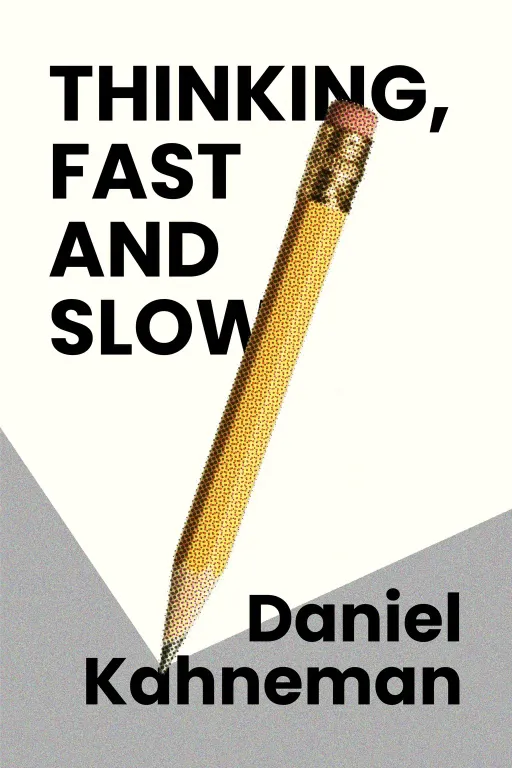
Nova: Because our brains are wired for shortcuts, Atlas! And that’s what we’re dissecting today with two monumental works: Daniel Kahneman's groundbreaking "Thinking, Fast and Slow" and Antonio Damasio's deeply insightful "Descartes' Error: Emotion, Reason, and the Human Brain." Kahneman, a psychologist, actually won a Nobel Prize in Economics for his work on prospect theory, which challenged traditional economic assumptions about human rationality.
Atlas: Wow, a psychologist winning an economics Nobel. That alone tells you how much he shook things up. It’s like saying, "Hey, all those perfectly rational economic models? Not so fast, human brains are messy!"
Nova: Precisely! And Damasio, a brilliant neuroscientist, picks up that thread by showing us just how deeply intertwined our emotions are with our supposed rationality. These books reveal a profound truth: our minds are far from purely logical machines. They're intricate labyrinths of instinct, emotion, and cognitive quirks.
Atlas: That’s actually really inspiring, because it validates so many of those moments where you feel like your brain is working against you. It's not just; it's how we're built. But if our understanding of reality is so influenced by these shortcuts and emotions, how do we even begin to trust our own thoughts?
The Architecture of Perception and Emotion
SECTION
Nova: That’s the million-dollar question, and it’s where Kahneman’s work, particularly his concept of System 1 and System 2 thinking, becomes absolutely crucial. He posits that we have two fundamental systems driving our thinking. System 1 is fast, intuitive, emotional, and largely unconscious. It’s what makes you swerve to avoid an obstacle, or instantly recognize a familiar face.
Atlas: Oh, I see. So, like my immediate anger when I’m cut off in traffic, or my default chicken order at the restaurant. That’s System 1 kicking in, right? The quick, almost automatic response.
Nova: Exactly! It’s efficient, it’s powerful, and it’s constantly at work. But then there’s System 2: slow, deliberate, logical, and effortful. This is what you engage when you’re solving a complex math problem, or carefully weighing the pros and cons of a major life decision.
Atlas: So you’re saying System 1 is the impulsive teenager, and System 2 is the wise, but sometimes lazy, adult.
Nova: That’s a great analogy! The problem is, System 1 often jumps to conclusions, using heuristics – mental shortcuts – that can lead to predictable biases. And System 2, while capable of correcting System 1, is. It prefers to conserve energy, so it often just endorses System 1’s intuitions unless there's a strong reason to intervene.
Atlas: That makes me wonder… how often are we using System 2 for important decisions? It sounds like we’re mostly on autopilot, guided by these fast, intuitive responses that might not always be right.
Nova: Far less often than we’d like to believe. Kahneman’s research is filled with fascinating experiments. For instance, he’d present people with a simple riddle: "A bat and a ball cost $1.10 in total. The bat costs $1 more than the ball. How much does the ball cost?"
Atlas: Okay, my System 1 is yelling "10 cents!" That’s my immediate, intuitive answer.
Nova: And that’s the common, incorrect answer! If the ball were 10 cents, the bat would be $1.10, making the total $1.20. The correct answer is 5 cents. The vast majority of people, even highly intelligent ones, fall for the System 1 trap. It illustrates how readily we accept the easy answer without engaging the more effortful System 2.
Atlas: Wow, that’s kind of heartbreaking. It means I’m probably making snap judgments all the time without even realizing it. So, Kahneman shows us our cognition often leads us astray, but where does Damasio come in? Because I know his work, "Descartes' Error," really challenges the idea that emotion is separate from reason.
Nova: That’s the perfect segue, Atlas. Damasio, through his work with neurological patients, stumbled upon a profound insight. He studied individuals who, due to brain damage, had lost the ability to emotion. You'd think, "Great, pure rationality!" But the opposite happened. These patients, like a man he called "Elliot," became utterly incapable of making decisions.
Atlas: Hold on, so someone who couldn't feel couldn't make a decision? That sounds counterintuitive. You’d think without emotions, decisions would be clearer, unclouded by feelings.
Nova: That’s the Cartesian error Damasio challenges – the long-held Western philosophical idea, famously articulated by Descartes, that mind and body, reason and emotion, are separate. Damasio found that Elliot, despite having intact intellect and memory, would spend hours debating trivial choices, like which color pen to use, or which day to schedule an appointment. He could articulate the pros and cons logically, but he couldn't the preference that would tip the scales.
Atlas: So basically, emotion isn't some messy impediment to good decision-making; it's actually the that allows the gears of reason to turn. Without it, you just get stuck. That’s a powerful idea.
Nova: Absolutely. Damasio argues that emotions provide "somatic markers"—gut feelings—that guide us, often unconsciously, toward beneficial outcomes and away from harmful ones. They act as a rapid signaling system, helping System 2 narrow down options by flagging certain choices as good or bad, based on past experience.
Atlas: In other words, my "gut feeling" about that chicken dish might not always be the most adventurous choice, but it’s still a form of information that my brain uses to make a decision, even if it's not purely logical. It’s like a quick, pre-cognitive filter.
Nova: Precisely. Damasio’s work, which received widespread critical acclaim for its innovative approach, shows that emotion isn't just a byproduct of thinking; it's an integral component of rational thought. This has massive implications because it means that trying to make "purely rational" decisions by suppressing emotion might actually be self-defeating.
Atlas: That gives me chills. So, Kahneman gives us the "how" – the two systems and their biases – and Damasio gives us the "why" – the fundamental role of emotion in even the most rational processes. Together, they paint a picture of a human mind that's far more complex and... well, human, than we often admit.
Rethinking Rationality
SECTION
Nova: And that complexity forces us to rethink what "rationality" even means. If our reason is so intertwined with emotion and prone to these cognitive shortcuts, how can we cultivate more reliable pathways to understanding and truth? This is where the practical application really comes in for our listeners.
Atlas: That’s a great way to put it. For our listeners who are managing high-pressure situations or making critical decisions—whether it's in business, personal finance, or even just daily life—understanding these mechanisms is vital. What's the first tiny step someone can take to start observing these systems at work?
Nova: A fantastic question. The tiny step is simply awareness. Observe a recent decision you made. Did you jump to a conclusion, or did you pause and deliberate? For example, if you just bought something online, was it an impulse buy or did you research extensively, read reviews, and compare prices? What emotional state were you in?
Atlas: Oh, I’ve been there. I totally know that feeling of clicking "buy now" and then having a vague sense of unease later. So it's about catching ourselves in the act, almost. But then what? If we identify our System 1 running wild, how do we engage System 2 more effectively?
Nova: One approach is to consciously slow down. Kahneman found that simply being in a state of cognitive ease – like feeling happy or relaxed – makes System 2 less likely to kick in. Conversely, if you’re slightly uncomfortable or presented with something that difficult, System 2 is more likely to engage. So, if you're making a big decision, try to create some cognitive friction. Ask yourself: "What's the opposite of my initial thought?" or "What evidence would disprove my current belief?"
Atlas: That’s actually really inspiring. It’s like creating an internal "devil's advocate" to challenge your own gut reactions. I still struggle with that myself, especially when I'm under time pressure. But what about the emotion side of things, from Damasio’s perspective? If emotions are crucial for decision-making, how do we use them wisely, instead of letting them lead us astray?
Nova: That’s where emotional intelligence becomes key. It's not about suppressing emotions, but recognizing them, understanding their origin, and distinguishing between relevant "somatic markers" and irrelevant emotional noise. For instance, if you're making a financial investment, fear is a natural emotion. Is it a rational fear based on market data, or an irrational fear based on a single bad past experience?
Atlas: So basically you’re saying, acknowledge the emotion, but then run it through a System 2 check. "Why am I feeling this way? Is this feeling giving me useful information, or is it a bias?" That makes a lot of sense. It’s about integrating the two, rather than trying to separate them.
Nova: Exactly. Both Kahneman and Damasio, in their own ways, are urging us towards a more nuanced understanding of ourselves. They challenge the conventional wisdom that we are purely rational beings and instead offer a richer, more accurate portrait of the human mind. It's a call to embrace our cognitive quirks and emotional depth, not fight against them.
Atlas: That’s actually really inspiring, because it means that self-awareness is probably the most powerful tool we have. By understanding how our minds work – the fast and slow, the emotional and the logical – we can start to navigate the labyrinth of illusion and reality with a bit more clarity.
Synthesis & Takeaways
SECTION
Nova: Absolutely. The profound insight here is that true understanding and reliable decision-making don't come from denying our inherent biases or suppressing our emotions. They come from recognizing these fundamental aspects of our human architecture and learning to work them. It's about building a partnership between our intuitive System 1 and our deliberate System 2, informed by our emotional landscape.
Atlas: So, it's not about becoming a robot, devoid of feeling, but about becoming a more self-aware, integrated thinker. It’s about harnessing the power of our emotions and intuitions, while also having the tools to critically examine them.
Nova: Precisely. It’s a journey towards what you might call "enlightened irrationality"—understanding our own cognitive glitches so we can make better, more robust decisions in a world that constantly tries to trick our fast thinking. The tiny step is observation; the deep question is continuous self-interrogation.
Atlas: I love that. "Enlightened irrationality." What a perfect way to frame it. It’s a recognition of our human condition, and an invitation to engage with it more thoughtfully.
Nova: This is Aibrary. Congratulations on your growth!