

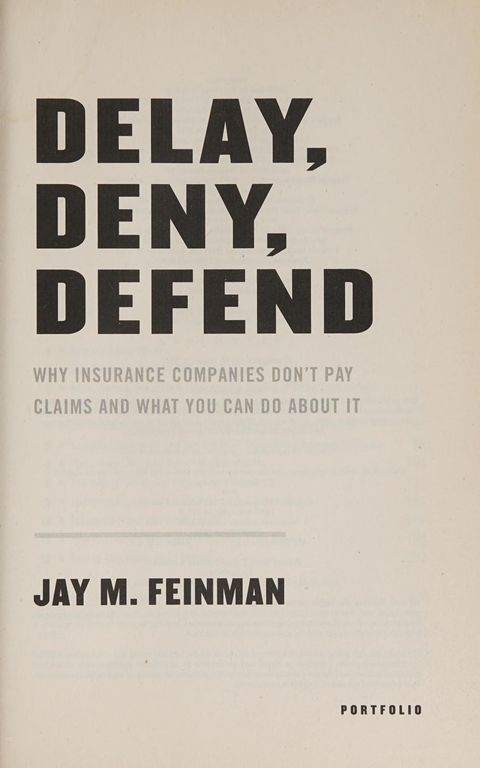
Delay, Deny, Defend
Why Insurance Companies Don't Pay Claims and What You Can Do About It
Introduction: The Promise vs. The Reality of Insurance
Introduction: The Promise vs. The Reality of Insurance
Nova: Welcome to Aibrary, the show where we dissect the ideas that shape our world. Today, we are diving into a topic that touches nearly every single one of us, yet operates largely in the shadows: the insurance industry. Imagine buying a safety net, only to find out the net is designed with holes. That’s the core argument of Jay M. Feinman’s searing 2010 book, Delay, Deny, Defend: Why Insurance Companies Don't Pay Claims and What You Can Do About It.
Nova: Exactly. Feinman’s research isn't theoretical; he cites dozens of real-life stories of victims unfairly denied payment. He posits that the industry has fundamentally shifted its goal. It’s no longer primarily about providing security; it’s about maximizing shareholder profit by minimizing payouts. The three Ds—Delay, Deny, Defend—are the operational playbook for achieving that goal.
Nova: That is the fundamental misunderstanding Feinman seeks to correct. In short, Delay means dragging out the process until you give up from exhaustion or financial strain. Deny means finding any technicality, however flimsy, to reject the claim outright. And Defend means that once you push back, they deploy armies of lawyers to make litigation so expensive and time-consuming that settling for pennies on the dollar seems like a win. It’s a calculated war of attrition against the very people they are contracted to protect. This book is essential because it pulls back the curtain on that war.
Nova: Let's dive into the mechanics of the system. This is where the strategy begins to erode the claimant's resolve before a formal denial even happens. We're moving into our first core chapter.
Key Insight 1: The Calculated Slowdown
The First D: Delay as a Weapon of Financial Attrition
Nova: The 'Delay' tactic is insidious because it often masquerades as due diligence. When you file a claim, the insurance company initiates a process—requesting forms, demanding recorded statements, sending adjusters, asking for medical records from years ago. On the surface, this is standard procedure.
Nova: The effect is financial exhaustion. Think about someone who has just had their home burn down or who is facing massive medical bills post-accident. They need funds to rebuild or pay doctors. Feinman details how companies can stretch a simple claim review process that should take weeks into many months, sometimes over a year. They use the claimant’s desperation against them.
Nova: Precisely. And the company profits from that interest rate differential, or worse, the claimant accepts a lowball offer just to stop the bleeding. Feinman points out that this tactic is highly effective because the company has massive administrative resources, while the claimant is usually acting alone, often while under extreme emotional duress.
Nova: Absolutely. It’s often about creating an insurmountable paper trail. They might request records that are tangential to the loss but are difficult or expensive for the policyholder to obtain—old tax returns, obscure medical histories, or documentation for items that were destroyed in the loss itself. It’s a form of procedural harassment.
Nova: It does. And the structure of the claims department often incentivizes this. Adjusters might have internal quotas or performance metrics tied to how much they the company, not how quickly they resolve legitimate claims. Feinman suggests that the internal culture views every dollar paid out as a failure of their cost-control mission.
Nova: That’s when the strategy escalates to 'Deny.' If Delay fails to make you quit, Deny attempts to make you legally irrelevant. We need to look at how they construct those denials, because they are rarely simple 'No's.' They are usually layered in complex legal jargon designed to confuse and intimidate.
Key Insight 2: The Art of the Technical Rejection
The Second D: Deny - Weaponizing Contract Language
Nova: The 'Deny' phase is where the insurance company leverages its greatest asset: its team of specialized lawyers who draft the policies in the first place. Feinman emphasizes that insurance contracts are contracts of adhesion—meaning one party dictates all the terms, and the other party must accept them as written or walk away.
Nova: They fall into a few categories. First, the 'Exclusion Clause' trap. They deny coverage based on an exclusion buried deep in the policy, often using vague terms like 'inherent defect' or 'wear and tear,' which they interpret as broadly as possible to cover the loss.
Nova: Very similar, but applied across property and casualty as well. A second major area is the 'Notice Requirement.' If you failed to notify them of a potential claim within a specific, often short, timeframe outlined in the fine print—even if the loss wasn't immediately apparent—they can deny the entire claim based on that procedural breach. Feinman calls this using procedural technicalities to defeat substantive rights.
Nova: That’s the point. Feinman also discusses 'Bad Faith Denial,' which occurs when the insurer knows the claim is valid but denies it anyway, often hoping the claimant won't fight back. He cites court cases where companies were castigated for 'unscrupulous tactics' and 'nonsensical legal arguments' when defending these denials.
Nova: Precisely. The denial is often just the prelude to the final, most expensive stage of their profit strategy. The Defend phase is where the company deploys its full legal arsenal to ensure that even if they eventually have to pay, they pay the absolute minimum possible, often years later.
Key Insight 3: The Cost of Justice
The Final D: Defend - Litigation as a Business Model
Nova: The 'Defend' stage transforms the dispute from a contractual disagreement into a full-blown legal war. Feinman details how insurance companies view litigation not as a last resort, but as a standard, budgeted component of their claims management process. They are prepared for it.
Nova: They rely heavily on aggressive discovery tactics. They will demand depositions from everyone remotely connected to the claim, file endless motions to compel discovery, and use procedural rules to bury the claimant in paperwork and legal fees. They are essentially trying to bankrupt the claimant’s lawyer through sheer volume of work.
Nova: It is. And Feinman highlights that this strategy works even when the insurance company knows it is on weak legal ground. If the potential payout is $100,000, but defending the case costs them $80,000 in legal fees over three years, they might still consider that a win if they settle for $40,000, because they avoided paying the full $100,000. The cost of defense becomes a tool for reducing the final settlement amount.
Nova: Yes, and this is where his expertise in tort and contract law shines. He discusses the concept of 'bad faith' litigation, where a claimant sues not just for the policy amount, but for damages resulting from the insurer’s improper handling of the claim. However, Feinman notes that even these punitive measures are often insufficient because the legal hurdles to prove bad faith are incredibly high.
Nova: Exactly. And this leads us to the final, crucial part of the book: what do we do? Feinman doesn't just diagnose the disease; he prescribes treatment. He offers a two-pronged approach: individual caution and systemic reform. We need to look at how consumers can protect themselves before they even sign on the dotted line.
Key Insight 4: Empowering the Policyholder
The Cure: Consumer Caution and Legal Reform
Nova: Feinman’s advice for the individual consumer starts long before a disaster strikes. He urges policyholders to treat insurance shopping with the same rigor they would a major investment. This means moving beyond just comparing monthly premiums.
Nova: It is, but the payoff is avoiding the entire Delay, Deny, Defend cycle. Feinman suggests looking closely at the definitions section, paying special attention to exclusions, and crucially, understanding the notice requirements. He advises consumers to seek independent legal advice purchasing complex policies, especially commercial ones, to ensure they truly understand what they are buying.
Nova: The key is documentation and communication discipline. Feinman stresses keeping meticulous records of every single interaction: dates, times, names of representatives, and summaries of conversations. If they request something in writing, respond in writing, referencing the specific policy section. Never rely on verbal agreements or assurances.
Nova: Feinman advocates for escalating the dispute internally first, often by appealing to a higher-level claims supervisor or the company’s internal ombudsman, armed with your comprehensive documentation. If that fails, he then moves to external pressure points, such as filing complaints with state insurance regulators. These regulators, while often slow, do have the power to investigate and fine companies, which can sometimes spur a faster, fairer settlement.
Nova: Absolutely. He argues that the entire regulatory framework needs strengthening to shift the balance of power. He suggests reforms that would make it easier to prove bad faith, impose stricter penalties for unreasonable delays, and perhaps even mandate clearer, plain-language policy documents that are legally binding.
Nova: That’s the ultimate goal: restoring the insurance contract to its intended purpose—a promise of security, not a sophisticated profit-extraction mechanism. Feinman’s work is a vital roadmap for understanding this hidden conflict.
Conclusion: Reclaiming the Promise
Conclusion: Reclaiming the Promise
Nova: We’ve spent this episode unpacking Jay M. Feinman’s crucial work in Delay, Deny, Defend. The takeaway is stark: the insurance industry, in many instances, operates under a business model that views policyholders as adversaries whose claims are liabilities to be managed down, not promises to be honored promptly.
Nova: But the power of this book, and the reason it remains so relevant, is that Feinman arms the listener. We now know to scrutinize policies before buying, to document every interaction meticulously, and to understand the escalation path when a claim is challenged. Knowledge is the first line of defense against attrition.
Nova: Indeed. The fight for fair claims handling is a fight for the integrity of the contract itself. Understanding the playbook is the first step toward demanding better systemic protections. Thank you for joining us for this deep dive into the mechanics of corporate defense.
Nova: This is Aibrary. Congratulations on your growth!