Beyond the Metrics: Cultivating Deep Work for Lasting Impact
10 minGolden Hook & Introduction
SECTION
Nova: If this episode found you, you probably spent the last ten minutes trying to start something important, only to be pulled away by a notification, an email, or that nagging thought about what's for dinner. Am I right?
Atlas: Oh man, Nova, you just described my entire morning, and probably half of our listeners' days too! It's like we're constantly juggling, but nothing ever truly gets finished to a level we're proud of.
Nova: Exactly! And that feeling of being perpetually busy but rarely impactful? That's the cold hard reality we're diving into today. We're talking about how to break free from that cycle and cultivate something incredibly valuable: deep work.
Atlas: Deep work. I'm already intrigued. Because honestly, the idea of truly focused, uninterrupted time feels like a luxury these days, not a standard practice.
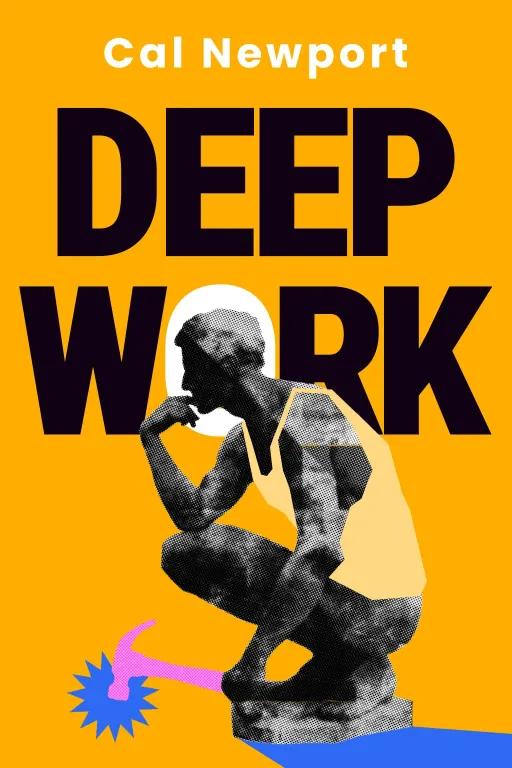
Nova: Well, it’s not just a luxury; it’s becoming the superpower of our age. And we’re dissecting it through the lens of two foundational texts: Cal Newport’s seminal work, "Deep Work," and James Clear’s immensely practical "Atomic Habits."
Atlas: Excellent choices. Cal Newport, a computer science professor, doesn't just theorize about deep work; he famously practices it, writing his books in focused, uninterrupted blocks, which makes his insights incredibly credible. And James Clear, who rebuilt his life after a serious injury using the very principles of tiny habits he teaches, brings such an authentic, lived perspective.
Nova: Absolutely. These authors aren't just talking the talk; they've walked it. And what they reveal, especially for anyone looking to build something meaningful, is that the ability to truly focus is the bedrock of lasting impact.
The Existential Threat of Shallow Work & The Promise of Deep Work
SECTION
Atlas: So, let's start with Newport then. What exactly deep work, and why is it so crucial right now? Because for a lot of our listeners, who are strategic builders and visionary leaders, being 'responsive' feels like job one.
Nova: That’s a fantastic point, Atlas. Deep work, as Newport defines it, is the ability to focus without distraction on a cognitively demanding task. It’s about working in a state of high concentration that pushes your cognitive capabilities to their limit, leading to new insights and high-quality output. It's the opposite of what he calls "shallow work"—the non-cognitively demanding, logistical tasks often performed while distracted, like answering emails or scheduling meetings.
Atlas: Okay, so deep work is the heavy intellectual lifting, and shallow work is the administrative stuff. But wait, for someone who's constantly navigating complex problems and leading a team, isn't being able to juggle multiple things at once, even if they're shallow, a necessary skill? Doesn't multitasking feel more efficient sometimes?
Nova: That’s a common misconception. The real story is that multitasking, or constantly switching between tasks, actually makes us less efficient. Newport introduces the concept of "attention residue." When you switch from one task to another, a remnant of your attention often remains on the original task. It’s like having too many tabs open in your brain—each switch leaves a little bit of processing power tied up in the previous tab, slowing everything down.
Atlas: Oh, I know that feeling! It's like you finish replying to an email, but a part of your brain is still replaying the conversation while you try to jump into a complex report. It’s exhausting.
Nova: Precisely! And the cost of this constant shallow work is immense. It’s not just feeling busy; it’s a profound erosion of our ability to produce meaningful, high-value work. For our listeners, who are driven by purpose and want to build movements, this is an existential threat to their impact. You end up feeling overwhelmed, burnt out, and paradoxically, not much closer to your big vision.
Atlas: So, how does deep work actually manifest in the real world? Can you give an example of someone who truly embodies this focused approach, someone who leveraged deep work to achieve something significant?
Nova: Absolutely. Think of someone like J. K. Rowling, who famously wrote much of in cafes, often in highly disciplined, focused sessions. Or, to bring it to our audience's world, imagine a brilliant software architect, let's call her Anya. Anya was drowning in meetings and Slack messages, unable to make progress on a critical new system design. She felt like she was constantly reacting, not creating.
Atlas: I imagine a lot of our listeners feel Anya's pain. The pressure to be always-on, always available, it's immense.
Nova: It is. But Anya read Newport and decided to experiment. She started blocking out two hours every morning, from 8 to 10 AM, specifically for "deep work." During this time, her office door was closed, notifications were off, and she wouldn't check email. She used that time to sketch out the system architecture, write critical code, and solve the most complex design challenges.
Atlas: And what happened?
Nova: The transformation was remarkable. In those two hours, she made more progress than in entire days of fragmented work. She wasn't just work; she was with clarity and precision. Her designs were more elegant, her code had fewer bugs, and her team started seeing her as the visionary leader she truly was, not just a responsive manager. This isn't just about output; it's about the quality and impact of that output. It's about transforming busy work into truly high-value creation.
Architecting Deep Work: The Power of Atomic Habits
SECTION
Atlas: That’s actually really inspiring. It paints a clear picture of the. But if deep work is the destination, how do we build the road there? Because telling someone to "just block out time" feels a bit like telling a struggling startup to "just raise more capital." How do we make this happen, especially when deadlines are looming and the inbox is overflowing?
Nova: That’s where James Clear’s "Atomic Habits" becomes our architectural blueprint. Clear shows us that it's not about heroic willpower or massive overhauls; it's about tiny, almost invisible changes that, over time, compound into powerful systems. He offers four laws of behavior change, which we can directly apply to cultivating deep work.
Atlas: Okay, so what are these laws, and how do they help us actually deep work instead of just wishing for it?
Nova: The first is "Make it Obvious." Design your environment so deep work is the default, and distractions are hidden. The second, "Make it Attractive," is about associating deep work with a positive feeling or reward. Third, "Make it Easy," reduce the friction to start deep work. And finally, "Make it Satisfying," track your progress to reinforce the habit.
Atlas: That makes sense. Let's focus on "Make it Easy" and "Make it Obvious" first, because that feels like the immediate hurdle. For someone who feels they have zero time, and their default is checking Slack every five minutes, what’s a 'tiny step' they can take? How do I make deep work 'obvious' and 'easy' when my environment is constantly screaming for my attention?
Nova: Great question. Let's start with "Make it Obvious." This means physically altering your workspace. If your phone is on your desk, face down, it's still obvious. Put it in another room. Close all unnecessary tabs on your computer. Maybe even use a separate, minimalist user profile for your deep work sessions. Make the cues for deep work unavoidable, and the cues for distraction invisible.
Atlas: So, it's about controlling the inputs, essentially. Like, if I want to eat healthier, I don't keep cookies in the house. If I want to do deep work, I don't keep my phone within arm's reach.
Nova: Exactly! Your environment is more powerful than your willpower. Then, for "Make it Easy," start incredibly small. Instead of aiming for a four-hour block, which feels daunting, block out just 30 minutes this week for uninterrupted, focused work on your most important task. Turn off all notifications. That’s it. Just 30 minutes.
Atlas: Just 30 minutes. That feels achievable. So, it's not about a complete overhaul, but micro-adjustments. It’s like building a resilient system, one tiny brick at a time, which really resonates with the idea of being an architect.
Nova: It truly is. Clear's philosophy is that you don't rise to the level of your goals; you fall to the level of your systems. By making deep work an "atomic habit"—a tiny, consistent action—you build a system that supports profound focus, even amidst chaos. You can even create a "deep work ritual": specific music, a specific coffee mug, even a specific scent—anything that signals to your brain, "It's deep work time."
Atlas: I love that. It’s about creating triggers and reducing friction. It sounds like the cumulative effect of these small, consistent efforts is what truly transforms our ability to do high-value work.
Synthesis & Takeaways
SECTION
Nova: That’s the profound insight, isn't it? Deep work isn't just about productivity; it's about reclaiming agency over our attention. In a world constantly vying for our focus, the ability to concentrate deeply is not just a skill; it's a form of resistance, a way to ensure that our output is truly meaningful, impactful, and aligned with our purpose. It's how we move from feeling busy to actually building something enduring.
Atlas: For anyone trying to build something meaningful—whether it's a product, a team, or even just a better version of themselves—this isn't optional. It's foundational. It's about designing your life, one focused block at a time, to achieve that clarity and impact you crave.
Nova: So, our call to action for you this week is simple, mirroring the "tiny step" from the books: Block out 30 minutes. Just 30 minutes. For uninterrupted, focused work on your single most important task. Turn off all notifications. See what happens when you give your most important work the attention it deserves.
Atlas: And we'd love to hear about it! Share your deep work wins with us. What's the one thing you're going to dive into deeply this week?
Nova: This is Aibrary. Congratulations on your growth!