

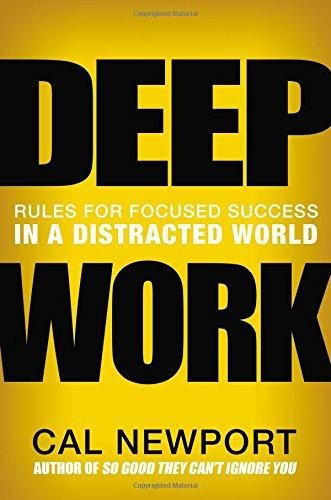
Deep Work
Rules for Focused Success in a Distracted World
Introduction
Nova: Have you ever reached the end of a long work day, feeling absolutely exhausted, but realized you didn't actually produce anything of value? You checked eighty emails, attended four meetings, and scrolled through LinkedIn a dozen times, but that big project you were supposed to start? It is still a blank page.
Nova: Exactly. And that is why we are diving into a book that has become a manifesto for the modern era. It is called Deep Work: Rules for Focused Success in a Distracted World by Cal Newport. Newport argues that in our current economy, the ability to focus without distraction is becoming increasingly rare and, at the same time, increasingly valuable.
Nova: Pretty much. Newport defines Deep Work as professional activities performed in a state of distraction-free concentration that push your cognitive capabilities to their limit. These efforts create new value, improve your skill, and are hard to replicate. On the flip side, he talks about Shallow Work, which is the non-cognitively demanding, logistical-style tasks often performed while distracted. These tasks tend not to create much new value in the world and are very easy to replicate.
Nova: That is the trap. Today, we are going to break down why our brains are struggling, the surprising science behind why multitasking is a lie, and the specific strategies Newport suggests to reclaim your focus. By the end of this, you might just find yourself wanting to delete your social media and move to a cabin in the woods.
Key Insight 1
The Economic Case for Focus
Nova: To understand why Deep Work is so critical, we have to look at the economy we live in today. Newport argues that there are two groups of people who will thrive in the coming years. First, those who can work with increasingly complex machines and algorithms. And second, those who are stars in their field.
Nova: Because to become a star, or to master a complex system, you have to learn hard things quickly. You cannot learn quantum physics or high-level coding by skimming a few blog posts between TikTok videos. Mastering a difficult skill requires intense, concentrated effort. Newport points out that if you can not learn, you can not thrive.
Nova: That is a perfect analogy. And there is a second part to his formula for success. It is not just about learning; it is about producing. He says high-quality work produced equals time spent times intensity of focus. If your intensity of focus is a zero because you are constantly interrupted, your output will be zero, no matter how much time you spend.
Nova: Newport calls this the Principle of Least Resistance. In a business environment, without clear feedback on what it means to be productive, we tend toward behaviors that are easiest in the moment. Sending an email is easy. Solving a complex architectural problem is hard. We also suffer from busyness as a proxy for productivity. If we look busy, we tell ourselves we are doing a good job, even if we are just moving digital paper around.
Nova: Exactly. But the reward for going deep is massive. Newport highlights people like Bill Gates, who famously took Think Weeks where he would disappear into a cabin just to read and think. That deep work is what fueled the innovations of Microsoft. Most of us will never take a Think Week, but Newport argues that even a few hours of deep work a day can put you ahead of ninety-nine percent of the workforce.
Key Insight 2
The Science of Attention Residue
Nova: Now, I want to talk about why multitasking is a total myth, and it comes down to a concept called Attention Residue. This research comes from Sophie Leroy, a business professor at the University of Minnesota.
Nova: Well, Dr. Leroy would disagree. Her research found that when you switch from Task A to Task B, your attention does not follow you immediately. A residue of your attention remains stuck on the previous task. This is especially true if Task A was unfinished or intense.
Nova: Precisely. That residue can last for twenty minutes or more. So if you check your email every ten minutes, you are essentially functioning at a lower cognitive capacity all day long. You never actually reach a state of full concentration. You are in a state of semi-distraction, which Newport calls attention fragmentation.
Nova: And there is a biological component to this too. When you focus intensely on a single task, you are triggering a process called myelination. Myelin is a fatty tissue that wraps around the neurons in your brain. Think of it like insulation on a wire. The more you use a specific neural circuit through deep focus, the more myelin develops around those neurons.
Nova: It allows the electrical signals to travel faster and more efficiently. Basically, Deep Work physically upgrades your brain. It makes you faster and more accurate at the specific skill you are practicing. But this only happens if you are focused. If you are constantly switching tasks, your brain never gets the signal to build that myelin. You stay at a plateau.
Nova: It sounds harsh, but that is the biological reality. Deep Work is not just a productivity hack; it is a requirement for excellence. If you want to be world-class, you have to protect your attention from that residue. You have to give your brain the space it needs to build those high-speed connections.
Key Insight 3
The Four Philosophies of Deep Work
Nova: So, if we agree that Deep Work is the goal, how do we actually do it? Newport realizes that not everyone can just quit their job and become a hermit. He outlines four different philosophies for integrating Deep Work into your life.
Nova: Spot on. It is called the Monastic Philosophy. This is for people who want to eliminate all shallow obligations. Think of the computer scientist Donald Knuth, who famously has no email address. He says his job is to learn things and tell others what he learned, and he can not do that if he is answering messages all day.
Nova: For most of us, yes. That is why the second one is the Bimodal Philosophy. This is where you divide your time into clearly defined stretches of deep work and everything else. You might spend four days a week being accessible and then take a three-day retreat where you go completely off the grid to work on a big project. Carl Jung used this approach; he had his main practice in the city and then his tower in Bollingen where he would go to think and write.
Nova: That is the Rhythmic Philosophy. This is the most common for people with standard jobs. You carve out a specific time every single day for deep work—say, 5:00 AM to 8:00 AM—before the rest of the world wakes up and starts demanding your attention. It is about creating a rhythm so that you do not have to use your willpower to decide to work. You just do it because it is 5:00 AM.
Nova: The Journalistic Philosophy. This is for the pros. It involves shifting into a deep work state whenever you have a free moment. If a meeting gets canceled and you have thirty minutes, you instantly go deep. Newport says this is very hard because it requires the ability to turn on your focus like a light switch, which most people can not do without a warm-up.
Nova: Exactly. The key is to choose the one that fits your life and stick to it. You can not just wait for inspiration or a quiet moment to strike. You have to build a structure that forces the deep work to happen. Newport is a big believer that you should treat your deep work hours like a sacred appointment that can not be moved.
Key Insight 4
Rules for a Focused Life
Nova: Beyond just scheduling, Newport gives us some pretty radical rules to follow. One of the most controversial is his take on social media. He suggests the Craftsman Approach to tool selection.
Nova: Not quite. It means a craftsman only uses a tool if its benefits significantly outweigh its negatives for their specific craft. Most of us use social media because of the Any-Benefit Approach. We think, well, I might see a funny meme or stay in touch with a high school friend, so it is worth having. Newport says that is a trap.
Nova: Yes. He suggests quitting all social media for thirty days. Do not announce it, just stop. After thirty days, ask yourself: Was my life significantly worse? Did anyone actually care that I was gone? For most of us, the answer is no. Social media is the ultimate shallow activity; it is engineered to fragment our attention.
Nova: Newport says yes, it is. This leads to his rule: Embrace Boredom. If every time you feel a tiny bit of boredom, you reach for your phone, you are teaching your brain that it can never be bored. You are training your brain to need constant novelty.
Nova: Exactly. You can not expect to spend sixteen hours a day in a state of fragmented attention and then suddenly be able to focus for two hours of deep work. You have to practice being bored. You have to train your brain to sit with a single thought. He even suggests scheduling your internet use. Instead of scheduling breaks from distraction, you should schedule breaks from focus.
Nova: Right. And finally, he talks about Draining the Shallows. This means being ruthless with your schedule. He suggests scheduling every minute of your day. Not to be a robot, but to ensure that you are making conscious choices about where your time goes. If you do not plan your day, the shallow work will naturally fill every available gap.
Conclusion
Nova: We have covered a lot today. From the economic necessity of being a star in your field to the biological process of myelination that only happens when we focus. Cal Newport's message in Deep Work is clear: the world is getting noisier, which means the value of silence and concentration is skyrocketing.
Nova: It is about moving from a life of frantic busyness to a life of focused contribution. Deep work is not just about getting more done; it is about doing work that matters. It is about the satisfaction that comes from pushing your brain to its limit and creating something truly excellent.
Nova: That is the best way to start. Small, consistent steps build the capacity for deep work over time. It is a muscle that has to be trained. If you want to dive deeper, I highly recommend picking up the book. It is filled with even more case studies and tactical advice for reclaiming your mind.
Nova: This is Aibrary. Congratulations on your growth!