

Mastering Your Time: Productivity for Visionary Leaders
Golden Hook & Introduction
SECTION
Nova: You know, Atlas, I was thinking about the sheer volume of information we're all bombarded with daily. It's like trying to drink from a firehose while simultaneously juggling flaming chainsaws.
Atlas: Oh, I love that imagery, Nova! And honestly, it sounds a lot like my Monday mornings. You're trying to achieve something meaningful, but the world just keeps throwing distractions at you.
Nova: Exactly! It makes you wonder how anyone, especially visionary leaders, manages to cut through the noise and actually impact. It feels like a lost art, doesn't it?
Atlas: It really does. I imagine a lot of our listeners, the pragmatists and visionaries among us, are constantly grappling with this. How do you maintain a strategic mind when your inbox is screaming for attention?
Nova: And that's precisely why we're diving into a fascinating concept today, one that's been championed by authors like Cal Newport and David Allen. We're talking about mastering your time, not just to get more done, but to achieve a deeper, more meaningful kind of productivity, especially for those leading the charge.
Atlas: Right, like how do you not just things, but do the things, profoundly?
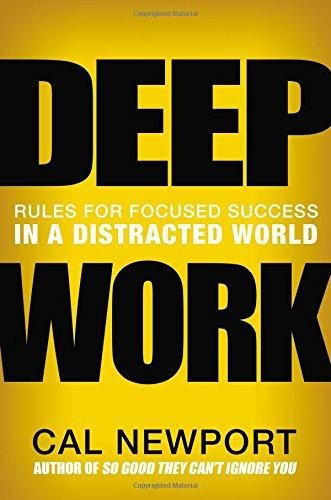
Nova: Exactly! Today, we're really exploring how to cultivate uninterrupted focus and architect your day for maximum impact. We'll draw heavily from Cal Newport's influential work on "Deep Work" and David Allen's comprehensive system in "Getting Things Done."
Atlas: I'm curious, what's one striking thing about these authors or their books that sets them apart?
Nova: Well, what's really compelling about Cal Newport is that he's not just a productivity guru; he's a computer science professor who practices what he preaches. He wrote "Deep Work" while balancing his academic research, teaching, and family life, essentially proving his own thesis in real-time. It’s not just theory for him; it's his lived reality, which gives the book immense credibility and a grounded perspective.
Atlas: Oh, that's actually really inspiring. It’s one thing to preach focus, another to live it while writing a book about it.
Cultivating Uninterrupted Focus: The Deep Work Advantage
SECTION
Nova: Absolutely. And that leads us to our first core idea: the cultivation of uninterrupted focus, or what Newport famously calls "deep work." He argues that in our increasingly distracted world, the ability to perform deep work – focused, uninterrupted effort on a cognitively demanding task – is becoming incredibly rare and, consequently, incredibly valuable.
Atlas: So you're saying that the more notifications we get, the more valuable it is to get them? That sounds almost counterintuitive in a world that pushes constant connectivity.
Nova: It does, doesn't it? But think about it: if everyone is constantly switching contexts, responding to emails, and checking social media, who's actually doing the hard, creative, strategic thinking that truly moves the needle? Newport posits that this deep work is what creates new value, improves skills, and is incredibly hard to replicate. It's the engine of innovation, essentially.
Atlas: I can definitely relate. For anyone trying to map out a complex supply chain or brainstorm a new product line, those constant pings from Slack or email can absolutely derail your train of thought. It feels like you're constantly starting over.
Nova: Precisely. Newport even talks about how knowledge workers often adopt a "shallow work" mindset, characterized by non-cognitively demanding logistical tasks, performed while distracted. This isn't just inefficient; it fundamentally hinders our ability to produce high-quality, impactful work.
Atlas: Okay, so how do you actually deep work? Is it just about turning off your phone and hoping for the best? Because honestly, that sounds a bit out there for busy leaders who often to be accessible.
Nova: That’s a great question, and it’s where Newport provides practical strategies. He suggests various "deep work philosophies." One is the "monastic approach," where you retreat entirely, like a writer going to a cabin. Another is the "bimodal approach," dedicating specific, extended periods to deep work, perhaps a few days a week, while reserving other times for shallow tasks.
Atlas: Like, you block out 90 minutes tomorrow purely for strategizing, and absolutely nothing else? No email, no quick checks, no "just five minutes" on social media?
Nova: Exactly. He emphasizes structuring your environment to minimize distractions, creating rituals, and learning to say no to requests that pull you into shallow work. It's about designing your day, rather than letting it be designed for you by external demands.
Atlas: That makes me wonder, how does this apply to someone navigating, say, regulatory compliance in the food industry? That's a field where you absolutely afford to miss details, and there are constant updates. It sounds like you need to be both deeply focused and constantly aware.
Nova: That’s a perfect example of where deep work truly shines. Imagine trying to decipher nuanced regulations while half-listening to a podcast and responding to texts. The risk of error, the sheer mental fatigue, would be immense. For tasks like regulatory analysis, deep work isn't just beneficial; it's critical for accuracy and strategic interpretation. It allows you to build a coherent mental model of complex information, which shallow work simply can't achieve. You need to carve out that uninterrupted time to truly and synthesize, not just skim.
Atlas: So, it's about giving your brain the mental real estate it needs to fully engage with a problem, rather than just flitting across the surface. That’s actually really inspiring, because it speaks to the quality of the output, not just the quantity.
Architecting Your Day for Impact with Getting Things Done
SECTION
Nova: Precisely. And that naturally leads us to the second key idea, which often acts as a powerful complement to deep work: architecting your day for impact, drawing from David Allen’s "Getting Things Done," or GTD. If deep work is about you focus, GTD is about you focus on, and how you manage everything else so that deep work is even possible.
Atlas: Okay, so you've got this block of time for deep work. But if your mind is still cluttered with a hundred other things you "should" be doing, is it really deep work? Or is it just a deeply stressed work session?
Nova: That's the core problem GTD addresses. Allen’s central premise is that our brains are great at creating ideas, but terrible at storing them. Every open loop, every unaddressed email, every vague "to-do" list item, consumes mental energy. GTD offers a comprehensive system to capture, clarify, organize, reflect, and engage with all your commitments.
Atlas: In other words, get it out of your head.
Nova: Exactly. It's about creating a trusted system outside your mind. The process starts with capturing everything – – that has your attention. Then, you clarify what each item means and what the next actionable step is. If it takes less than two minutes, do it immediately. If not, delegate it, defer it, or file it away.
Atlas: That makes sense. I imagine a lot of our listeners, the pragmatists especially, are thinking, "Okay, but how do I integrate this into a team's workflow? It sounds like a lot of individual discipline."
Nova: That's a brilliant question, and it highlights a common misconception. While GTD is often seen as a personal productivity system, its principles are incredibly powerful for teams. Imagine a team where every member consistently clarifies next actions, tracks projects, and reviews their commitments. Communication becomes clearer, dependencies are managed proactively, and fewer things fall through the cracks.
Atlas: So, it’s not about micromanaging, but about creating a shared language and system for managing collective commitments?
Nova: That’s a perfect example. It reduces mental clutter for everyone, allowing them to engage in their own deep work, confident that other tasks are accounted for. For visionary leaders, this means less time chasing down details and more time focusing on strategic growth and consumer psychology, which are critical for connecting deeply with their market.
Atlas: I can see how that would be transformative. If everyone's mental bandwidth isn't constantly consumed by remembering what they need to do next, they can actually about higher-level problems, like optimizing supply chains, which is often crucial for quality and smooth operations.
Nova: Absolutely. It transforms an organization from reactive to proactive, freeing up cognitive space for innovation and strategic thinking. It’s about building a robust operating system for your professional life.
Synthesis & Takeaways
SECTION
Nova: So, what we've really been talking about today, when you bring Deep Work and Getting Things Done together, is not just about being busy, but about being. It's about recognizing that in a world designed for distraction, cultivating genuine focus and a rock-solid organizational system isn't a luxury; it's a strategic imperative.
Atlas: That’s actually really inspiring. It’s not just about ticking off tasks, but about creating the mental space to pursue your vision, to truly make an impact. It’s about being a leader who plans, not just dreams.
Nova: Indeed. The core insight here is that your ability to achieve sustained growth as a visionary leader hinges on two things: your capacity for uninterrupted, deep focus on your most critical tasks, and a comprehensive system to manage the deluge of everything else. Without both, you’re either lost in the weeds or perpetually distracted.
Atlas: And honestly, that sounds like the journey itself: trusting your instincts, refining your message daily, and embracing the process of growth. It’s all interconnected.
Nova: It is. So, if there’s one tiny step listeners can take tomorrow, it’s this: block out 60-90 minutes in your calendar for 'deep work' on your single most critical task. Eliminate all distractions. Just observe the difference in your progress and the clarity of your thought.
Atlas: That’s a practical, actionable step that anyone can try. And for those leading teams, thinking about how to integrate the principles of "Getting Things Done" into your team's workflow could genuinely create a more streamlined, less stressful, and highly productive environment. This is Aibrary. Congratulations on your growth!