

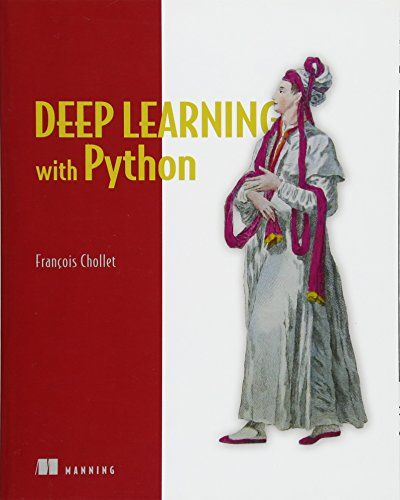
Deep Learning with Python
Introduction
Nova: Welcome back to Aibrary, the podcast where we crack open the most influential books in technology and extract the ideas that matter. I'm Nova, your guide through the pages.
Nova: : And I'm your co-host, always ready with the questions you're probably thinking. Today we're diving into a book that has become something of a bible for aspiring deep learning practitioners: Deep Learning with Python by Francois Chollet.
Nova: And here's what makes this book special. The author isn't just some academic writing from an ivory tower. Francois Chollet is the actual creator of Keras, the deep learning framework that has been downloaded over two million times and is now the official high-level API inside TensorFlow. When you read this book, you're learning from the person who literally designed the tools you'll be using.
Nova: : That's a pretty compelling credential. But here's my question: there are dozens of deep learning books out there. What makes this one the one that people keep recommending to beginners?
Nova: That's exactly what we're going to unpack. Chollet has this rare gift for explaining complex ideas without dumbing them down. He takes you from zero to building real neural networks that can classify images, generate text, and even create art. And he does it with a philosophical depth that most technical books lack. By the end of this episode, you'll understand why this book has over four and a half stars across thousands of reviews and why it's often called the best first book on deep learning.
Nova: : Alright, I'm sold. Let's get into it.
Who is Francois Chollet and Why His Approach Matters
The Philosopher-Programmer
Nova: So before we dive into the book itself, let's talk about the author, because his background explains everything about why this book reads differently from other technical texts. Francois Chollet is a French software engineer and AI researcher who joined Google in 2015. But here's the fascinating part: he created Keras not as a Google project, but as a personal open-source contribution back in 2015, driven by a frustration with how inaccessible deep learning tools were at the time.
Nova: : Wait, so the framework that now powers a huge chunk of production deep learning systems started as one person's side project?
Nova: Exactly. And that ethos of accessibility runs through everything Chollet does. He has this deep conviction that deep learning shouldn't be reserved for PhDs at elite institutions. The book opens with a line that really sets the tone: he says that deep learning is accessible to anyone with a basic understanding of programming and high school math. Not because he's oversimplifying, but because he genuinely believes the core ideas are elegant and graspable.
Nova: : That's a bold claim. High school math? Really? Because when I think of neural networks, I think of gradients, backpropagation, calculus...
Nova: And you're right to be skeptical. But Chollet's approach is to teach you the intuition first. He spends an entire chapter on the mathematical building blocks, but he presents them as concepts rather than derivations. He shows you what a tensor is by comparing it to a nested list of numbers. He explains gradient descent by having you imagine a ball rolling down a hill. The math is there, but it's always in service of understanding, not as a barrier to entry.
Nova: : So he's not just a programmer who wrote a book. He's almost like a teacher who happens to be a world-class engineer.
Nova: That's the perfect way to put it. And there's another dimension to Chollet that shapes the book profoundly. He's a deep thinker about the nature of intelligence itself. He's written extensively about the limitations of deep learning and what it would take to achieve artificial general intelligence. This philosophical bent means the book doesn't just teach you how to build models. It teaches you to think critically about what those models are actually doing.
Nova: : I love that. So the book has a soul, not just a table of contents.
Nova: Beautifully said. And that soul comes through most clearly in how he frames the entire field. He describes deep learning not as a bag of tricks, but as a layered approach to learning representations from data. Every chapter reinforces this core idea: that neural networks are essentially geometric transformations of data manifolds. Once you grasp that, everything else clicks into place.
The First Half: Building Your Deep Learning Foundation
From Tensors to Training
Nova: Let's walk through the architecture of the book. The first edition came out in 2017 and was an instant classic. Then in 2021, Chollet released a substantially revised second edition that reflects how much the field changed in just four years. The book is organized into four parts, and the first part is all about fundamentals.
Nova: : So if I'm a complete beginner, what does chapter one actually look like?
Nova: Chapter one is this beautiful, sweeping overview of artificial intelligence, machine learning, and deep learning. Chollet traces the history from the 1950s to the present day, explaining why deep learning exploded when it did. He talks about hardware advances, the data revolution, and algorithmic breakthroughs. But he also gives you the big picture right away: he shows you what deep learning is good at, what it's bad at, and where the field might be heading.
Nova: : I appreciate when authors are honest about limitations upfront. It builds trust.
Nova: Absolutely. Then chapter two is where you roll up your sleeves. He introduces tensors, the fundamental data structure of deep learning. And this is where Chollet's teaching style really shines. He walks you through building a simple neural network in pure Python, using nothing but basic NumPy operations. No Keras, no TensorFlow. Just raw code so you can see what's happening under the hood.
Nova: : That's actually brilliant. It's like learning to cook by understanding the ingredients before you start using fancy appliances.
Nova: Exactly. And then chapter three is where Keras finally enters the picture. By this point, you've earned it. You understand what a tensor is, how gradient descent works, what backpropagation does. Now Chollet shows you how Keras makes all of this elegant and simple. He introduces the Sequential API, and within a few pages, you're building a neural network that classifies movie reviews as positive or negative with over ninety percent accuracy.
Nova: : Wait, by chapter three you're already doing sentiment analysis on real data?
Nova: That's the magic of this book. Chollet doesn't make you wait until chapter ten to do something impressive. Every chapter has a working code example that produces meaningful results. The IMDB sentiment classifier, the Reuters newswire classifier, a regression model for predicting Boston housing prices. By the end of part one, you've built multiple working models and you understand the core workflow: define your model, compile it with a loss function and optimizer, fit it to training data, and evaluate it on test data.
Nova: : That rapid feedback loop must be incredibly motivating for readers.
Nova: It is. And it's intentional. Chollet has said in interviews that he designed the book to combat what he calls the "trough of disillusionment" that many beginners hit when learning deep learning. You know, that moment when the math gets heavy and you wonder if you're cut out for this. By giving you wins early and often, he keeps you engaged through the harder material.
The Second Half: Convolutional Networks, RNNs, and Generative Models
Vision, Language, and Beyond
Nova: Part two of the book is where things get really exciting. Chollet dedicates two full chapters to the two domains where deep learning has had its most dramatic impact: computer vision and natural language processing.
Nova: : Let me guess. Convolutional neural networks for vision?
Nova: You got it. Chapter five is a deep dive into CNNs. Chollet explains the concept of convolution in a way that actually makes intuitive sense. He describes it as sliding a small window across an image and looking for patterns like edges, textures, and eventually complex features like eyes or wheels. He walks you through building a CNN from scratch to classify MNIST digits, then shows you how to use data augmentation and pretrained models like VGG16 to tackle more complex problems with smaller datasets.
Nova: : Pretrained models. That's transfer learning, right? Taking a model trained on millions of images and fine-tuning it for your specific task?
Nova: Exactly, and Chollet is a huge advocate for this approach. He makes the case that for most real-world problems, you shouldn't be training models from scratch. You should be standing on the shoulders of giants. He shows you how to use convolutional bases from models trained on ImageNet and adapt them to classify everything from dogs versus cats to medical images.
Nova: : That's such a practical insight. Most people don't have millions of labeled images lying around.
Nova: Right. And then chapter six tackles text and sequences. He covers recurrent neural networks, LSTMs, and GRUs. He shows you how to build a temperature-forecasting model using time-series data, and how to use word embeddings to understand semantic relationships between words. The example that always sticks with readers is when he trains an LSTM to generate text in the style of Nietzsche. It's both hilarious and profound.
Nova: : Nietzsche? That's a choice. What does AI Nietzsche sound like?
Nova: It's this bizarre, almost-coherent philosophical rambling. The model learns the cadence and vocabulary of Nietzsche's writing, but the actual meaning is nonsense. It's a perfect illustration of what these models can and cannot do. They learn statistical patterns, not understanding.
Nova: : Which ties back to Chollet's philosophical perspective on the limits of deep learning.
Nova: Precisely. And then in the second edition, Chollet added a chapter on generative deep learning that covers variational autoencoders, generative adversarial networks, and even an introduction to transformers. He shows you how to generate images, how to perform neural style transfer, and how to build a basic text generator using a transformer architecture. This chapter alone makes the second edition worth buying even if you read the first one.
Nova: : Transformers in particular have become so central to everything in AI over the last few years.
Nova: They have, and Chollet does a nice job of explaining the attention mechanism without getting lost in the mathematical weeds. He frames it as the model learning which parts of the input are relevant to which parts of the output. It's a simple idea with profound consequences, and it's the foundation of everything from BERT to GPT.
Best Practices, Pitfalls, and the Deep Learning Workflow
The Art and Science of Model Building
Nova: Part three of the book is where Chollet shifts from teaching you techniques to teaching you judgment. These chapters cover the advanced practices that separate someone who can follow a tutorial from someone who can solve real problems.
Nova: : This is the stuff you don't get from YouTube videos.
Nova: Exactly. Chapter seven is all about the Keras functional API and advanced model architectures. The Sequential model is great for simple pipelines, but real-world problems often require models with multiple inputs, multiple outputs, or non-linear topology. Chollet shows you how to build multi-input models for question answering, how to create residual connections, and how to think about model architecture as a graph of layers.
Nova: : Residual connections. Those are the skip connections that made very deep networks trainable, right?
Nova: Yes. And Chollet explains them beautifully. The intuition is simple: if you have a very deep stack of layers, it helps to add the original input back in at various points so the network can choose to learn identity mappings when deeper processing isn't helpful. It's one of those ideas that seems obvious in hindsight but was a genuine breakthrough.
Nova: : What about the practical workflow stuff? How to actually debug a model that isn't learning?
Nova: That's chapter seven and eight. Chollet introduces his universal workflow for machine learning: define the problem, choose a measure of success, decide on an evaluation protocol, prepare your data, develop a model that beats a simple baseline, then iteratively improve it through hyperparameter tuning and regularization. He emphasizes something that beginners often miss: you should always start with a simple model and get it to overfit before you try to generalize.
Nova: : Wait, deliberately overfit? That seems counterintuitive.
Nova: It does, but here's the logic. If your model can't even overfit on a small subset of training data, you have a bug or an architectural problem. Once you confirm it can memorize the training data, then you can apply regularization techniques like dropout, weight decay, and early stopping to improve generalization. It's a diagnostic approach that saves enormous amounts of time.
Nova: : That's such a practical tip. What about the chapter on model evaluation?
Nova: Chapter eight might be the most important chapter in the entire book. Chollet walks through the proper way to evaluate models using held-out validation sets, K-fold cross-validation, and the critical importance of never leaking information from your test set into your training process. He tells a cautionary tale about researchers who accidentally tuned their models on test data and published results that looked amazing but failed to replicate.
Nova: : The classic data leakage problem.
Nova: Exactly. And he gives concrete strategies to avoid it. He also covers how to think about different evaluation metrics. Accuracy can be misleading for imbalanced datasets. Precision, recall, and F1 scores tell a richer story. And for regression problems, mean absolute error often gives a more intuitive picture than mean squared error. These are the kinds of judgment calls that experienced practitioners develop over years, and Chollet packages them into a single chapter.
Chollet's Philosophical Critique and Vision for the Future
The Limits of Deep Learning
Nova: The final chapter of the book, chapter nine in the first edition and expanded in the second, is where Chollet puts on his philosopher hat. And honestly, this might be the most memorable part of the entire book.
Nova: : This is the part I've been waiting for. What does the creator of Keras think deep learning cannot do?
Nova: He's remarkably candid. Chollet argues that deep learning, for all its impressive results, is fundamentally a form of geometric curve fitting. Neural networks learn a continuous geometric transformation from input space to output space. This works brilliantly for perception problems like image recognition and speech synthesis, where the mapping from input to output is relatively smooth and continuous.
Nova: : But the real world isn't always smooth and continuous.
Nova: Exactly. Chollet points out that deep learning struggles with problems that require reasoning, abstraction, and explicit program synthesis. A neural network can learn to translate between languages with impressive fluency, but it can't truly understand what it's translating. It can generate plausible-sounding text, but it can't reason about whether that text is true or false. These are fundamental limitations of the geometric approach.
Nova: : So what's his proposed solution? Does he think we need entirely new paradigms?
Nova: He argues that the path forward involves combining deep learning with symbolic AI, what he calls "hybrid models." The idea is that neural networks are excellent at processing raw perceptual data and learning intuitive patterns, while symbolic systems are excellent at explicit reasoning and abstraction. The future, in his view, lies in systems that integrate both approaches.
Nova: : That's a pretty controversial position in some circles, isn't it? A lot of people in deep learning think scaling up current architectures will eventually solve everything.
Nova: It is controversial, and Chollet has been an outspoken critic of the "scale is all you need" philosophy. He's argued publicly that simply making models bigger and training them on more data won't get us to artificial general intelligence. He points to the ARC benchmark, which he created, as evidence. The ARC tasks are simple puzzles that humans can solve easily but that current AI systems, including large language models, struggle with dramatically.
Nova: : ARC stands for Abstraction and Reasoning Corpus, right?
Nova: Yes. And it's designed to test for a very specific kind of intelligence: the ability to look at a few examples and infer an abstract rule, then apply that rule to new situations. This is something humans do effortlessly from a young age, but it remains extremely difficult for deep learning systems. Chollet uses this as evidence that we're missing something fundamental about intelligence.
Nova: : So the book ends not with a triumphant declaration that deep learning will solve everything, but with a humble acknowledgment of how much we still don't understand.
Nova: That's exactly right. And it's what makes the book so enduring. It teaches you to be an effective practitioner while also teaching you to be a thoughtful critic of the technology you're building. In an era of AI hype, that combination is rare and valuable.
Conclusion
Nova: So let's bring it all together. Deep Learning with Python by Francois Chollet is not just a technical manual. It's a complete intellectual journey through one of the most important technologies of our time, guided by one of its most thoughtful practitioners.
Nova: : What I'm taking away is that the book succeeds on three levels. First, it's an incredibly practical guide that gets you building real models within the first few chapters. Second, it teaches you the underlying principles so you're not just copying code, you actually understand what's happening. And third, it gives you a critical framework for thinking about what deep learning can and cannot do.
Nova: That's a perfect summary. If you're someone who wants to get started with deep learning, this is almost certainly the book you should read first. It assumes you know Python and a bit of high school math, and it takes you all the way to building state-of-the-art models for vision, language, and generation. The second edition, published in 2021, is the one to get. It's been substantially updated with modern best practices, TensorFlow 2, and coverage of transformers and generative models.
Nova: : And even if you're already experienced, the later chapters on best practices and the philosophical critique of deep learning are worth the price of admission alone.
Nova: Absolutely. Chollet's voice is what makes this book special. He's not just teaching you a technology. He's inviting you into a way of thinking. He wants you to be curious, skeptical, and rigorous. He wants you to build things that work, but also to question what "working" really means.
Nova: : The book has this wonderful closing thought where Chollet says that deep learning is just one tool in a much larger toolbox, and that the future belongs to people who can combine deep learning with other approaches in creative ways. It's a refreshingly humble perspective from someone who could easily claim to have all the answers.
Nova: And that humility, combined with genuine technical depth, is why this book has become the classic that it is. Whether you're a student, a software engineer looking to pivot into AI, or just a curious mind trying to understand the technology reshaping our world, Deep Learning with Python deserves a spot on your shelf.
Nova: : Or on your e-reader. It's a Manning book, so the digital version comes with those great liveBook features.
Nova: Good point. Alright, that's our deep dive into Deep Learning with Python by Francois Chollet. We hope this episode has given you a clear picture of what the book offers and why it matters.
Nova: : If you've read the book, we'd love to hear what resonated with you. And if you haven't, maybe this is the nudge you needed.
Nova: This is Aibrary. Congratulations on your growth!