The Decisive Mind: A Product Manager's Guide to Conquering Choice
12 minGolden Hook & Introduction
SECTION
Nova: Erica, as a product manager, you live in a world of choices. I'm curious, how often do you find yourself stuck in what feels like a simple, but impossible, 'this or that' decision? You know, "Should we build this feature OR that one?"
Erica Karikari: Oh, constantly. It’s the classic trap. You get so focused on the binary choice right in front of you that you feel like those are the only two paths in the entire universe. It’s paralyzing, and it puts so much pressure on making the one "right" call, which, as a new PM, can really shake your confidence.
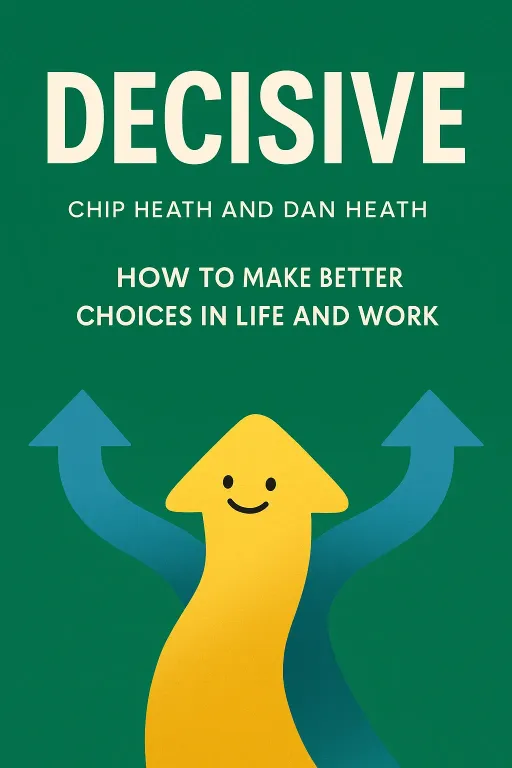
Nova: Exactly! That feeling of paralysis is what we're tackling today. We're diving into a fantastic book, "Decisive: How to Make Better Choices in Life and Work" by Chip and Dan Heath. They argue that we're often our own worst enemies when it comes to making good choices, but the good news is, we can fix it with a better process.
Erica Karikari: A process for making decisions sounds like music to my ears. It feels like it could be a form of self-care, almost, to reduce that anxiety.
Nova: That's the perfect way to put it. Today we'll dive deep into this from two perspectives. First, we'll unmask the four hidden villains that constantly sabotage our best intentions. Then, we'll equip ourselves with two powerful antidotes from the book's WRAP framework: a technique to instantly widen our options, and a simple question to gain crucial emotional distance.
Deep Dive into Core Topic 1: The Four Hidden Villains of Decision-Making
SECTION
Nova: So let's meet these villains. The Heath brothers identify four of them. First, there's, which is that 'this or that' trap you just mentioned, where we limit our options. Then there's the, where we only look for information that supports what we already believe.
Erica Karikari: I see that one all the time. You have a pet feature you want to build, and suddenly every piece of user feedback seems to confirm it's a brilliant idea, and you ignore the rest.
Nova: Precisely. The third villain is. This is when we let a fleeting feeling—anger, excitement, fear—drive a decision with long-term consequences. And finally, there's, where we think we know more about how the future will unfold than we actually do.
Erica Karikari: That last one feels especially dangerous in the tech world, where everyone is trying to predict the future.
Nova: It's incredibly dangerous, and there's a classic story from the book that perfectly illustrates it. Let's go back to London, January 1st, 1962. A young four-man rock-and-roll group called The Beatles has just finished an hour-long audition for Decca Records, one of the two biggest record labels in Britain. They played fifteen songs and felt pretty good about it.
Erica Karikari: Wow, I can only imagine the nerves and the hope in that room. This is their big shot.
Nova: It was. Their manager, Brian Epstein, waited anxiously for the verdict. A few weeks later, he got a letter from a Decca executive named Dick Rowe. The letter rejected them, and the reason he gave is now legendary. He wrote, and I'm quoting here, "We don’t like your boys’ sound. Groups are out; four-piece groups with guitars, particularly, are finished."
Erica Karikari: Oh, no. That's painful to hear, even now. He was so certain, so absolute. "Finished."
Nova: Finished! Think about the sheer overconfidence it takes to declare an entire genre of music dead. And the narrow framing! He was looking at the current charts, at what was popular, and couldn't imagine a future where the soundscape could change. He was so stuck in the 'spotlight' of the present that he missed the biggest cultural phenomenon of the 20th century waiting in his lobby.
Erica Karikari: That hits home. In product, we're always looking at data and current user behavior, and it's so easy to say, "Well, our users don't do X, so they'll never want Y." It takes real discipline to fight that impulse. That story shows how overconfidence isn't just arrogance; it's a failure of imagination. It makes me think about how many great ideas are dismissed in meetings because they don't fit the established "rules" of what's supposed to work. It’s a huge source of self-doubt for anyone trying to innovate.
Nova: Exactly. You start to wonder if your "crazy" idea is genuinely bad, or if you're just talking to Dick Rowe. So, knowing these villains exist is the first step. But how do we actually fight them?
Deep Dive into Core Topic 2: Practical Antidotes: Widening Options and Attaining Distance
SECTION
Nova: This brings us to the antidotes, which are part of the Heath brothers' simple, four-step WRAP process. It stands for: Widen Your Options, Reality-Test Your Assumptions, Attain Distance Before Deciding, and Prepare to Be Wrong. We're going to focus on the 'W' and the 'A'. Let's start with Widen Your Options.
Erica Karikari: So, breaking out of that "this or that" trap. How do we do it?
Nova: One of the most powerful tools is something they call the. The book tells the story of a director at a graduate school, Margaret Sanders. She had an administrative assistant, Anna, who was great at paperwork but terrible with people. Anna was the first face visitors saw, and her awkwardness was creating a bad first impression.
Erica Karikari: Okay, so the classic dilemma: "Should I fire her or not?" A narrow frame.
Nova: Exactly. Firing her was complicated and felt harsh, but keeping her in the role was hurting the department. Margaret was stuck. So, a decision advisor asked her the Vanishing Options Test question: "Imagine you woke up tomorrow and both of your current options had vanished. You cannot fire Anna, and you cannot keep her in her current role. What else could you do?"
Erica Karikari: That's a fascinating constraint. It forces you to get creative. What did she come up with?
Nova: Well, her mind immediately started churning. She thought, "Well, if I can't fire her and she can't be at the front desk... I'd have to move her desk." And if she moved her desk, someone else would have to cover the front. Who? She realized she could hire a couple of work-study students for a few hours a day. They'd be great with people, and it would only cost about $20 a day.
Erica Karikari: Wow. So a problem that seemed like this huge, agonizing personnel decision was solved for $20 a day, just by taking the initial options off the table. That's a tool I could use tomorrow. We get stuck on, "Should we invest millions in this epic feature or do nothing?" The Vanishing Options Test would force us to ask, "What if we couldn't do either? What else could we do?" Maybe the answer is a tiny, experimental version, or a non-product solution like better training for our users. It completely reframes the problem from a choice to a creative challenge.
Nova: That's the magic of it! It moves you from judgment to creativity. Now, let's look at the 'A' in WRAP: Attain Distance Before Deciding. This is all about tackling that villain of Short-Term Emotion. When we're in the heat of a moment, our judgment is clouded.
Erica Karikari: This is huge for personal growth and mental health. A tough conversation, negative feedback, a project going wrong... it's so easy to react emotionally and make things worse.
Nova: Absolutely. And the book offers a brilliantly simple tool for this, called the. It was invented by business writer Suzy Welch. When you're facing a tough choice, you just ask yourself three questions: How will I feel about this decision in 10 minutes? How about in 10 months? And how about in 10 years?
Erica Karikari: I love that. It's like a time-traveling empathy machine for your future self. I can see how that works instantly. Let's say I get some really harsh feedback on a new product design. In 10 minutes, my stomach is in knots, I'm defensive, maybe I feel like a failure. My impulse might be to fire back a defensive email.
Nova: Right, the short-term emotion is screaming.
Erica Karikari: But if I ask about 10 months from now? I'll probably barely remember this specific piece of feedback. I'll have iterated on the design a dozen times. The sting will be gone, and hopefully, the product will be better because of it. And in 10 years? This moment will be completely insignificant. It puts the momentary panic in its proper place. It’s not about ignoring the emotion, but about seeing it as just one data point in a much longer journey.
Nova: You've just perfectly articulated the power of attaining distance. It doesn't erase the feeling, but it shrinks it down to its actual size. It helps you honor your long-term goals—like being a resilient, learning-focused leader—over your short-term feelings of being hurt or defensive.
Synthesis & Takeaways
SECTION
Nova: So, when we pull this all together, Erica, it seems the big idea in "Decisive" isn't about finding a magic formula for being right. It's about trusting a process to be more thoughtful. We've seen how hidden villains like overconfidence can lead to historic blunders, but also how simple tools like the Vanishing Options Test or 10/10/10 can give us the clarity we need.
Erica Karikari: It really is empowering. It suggests that good decision-making isn't an innate talent some people have and others don't. It's a skill you can build. Having a process like this makes the whole idea of leadership feel more accessible. It builds self-confidence because you know you have a reliable way to approach a problem, even if you don't know the answer yet.
Nova: That's a beautiful way to put it. And to leave our listeners with one final, incredibly simple tool for attaining distance, the Heath brothers share a question that researchers have found to be one of the most effective for personal decisions. It's simply: "What would I tell my best friend to do in this situation?"
Erica Karikari: Yes! As an INFJ, that resonates so deeply. It's often so much easier to see the path forward for someone we care about. We see the big picture for them, we want what's best for their long-term happiness, and we cut right through the short-term emotional noise that's clouding their vision.
Nova: And the beauty is, we can give that same clear, compassionate advice to ourselves. It’s the ultimate way to get out of our own heads and make a choice that truly honors our core priorities.
Erica Karikari: So the next time we're stuck, we just have to ask. It's a simple, powerful first step.
Nova: A perfect place to end. Erica, thank you for bringing such wonderful insight to this.
Erica Karikari: This was fantastic. Thank you, Nova.