The Unseen Hand: How Ancient Systems Still Shape Modern Politics
Golden Hook & Introduction
SECTION
Nova: Atlas, quick game. Word association. First thing that comes to mind. Ready?
Atlas: Oh, I love these. Hit me.
Nova: Money.
Atlas: Power. Definitely power.
Nova: Government.
Atlas: Control. Also, bureaucracy, but let's stick with control for now.
Nova: Debt.
Atlas: Burden. And maybe… obligation?
Nova: See, that's where it gets interesting! Because most of us think of money, government, and debt as these purely modern, complex financial or political constructs. But what if I told you the very foundations of these ideas are millennia old, and understanding that changes everything?
Atlas: Wow, that’s actually fascinating. I guess I've always thought of economics and politics as evolving, but not necessarily rooted in something so… ancient.
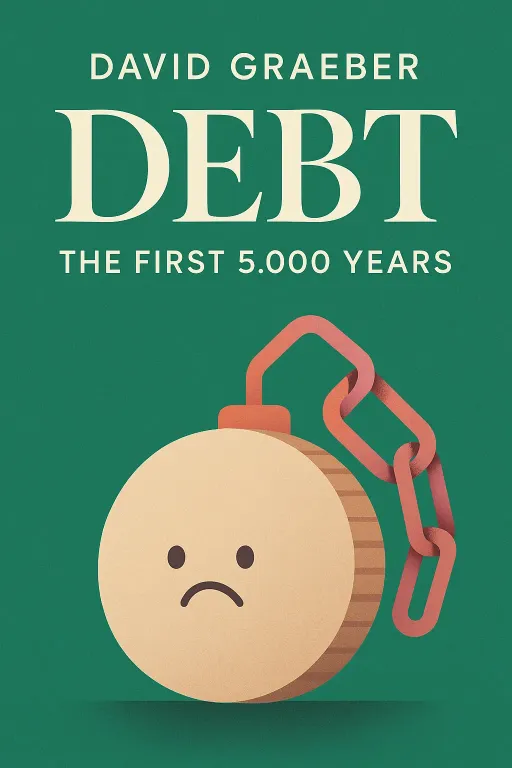
Nova: Exactly! Today, we're diving into two brilliant minds who cracked open that historical blind spot: David Graeber, with his groundbreaking work, "Debt: The First 5,000 Years," and Yuval Noah Harari, with "Sapiens: A Brief History of Humankind." Graeber, an anthropologist and anarchist, really challenged the mainstream economic narrative with his research, earning widespread acclaim for making us rethink everything. And Harari, a historian, wrote a book that became a global phenomenon for its sweeping, interdisciplinary take on humanity.
Atlas: Okay, but wait. "Debt: The First 5,000 Years"? Are you saying ancient debt is directly relevant to my credit card statement or the national budget today? Because that sounds like a stretch.
Debt as a Foundational Social Construct: Beyond Barter
SECTION
Nova: It’s not a stretch, Atlas, it’s a revelation. Graeber profoundly argues that debt, rather than barter, was the original economic system. Think about it: the classic story is we all bartered goods, then invented money, then debt. Graeber flips that on its head. He says human societies were built on networks of obligation and reciprocity, which is essentially debt in its most fundamental form. Before we had coins or even formal markets, people owed each other favors, protection, and resources.
Atlas: So you’re saying it wasn't about swapping my two sheep for your three chickens? It was more like, "I'll help you build your barn this week, and you owe me a hand with my harvest next month"?
Nova: Precisely! And this wasn't just neighborly good turns. Graeber illustrates this beautifully by looking at ancient Mesopotamia. They had elaborate systems of debt, often involving grain or silver. But here's the kicker: they also had periodic "debt jubilees."
Atlas: A debt jubilee? What’s that, like a massive party where everyone just forgets what they owe?
Nova: In a way, yes, but with profound social implications. Imagine a king coming to power, or a major crisis hitting, and decreeing that all debts, especially those owed by common farmers to the elite, were simply wiped clean. The cause was often rising social instability, as debt bondage would push too many people into slavery, threatening the very fabric of society. The process was a royal decree, a conscious political act. And the outcome? It was a reset. It prevented the complete collapse of the social order, maintaining a fragile balance and preventing perpetual enslavement.
Atlas: Hold on, so you're saying our entire modern financial system might be built on a misunderstanding of how economics actually began? And that ancient rulers were more 'progressive' than modern bankers in some ways? That's… that's truly astonishing. What exactly do you mean by 'moral economy' versus a 'market economy' in this context?
Nova: It’s a crucial distinction. In ancient moral economies, debt was deeply personal and social. If you owed your neighbor, it was part of a relationship, bound by community norms and often religious tenets. The idea of limitless accumulation of interest or perpetual debt bondage was seen as morally corrupting. A market economy, on the other hand, abstracts debt. It becomes a number on a ledger, impersonal, divorced from social context. The market dictates, not the community or a moral code.
Atlas: That makes sense. This really makes you rethink the 'foundational understanding' of capitalism. It’s not just about transactions, it’s about who owes whom, and why, and the very nature of those obligations. For our listeners who are constantly dealing with financial pressures or observing global economic inequalities, this perspective is incredibly powerful. It re-contextualizes so much of what we just accept as 'the way things are.'
Shared Fictions & Collective Myths: The Architecture of Human Cooperation
SECTION
Nova: Absolutely. And speaking of agreements that hold us together, this naturally leads us to Harari's brilliant insight into 'shared fictions.' He argues that what truly sets humans apart and allowed us to dominate the planet isn't our individual intelligence, but our unique ability to cooperate flexibly in large numbers. And we do this through shared fictions, or collective myths.
Atlas: Shared fictions? Like, Santa Claus? Or the Tooth Fairy?
Nova: Well, yes, but on a much grander, society-building scale. Think about money. A dollar bill is just a piece of paper, or a number on a screen. It has no inherent value. But we all collectively agree it does. That shared belief is a fiction. The same goes for nations. A country isn't a natural entity; it's a story we tell ourselves about shared history, culture, and borders. Or corporations, or human rights, or laws. These are all stories, narratives that exist only in our collective imagination.
Atlas: Wow, so you're saying nations and corporations are essentially just really successful stories we tell each other? That's kind of mind-blowing. It makes me wonder about the fragility of these systems if the 'story' ever breaks down. Can you give an example of how this plays out in, say, everyday politics?
Nova: Take the concept of a 'free market.' It’s not a natural law of the universe; it’s a shared fiction, a belief system about how economic interactions work. Politicians invoke it, economists debate it, but its power comes from our collective agreement to operate within its rules. Or national identity itself. The idea of being 'American' or 'French' allows millions of strangers to feel a bond, to fight wars, to pay taxes, to build vast infrastructures, all based on a story they've inherited and chosen to believe. Without that shared fiction, large-scale cooperation—and therefore, large-scale political organization—would be impossible.
Atlas: That’s a perfect example. It's like looking at the operating system behind history. All those geopolitics and social movements we study are running on these invisible lines of code, these shared fictions. It's not just about what physically exists, but what we collectively imagine and agree upon. This really appeals to my inner analyst—it's about the foundational understanding of how societies actually function, not just what they appear to be on the surface.
Synthesis & Takeaways
SECTION
Nova: And that’s the profound connection between Graeber and Harari. Graeber shows us that even our earliest forms of social organization were built on complex, often moral, systems of debt and obligation. Harari then expands on that, demonstrating how our unique ability to create and believe in shared fictions allowed these small, moral economies to scale up into the vast, impersonal nation-states and global markets we have today. Both reveal that the "unseen hand" shaping modern politics isn't some abstract market force, but millennia-old human behaviors and social contracts, often disguised as modern innovations.
Atlas: That’s actually really inspiring, because if debt is fundamentally social, and our nations and economies are just stories we tell each other, then changing the narrative becomes immensely powerful. It suggests that these systems aren't immutable forces of nature, but rather human creations that we can, theoretically, reshape. It makes me wonder, how might understanding these ancient origins change our approach to contemporary political and economic reforms?
Nova: It means we have to look deeper than the surface. When we talk about economic inequality, we can't just look at interest rates; we have to ask about the underlying social obligations, the moral dimensions of debt. When we debate national identity, we have to recognize it as a powerful story, one that can be rewritten or reinterpreted. It's about recognizing the deep historical roots that explain why certain challenges persist.
Atlas: I love that. For our listeners who crave unique insights and enjoy challenging conventional thinking, this is a massive invitation to look at the world differently. I encourage everyone to start a dedicated journal, capture your evolving insights on these political and historical threads. Pay attention to the 'stories' being told around you, and question the 'debts' that are truly meaningful.
Nova: Absolutely. Start seeing the unseen hands at work. It changes everything.
Atlas: This is Aibrary. Congratulations on your growth!