The Long Arc of Innovation: How Ancient Wisdom Shapes Modern Breakthroughs
Golden Hook & Introduction
SECTION
Nova: Most people believe innovation is this shiny, new thing, right? A lightning bolt of genius striking in a Silicon Valley garage. But what if that belief is actually our biggest blind spot, preventing us from truly seeing where the next breakthrough will come from?
Atlas: Hold on, Nova. Are you really suggesting that our obsession with "new" is making us, well, innovative? That sounds almost counter-intuitive, especially for those of us constantly trying to stay ahead of the curve.
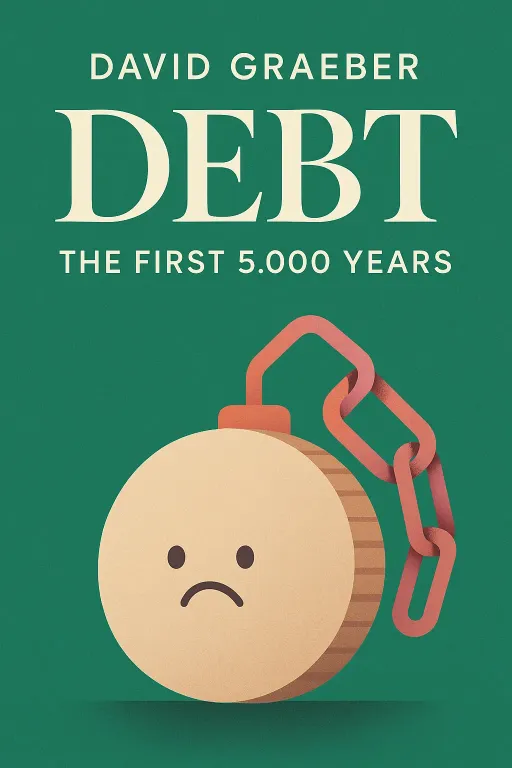
Nova: Absolutely, Atlas. It's a deep-seated misconception. We're conditioned to think of progress as a linear march forward, always leaving the past behind. But today, we're going to challenge that. We're diving into what we call "The Long Arc of Innovation: How Ancient Wisdom Shapes Modern Breakthroughs," exploring the profound insights revealed by books like "Debt: The First 5000 Years" by David Graeber and "Sapiens: A Brief History of Humankind" by Yuval Noah Harari. These aren't just history books; they're blueprints for understanding our present.
Atlas: So the deep question here, for anyone grappling with complex contemporary issues, is: "How might acknowledging the ancient origins of a current problem change your approach to solving it today?" That's a strategic question right there.
The 'Blind Spot' of Modern Innovation: Why We Miss History's Echoes
SECTION
Nova: Exactly. Let's start with this "blind spot." Imagine innovation as an iceberg. We only ever see the gleaming tip, the latest app, the newest gadget. But beneath the surface, there's this massive, ancient foundation of ideas, human behaviors, and societal structures that underpin everything. When we ignore that submerged mass, we’re essentially trying to build new structures on a foundation we don't understand.
Atlas: Can you give us a concrete example? Because for someone constantly looking for the next disruptive technology, it's hard to reconcile that with, say, ancient history. What seemingly cutting-edge concept actually has deep historical roots?
Nova: Think about distributed ledger technology, or the idea of shared, decentralized record-keeping. Sounds very Web3, right? Very modern blockchain. But if you look back to ancient Mesopotamia, you find sophisticated clay tablet archives. They weren't just storing information; they were managing complex credit systems, land ownership, and trade agreements using a distributed, verifiable system. Scribes maintained these records, and their widespread, standardized nature created a form of public trust. The cause was the need for complex economic transactions, the process was meticulous clay tablet record-keeping, and the outcome was a functioning, large-scale economy without centralized digital databases.
Atlas: Wow. So, you're saying the of a shared, immutable ledger to build trust in transactions isn't new; it's just the that's changed? That's a fascinating reframe. For someone trying to develop a truly innovative solution today, ignoring this kind of historical context could actually be a strategic disadvantage, couldn't it? You might be reinventing a wheel without understanding why the first one was round.
Nova: Precisely. It’s not about just repeating history, but understanding the underlying human needs and social dynamics that those ancient solutions addressed. Graeber, for instance, an anthropologist and anarchist scholar who brought a truly radical perspective to economics, meticulously traced how concepts like debt and credit are not just financial tools but fundamental social institutions, shaping human relationships for millennia. His work essentially rewrites our understanding of economic history, showing how our current systems are deeply embedded in these ancient patterns, often in ways we don't even realize.
Atlas: That's a great way to put it. It highlights how many "new" problems we face might simply be ancient challenges wearing modern clothes.
Unearthing the Foundations: How Ancient Systems Built Our Modern World
SECTION
Nova: And that strategic disadvantage often comes from not understanding the very foundations our modern systems are built upon, foundations laid millennia ago. This is where "Debt" and "Sapiens" truly shine. Graeber's magnum opus isn't just about money; it’s about how debt, credit, and gift economies are ancient social technologies. He argues that before coinage, most societies operated on systems of credit and debt without formal currency. People kept mental ledgers, and social relationships were the collateral.
Atlas: Wait, so you're saying our entire concept of credit scores and mortgages isn't just a modern banking invention, but has roots in, say, ancient Sumerian clay tablets? How does that change how we view financial problems today? Because if debt is inherently social, not just economic, that’s a massive shift in perspective.
Nova: Exactly! Graeber shows how entire civilizations rose and fell based on these debt cycles, including massive debt jubilees where debts were periodically wiped clean to prevent social collapse. He meticulously documents how these ancient practices shaped everything from law to religion. The shift from a moral economy of debt to a market economy of debt has profound implications. For someone trying to understand modern financial crises or even geopolitical stability, seeing these ancient patterns offers a completely different lens. It’s not just about interest rates; it’s about human relationships and power dynamics that have played out for thousands of years.
Atlas: That's powerful. It makes me think about how modern discussions around student loan forgiveness or even international aid aren't just about economic policy, but echo these incredibly old social contracts around obligation and community. This isn't just for historians; this is for strategists.
Nova: And Harari, in "Sapiens," takes an even broader view, illustrating how the cognitive revolution, when humans developed complex language and the ability to believe in shared fictions, fundamentally altered human cooperation. This wasn't a technological innovation in the modern sense, but a revolution in our ability to organize and solve problems on an unprecedented scale. That ability to cooperate flexibly in large numbers, based on shared myths—whether it's religion, nations, or corporations—is the bedrock of all complex innovation that followed.
Atlas: So, understanding these ancient forms of cooperation, or even the psychological underpinnings of why humans create shared fictions, could actually offer insights for ethical leadership or even how to foster more effective teams in a globalized world today, couldn't it? It's about finding the fundamental human drivers.
Nova: Precisely. The challenges of coordinating thousands or millions of people, of building trust, of creating shared purpose — these are ancient problems. Harari shows how our ancestors solved them, not with apps, but with stories and shared beliefs. The Nova take is clear: understanding historical economic and social structures reveals the enduring human needs that drive innovation, regardless of the era. It clarifies complexity.
Atlas: It’s not just about what worked then, but it worked, and how those underlying principles can be reapplied now. It’s about patterns, not just events.
Synthesis & Takeaways
SECTION
Nova: Absolutely. So, to synthesize this, the "long arc of innovation" isn't just a fascinating historical footnote. It's a critical lens. True breakthroughs often come not from inventing something entirely new, but from rediscovering ancient wisdom, understanding the deep roots of human behavior, and applying those timeless principles to modern tools and contexts.
Atlas: So, to come full circle to the deep question from our reading: if we acknowledge the ancient origins of, say, a modern economic crisis or a challenge in global cooperation, does that fundamentally shift our approach from just a quick fix to something much more foundational and sustainable? Does it lead to more meaningful solutions?
Nova: It absolutely does. It shifts our focus from merely treating symptoms to understanding the systemic, millennia-old causes. It gives us a richer toolkit, not just of technology, but of human wisdom and societal structures that have proven resilient over vast stretches of time. It reminds us that while the surface changes, the human operating system largely remains the same.
Atlas: It makes you wonder, doesn't it, what other "new" problems we're facing today that have ancient solutions waiting for us to rediscover? It’s a powerful call to look back to move forward.
Nova: This is Aibrary. Congratulations on your growth!