The Hidden Architectures of Influence: Decoding Societal Systems
Golden Hook & Introduction
SECTION
Nova: What if everything you thought you knew about money, about where it came from, was completely wrong? Not just a little wrong, but fundamentally, mythically wrong?
Atlas: You are telling me my entire understanding of economics, the very foundation of modern society, is a fairy tale concocted somewhere along the line? That's a bold claim, Nova.
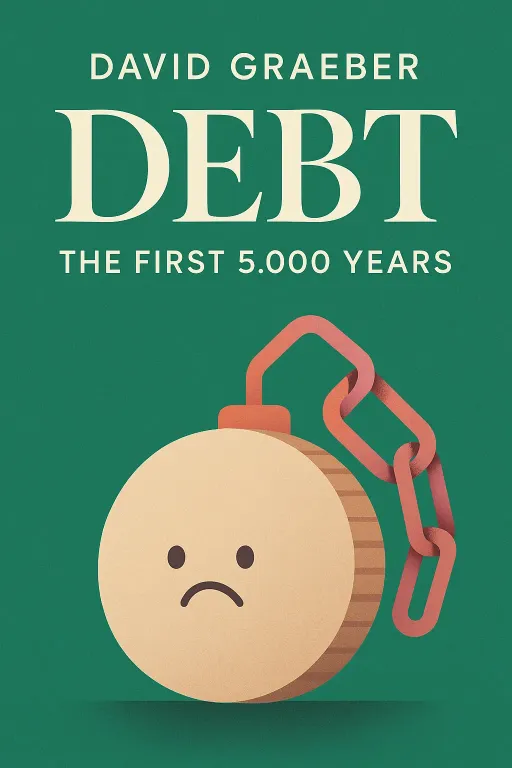
Nova: It is, Atlas, but it's a claim backed by truly profound scholarship. Today, we are tearing down some foundational myths with two incredible books: David Graeber's monumental "Debt: The First 5000 Years" and James C. Scott's "Seeing Like a State." Graeber, a brilliant anthropologist and anarchist activist, spent decades unearthing the true origins of our economic systems, challenging centuries of conventional wisdom. His work, lauded globally for its interdisciplinary approach and rigorous research, forces us to rethink our moral relationship with money itself.
Atlas: So, it's not just an economic history, it's a moral philosophy wrapped in anthropology. That's fascinating.
Nova: Exactly. And Scott, a political scientist renowned for his critical examination of state power, offers an almost chilling insight into how governments, in their relentless pursuit of order and efficiency, inadvertently create chaos. Both of these thinkers peel back the layers to reveal the hidden architectures that silently dictate our societal structures, from ancient contracts of debt to the modern state's relentless quest for order.
Atlas: That's exactly the kind of deep dive our listeners, who are always seeking to understand the unseen influences on society, are here for. We're talking about the fundamental operating systems of how we live, not just the surface applications.
The Deep Roots of Debt and Value: Beyond Barter
SECTION
Nova: Absolutely. And let's start with Graeber, because his thesis is so counterintuitive. We're taught that money emerged from barter – you had a cow, I had some grain, we traded. Simple. But Graeber, drawing on vast anthropological and historical evidence, shows that this "barter myth" is precisely that: a myth.
Atlas: So, you're saying it wasn't about swapping goats for grain, but more like a running tab with your neighbor, backed by social trust? How would that even work in a primitive society?
Nova: Precisely! He argues that most early economies were actually "moral economies" built on systems of debt and credit. People knew each other. If I needed grain this season, you'd give it to me, and I'd owe you one. Not in a strict, immediate exchange, but as part of an ongoing social relationship. Think about ancient Mesopotamia, where temple economies managed vast systems of credit and agricultural loans, often with regular debt jubilees to prevent social collapse. It was about maintaining social cohesion and reciprocal obligations.
Atlas: Wow. That makes me wonder about our modern credit scores. Is there a deep, ancient echo in how we perceive financial obligation today, even when it’s totally detached from personal relationships?
Nova: Absolutely. Graeber meticulously traces how this moral dimension of debt has been present throughout history, often manifesting in cycles of debt forgiveness, or even violent revolutions when debt burdens became unbearable. He highlights how the concept of "paying your debts" became deeply intertwined with morality, even religion, long before the invention of coinage. The idea of a "clean slate" or "redemption" often had economic roots.
Atlas: But isn't modern debt just... numbers on a screen? Impersonal, abstract, cold. Where's the moral component there? I mean, a bank doesn't care about my social standing, just my credit history.
Nova: That's the shift, isn't it? Graeber argues that the rise of coinage and later, complex financial instruments, allowed debt to become increasingly abstract and detached from personal relationships. This detachment, he suggests, is what allows for the more exploitative forms of debt we see today, because the moral constraints of a tight-knit community are removed. It's no longer about owing your neighbor; it's about owing an anonymous entity.
The State's Gaze: Legibility, Control, and Unintended Consequences
SECTION
Nova: And speaking of how abstract systems reshape our lives, let's pivot to another architecture, one built by states trying to 'see' us better. This brings us to James C. Scott and his concept of 'legibility.'
Atlas: Legibility? Like, easy to read?
Nova: Exactly, but on a societal scale. Scott argues that states, in their efforts to control, tax, and administer their populations, have an inherent need to make society 'legible.' They need to simplify the messy, complex, organic reality of human life into standardized, quantifiable categories that can be easily mapped, measured, and managed from a central authority.
Atlas: Wait, so giving everyone a last name wasn't just about identity, it was about making us easier to tax and conscript into armies? That's… a bit unsettling.
Nova: It's a perfect example! Before standardized last names, many people were known by their occupation, their father's name, or where they lived. It was fluid, local, and incredibly difficult for a state to track. So, states mandated surnames, standardized property records, created standardized weights and measures, even standardized languages. These weren't just neutral administrative improvements; they were tools to make populations visible and controllable.
Atlas: What other everyday systems are designed to make us 'legible' to the state? I'm thinking about things like census data, national ID numbers...
Nova: Precisely. And it extends beyond just people. Think about how states try to manage natural resources. Scott gives a fascinating example of scientific forestry in Germany. Traditional forest management was complex, based on generations of local knowledge, recognizing diverse species and their interdependencies. But for the state, this was illegible.
Atlas: So, they simplified it? Planted rows and rows of a single, fast-growing tree species?
Nova: Exactly! They saw the forest as a timber factory, not a complex ecosystem. They streamlined it for maximum legibility and yield. But this simplification, this imposition of a 'rational' order, often ignored the local complexities. It stripped the forest of its ecological resilience, making it more vulnerable to pests and diseases, and ultimately, less productive in the long run. The state's attempt to 'see' and control the forest more effectively paradoxically led to its degradation.
Atlas: That sounds rough, but isn't some level of standardization necessary for a functional society? Like, roads and maps need to be legible, right? Where's the line between necessary order and destructive oversimplification?
Nova: That's the core tension Scott explores. He's not arguing against all forms of state planning, but highlighting the inherent dangers when abstract, top-down blueprints ignore the rich, nuanced, and often highly effective local knowledge and practices. The problem arises when the state's simplified map becomes more 'real' than the complex territory it represents, and when that simplified map is then used to violently reshape the territory itself. It's a warning against what he calls "high-modernist ideology"—the belief that rational, scientific planning can redesign society from above without unintended consequences.
Synthesis & Takeaways
SECTION
Nova: So, when we put Graeber and Scott together, we see a powerful, unifying theme emerge. Both reveal how the systems we live within, whether they're economic or administrative, are not natural or inevitable. They are built on hidden assumptions, historical contingencies, and a relentless drive for control and order, often with profound, and often unintended, consequences for human lives.
Atlas: So, the takeaway is, whether it's our money or our identity, we're living inside architectures designed long ago, or designed with an abstract logic that misses the messy human reality. It makes you realize how much of what we take for granted is actually constructed.
Nova: It absolutely does. It's about recognizing that these systems, whether it's the moral weight of debt or the simplifying gaze of the state, aren't just background noise. They are active forces shaping our choices, our relationships, and our very understanding of the world. For our listeners, who are often trying to make sense of complex societal patterns and unseen influences, what's the one thing they should keep in mind from these two thinkers?
Atlas: I think it's this: always question the "naturalness" of things. If something feels inherently true, inherently just, or inherently efficient, pause. Look for the human choices, the power dynamics, and the historical layers that built that architecture. Because the truth is often far more complex, and frankly, far more interesting.
Nova: Beautifully put. So, the next time you look at a spreadsheet, sign a contract, or even just consider your own name, consider: what hidden architecture is truly at play?
Nova: This is Aibrary. Congratulations on your growth!