

Debt Trap
Introduction
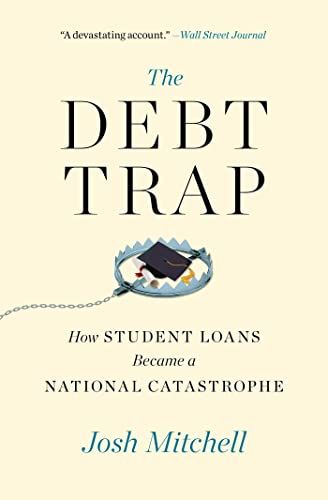
Nova: Welcome back to Aibrary. Today we're diving into a book that NPR named one of the best books of 2021 and that the New York Post called essential reading. It's called The Debt Trap: How Student Loans Became a National Catastrophe by Wall Street Journal reporter Josh Mitchell. And here's a number to start us off: 43 million Americans owe a collective 1.6 trillion dollars in student debt. That's roughly the size of Canada's entire economy.
Nova: : That number is almost impossible to wrap your head around. And what gets me is that this didn't happen overnight. Mitchell traces this back more than sixty years. So where does this story actually begin?
Nova: It begins on an October evening in 1957, at Lyndon Johnson's ranch in Texas. The Soviet Union had just launched Sputnik, the first satellite in orbit. Johnson and his guests stood outside, staring at the sky, trying to catch a glimpse of it. For Johnson, this was a wake-up call. America needed to become a more educated country, and fast. He had grown up poor, gone to college on loans himself, and he knew firsthand that a degree could lift people out of poverty.
Nova: : So the student loan program was born out of the space race? That's not the origin story I expected.
Nova: Exactly. And that's what makes Mitchell's book so compelling. He shows how a well-intentioned program, designed to fight the Cold War and later the War on Poverty, morphed into what one of its original architects called a monster. Mitchell spent years as the Wall Street Journal's economics correspondent, and he brings that investigative rigor to every page. He doesn't just give us policy analysis. He gives us real people, like Brandon, a Navy veteran who showed up at Howard University in 2006 with dreams of a better life and walked out with nearly a hundred thousand dollars in debt.
Nova: : And that's the trap, isn't it? You do exactly what society tells you to do, go to college, get the degree, and you end up buried. Let's unpack how this happened.
The Birth of a System
From Sputnik to Sallie Mae
Nova: So the story really has two founding visionaries. There's Lyndon Johnson, of course, but also a Southern Democrat named Carl Elliott from Alabama. In the late 1950s, Elliott fought for a universal scholarship program. He wanted the first two years of college to be essentially free. But that idea ran into a wall. The Vietnam War was draining the budget, and many politicians argued that scholarships smacked of socialism. Loans, they said, were a more individual, more American solution.
Nova: : So instead of grants, we got loans. And the burden shifted from society to the individual student.
Nova: Right. And here's where it gets really interesting. In 1965, Johnson pushed Congress to create the federal student loan program. But there was a problem. If the government made loans directly, it would show up as a big expense on the federal budget and increase the deficit. So Congress came up with a workaround. They would get private banks to make the loans, and the government would guarantee them. On paper, the program looked cheap.
Nova: : Let me guess. That workaround created a monster.
Nova: It created something called Sallie Mae, the Student Loan Marketing Association, in 1972. Sallie Mae was a government-sponsored enterprise designed to funnel money from the Treasury to banks, and from banks to students. Mitchell calls it a Frankenstein. The original idea was that Sallie Mae would seek private investment to fund student loans. That failed. So Congress let Sallie Mae borrow directly from the Treasury at rock-bottom rates. Then, in just four years, Congress agreed to guarantee 100 percent of student loan defaults. Banks had zero risk.
Nova: : Zero risk? So banks could lend to anyone and if the student couldn't pay, the government, meaning taxpayers, would cover the entire loss?
Nova: Exactly. And then in 1980, Sallie Mae went public, selling shares on Wall Street. Congress guaranteed it a profit margin of 3.5 percent above costs. Mitchell tells this incredible story about a 1981 congressional hearing where a senator from West Virginia was asked what she thought of Sallie Mae. Her response was, quote, Who is she? That was how little oversight there was. Lawmakers didn't even know what they had created.
Nova: : That's jaw-dropping. And I imagine once Wall Street got involved, the incentives went completely haywire.
Nova: They did. In 1981, a new executive named Al Lord joined Sallie Mae. He looked at the finances and saw an opportunity to make billions. Under Lord's leadership, Sallie Mae became a profit machine. Mitchell writes that the student loan program became, in his words, the quintessential form of crony capitalism. Banks made money. Sallie Mae made money. Colleges collected tuition. And students? They got the debt.
How Colleges Learned to Raise Prices with Abandon
The Tuition Explosion
Nova: Here's a statistic that stopped me cold when I read it. Between 1980 and today, average tuition and room and board at four-year private colleges has risen nearly 800 percent. That's more than five times the rate of inflation. A four-year degree at a private college now costs nearly 200,000 dollars on average. At a public college, it's over 100,000.
Nova: : 800 percent. How is that even possible? What were colleges spending all that money on?
Nova: Mitchell argues that the student loan system itself enabled this. Far from making college more affordable, easy access to loans gave colleges a blank check to raise prices. He calls it a higher education industrial complex. And he uses the University of Alabama as a case study. Alabama transformed itself into what Mitchell describes as a Disneyfied campus, with luxury dorms, climbing walls, lazy rivers. They were competing for out-of-state students who could pay higher tuition. The football coach there makes nearly 10 million dollars a year.
Nova: : So colleges were essentially in an arms race of amenities, funded by student debt. But what about the students who couldn't afford it?
Nova: That's the tragic part. Mitchell profiles a student named Thomas who graduated from Alabama with 153,000 dollars in debt. He was actually barred from walking at his own commencement because he owed the university 2,800 dollars. His father had just died, and he had used his money for the cremation. The university knew this and still wouldn't let him cross the stage.
Nova: : That is genuinely cruel. And it speaks to how depersonalized the whole system became.
Nova: Mitchell also points out that states have been steadily cutting funding to public universities for decades. So schools became more dependent on tuition dollars. And because students could always borrow more, there was no downward pressure on prices. It's a classic moral hazard. Studies show that the more an activity is insured, the more people take risks. When lenders face zero risk and schools face zero consequences for high prices, you get exactly what we got.
Nova: : And this wasn't just private banks. The government was in on it too, right?
Nova: Absolutely. Mitchell reveals that Congress actually started charging more interest on student loans while students were still in school, before they could even begin making payments. Why? Because they used that interest to make the federal budget look smaller. In some cases, they used student loan interest to reduce the deficit. Mitchell tells the story of a woman who went to school for ten years to become a psychologist. By the time she graduated, she owed 120,000 dollars, and nearly a quarter of that was just accumulated interest. She eventually had to file for bankruptcy even after paying back her original balance and then some.
Default, Shame, and the Impossible Escape
The Human Cost
Nova: By 2016, the numbers had become staggering. Three thousand people were defaulting on a student loan every single day. By the end of that year, eight million Americans were in default. That's roughly the same number of people who lost their homes to foreclosure during the housing crisis. And unlike a mortgage, you can't walk away from a student loan.
Nova: : Wait, can you declare bankruptcy on student loans?
Nova: That's one of the most shocking parts of Mitchell's reporting. In 1998, Congress made it nearly impossible to discharge student loans through bankruptcy. It's one of the only types of debt that follows you literally to the grave. The government can garnish your wages, your tax refunds, even your Social Security checks. Mitchell reports that more than a million seniors have had their Social Security checks garnished because of unpaid student loans.
Nova: : So you have retirees, people in their seventies and eighties, having their Social Security reduced because of loans they took out decades ago, or loans they co-signed for their children or grandchildren.
Nova: Exactly. And Mitchell says the thing that struck him most while reporting this book was the shame. Every person he interviewed felt deeply ashamed of their debt. They had done everything society told them to do. Go to college. Get the degree. Sign on the dotted line. They believed it was good debt, an investment in their future. And when it didn't pay off, they blamed themselves.
Nova: : That's heartbreaking. And Mitchell also highlights how this crisis has a racial dimension, doesn't he?
Nova: Yes, and it's one of the most important threads in the book. Student debt has grown fastest among Black households. Black students are more likely to borrow, they borrow larger amounts, and they default at disproportionately higher rates. Mitchell profiles Brandon, a Black student who attended Howard University. He came from a modest background, raised by a single mother in the Army and his great-grandmother. He joined the Navy, served his country, then used the GI Bill and federal loans to attend Howard. He graduated with nearly 100,000 dollars in debt. His family relationships fractured under the financial strain.
Nova: : And Howard is one of the most prestigious historically Black universities in the country. This isn't a story about predatory for-profit schools, though those exist too. This is about the flagship institutions.
Nova: Right. Mitchell is careful to show that the problem spans the entire system. He writes about for-profit schools that were essentially diploma mills, publicly traded companies whose biggest revenue source was the federal student loan program. But he also shows how traditional nonprofit universities and even elite institutions are complicit. The whole system is built on perverse incentives.
Solutions and the Uncomfortable Questions
The Road Forward
Nova: So after 250 pages of documenting this catastrophe, Mitchell doesn't just walk away. He offers six concrete recommendations. And they're not the typical partisan talking points.
Nova: : Let's hear them. What does he propose?
Nova: First, forgive the interest on student loans. Many borrowers have paid back their original principal but are drowning in accumulated interest. Mitchell argues that giving people a fair shot at paying off their actual balance would be transformative. Second, make colleges and universities put up their own money. If schools had financial skin in the game, if loan defaults actually cost them something, they'd be far more careful about encouraging students to take on reckless debt.
Nova: : That makes so much sense. Right now, schools collect the tuition regardless of whether the student ever graduates or gets a job. There's zero accountability.
Nova: Third, make community college truly free. Mitchell doesn't support four years of free college for everyone, but he argues that one or two years of free community college would let students test the waters without taking on life-altering debt. Fourth, revise the American Dream to respect alternatives to the four-year degree. He points to research showing that apprenticeship programs are highly effective at getting students well-paid jobs without the debt burden.
Nova: : So he's saying we need to stop treating college as the only legitimate path to success.
Nova: Exactly. Fifth, the government should stop subsidizing graduate school. Mitchell is particularly critical of the Grad PLUS loan program, which he calls the most dysfunctional financial product in the system. It allows graduate students to borrow virtually unlimited amounts, which has driven up the cost of master's and doctoral programs. And sixth, states, cities, and communities need to step up. He cites Kalamazoo, Michigan, where wealthy philanthropists invested in the education of their own citizens.
Nova: : Those are practical ideas. But Mitchell also supports some level of debt cancellation, doesn't he?
Nova: He does, but in a nuanced way. He argues that a modest amount of cancellation, say 10,000 dollars, would be especially helpful for minority borrowers who default disproportionately. He points out that if the government were a private lender, it would have already written down this bad debt. A private bank would acknowledge that certain loans are never going to be repaid and wipe them off the books. But he doesn't support blanket forgiveness of all student debt. His question is: how does that help next year's students who take out 150,000 dollars? Without structural reform, we'd just be back in the same crisis in a few years.
Nova: : So the core message is that forgiveness without reform is just a band-aid.
Nova: That's it exactly. Mitchell's book is ultimately a call for structural change. He wants us to confront the uncomfortable question we've been avoiding for sixty years: should everyone go to college, and who should pay for it?
Conclusion
Nova: The Debt Trap is one of those rare books that manages to be both a gripping narrative and a devastating policy analysis. Mitchell takes us from a ranch in Texas in 1957, where Lyndon Johnson stared at the stars and dreamed of an educated America, all the way to the present day, where 43 million people are carrying 1.6 trillion dollars in debt, where seniors have their Social Security garnished, and where 3,000 people default every single day.
Nova: : What stays with me is how the system was built, layer by layer, with good intentions at every step. Johnson wanted to fight poverty. Elliott wanted to open doors for the poor and for Black students. But each compromise, each workaround, each decision to protect banks and hide costs from the federal budget, added another brick to the trap.
Nova: And Mitchell doesn't let anyone off the hook. Not Congress, not the banks, not Sallie Mae, not the universities. But he also doesn't let borrowers completely off the hook either. The book raises hard questions about personal responsibility alongside systemic failure. Could that student from Florida have chosen a cheaper in-state school instead of Alabama? Yes. But was he also responding to incentives that the system deliberately created? Absolutely.
Nova: : So what's the one thing you want listeners to take away from this book?
Nova: I think it's this. The student debt crisis is not an accident. It's not a natural disaster. It was built, deliberately, over decades, by people who knew what they were doing. And because it was built, it can be rebuilt differently. Mitchell's recommendations, forgiving interest, making schools put up their own money, free community college, ending Grad PLUS loans, these are not radical ideas. They're practical fixes to a machine that was designed badly from the start.
Nova: : The question is whether we have the political will to actually do it. As Mitchell points out, we've been having the same debates since the 1960s and we've never resolved them.
Nova: That's the challenge. But books like The Debt Trap make it harder to look away. They force us to see the real people behind the statistics, the Brandons and the Thomases and the single mothers and the Navy veterans who played by the rules and got trapped anyway. If you've ever taken out a student loan, if you have kids who might go to college, if you work in higher education, or if you just want to understand one of the defining economic crises of our time, this book is essential reading.
Nova: : This is Aibrary. Congratulations on your growth!