

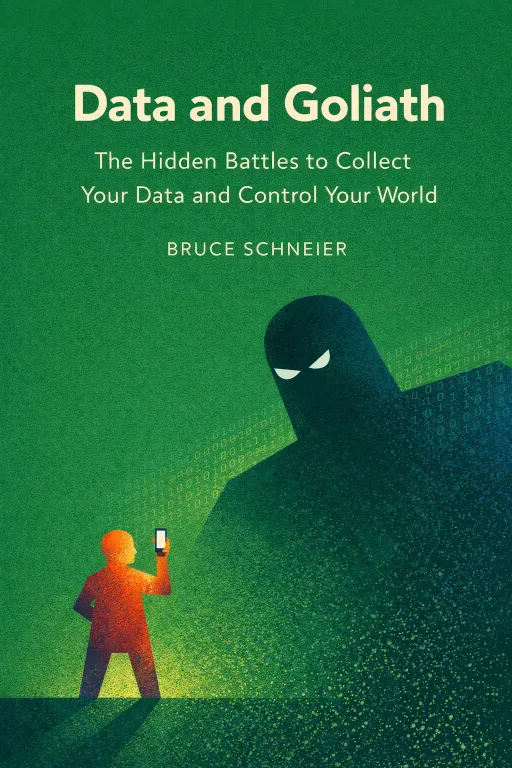
Data and Goliath
The Hidden Battles to Collect Your Data and Control Your World
Introduction
Nova: Think about the last thing you did before you sat down to listen to this. Maybe you checked your email, looked up a recipe, or just walked across the room with your phone in your pocket. To you, those were just moments in your day. But to a massive, invisible infrastructure, those were data points. Every move you made was recorded, stored, and analyzed.
Nova: It is dramatic when you realize the scale. Today we are diving into a book that changed the way we talk about this entire digital landscape. It is called Data and Goliath: The Hidden Battles to Collect Your Data and Control Your World by Bruce Schneier. He is one of the world's leading security experts, and he argues that we have accidentally built a world of ubiquitous surveillance.
Nova: Exactly. Schneier describes a world where we are constantly being watched by two giants: the corporate world and the state. And the scariest part is that they are often working together. He published this back in 2015, right in the wake of the Edward Snowden revelations, and honestly, his warnings have only become more relevant as we move into the age of AI.
Nova: We definitely are. We are going to break down how your data is being used as a weapon, why the bargain we made for free apps might be the worst deal in history, and what we can actually do to fight back against the digital giants.
Key Insight 1
The World of Ubiquitous Surveillance
Nova: Let's start with a concept Schneier calls data exhaust. Think of it like the smoke coming out of a car's tailpipe. It is a byproduct of an action. When you use your phone, you are not trying to create a map of your movements, but your phone creates one anyway as it pings cell towers. That is data exhaust.
Nova: Precisely. Schneier points out that surveillance used to be expensive. If the government wanted to follow you, they had to hire people to physically tail you in a car. It was a one-to-one ratio. But today, surveillance is automated and incredibly cheap. It is one-to-many. The sensors are everywhere: in our pockets, on our street corners, in our thermostats, and even in our cars.
Nova: Yes. We used to call it the Internet of Things, but Schneier argues it is more accurately the Internet of Sensors. Your smart fridge, your fitness tracker, your e-reader. They are all reporting back. He gives this striking example: your cell phone is a tracking device that happens to make phone calls. If you think of it that way, the perspective shifts completely.
Nova: Schneier argues that the distinction between marketing and surveillance has basically disappeared. When a company tracks your every move to predict what you will buy, they are building a psychological profile of you. They know your habits, your health concerns, your political leanings, and your relationships. In the book, he mentions how Target famously figured out a teenager was pregnant before her own father did, just by analyzing her shopping patterns.
Nova: Because it is not just about peanut butter, Leo. It is about the fact that this data is permanent. It is searchable. It is linkable. Once that data is out there, you lose control over how it is used. It can be used to decide your insurance premiums, your credit score, or even whether you get a job interview. You are being judged by algorithms based on data you didn't even know you were providing.
Nova: Exactly. And that digital version of you can be used to manipulate your behavior in ways that are so subtle you don't even notice them happening.
Key Insight 2
The Public-Private Partnership
Nova: This brings us to the core of the Goliath metaphor. Schneier talks about an unholy alliance between corporations and the government. He calls it the public-private surveillance partnership.
Nova: That is the public-facing side of it. But behind the scenes, they are deeply interdependent. Think about it: the government wants to surveil its citizens, but it is often limited by the Fourth Amendment or other privacy laws. However, corporations aren't bound by those same rules. They can collect whatever they want as long as you click I Agree on a terms of service page.
Nova: Often, yes. Schneier explains that the NSA and other intelligence agencies don't need to build their own tracking infrastructure because Google, Facebook, and Verizon have already built it for them. The government can then use subpoenas, National Security Letters, or even just buy the data from third-party brokers to get what they need.
Nova: In many cases, yes. There is a massive industry of data brokers who aggregate information from thousands of sources and sell it to the highest bidder. And the government is a very high bidder. Schneier points out that about seventy percent of the U. S. intelligence budget goes to private contractors. The line between where the government ends and the private sector begins is incredibly blurry.
Nova: That is exactly Schneier's point. He argues that we have created a system where surveillance is the business model of the internet. We get free services like search and social media, and in exchange, we allow ourselves to be tracked. This data is then shared with the government, creating a total surveillance society that neither side could have built alone.
Nova: Precisely. And because this partnership is so profitable and so useful for national security, there is very little incentive for either side to change it. They have a shared interest in keeping the data flowing. Schneier calls this the golden age of surveillance because never before has it been so easy to know so much about so many people at such a low cost.
Key Insight 3
The Nothing to Hide Fallacy
Nova: Now, Leo, I want to address that point you made earlier. The idea that if you aren't doing anything wrong, you have nothing to hide. Schneier spends a lot of time dismantling this.
Nova: Schneier's response is that privacy isn't about hiding wrongs; it is about protecting your humanity. He argues that when we know we are being watched, we change our behavior. This is called the chilling effect. We become more conformist. We are less likely to explore radical ideas, less likely to dissent, and less likely to be our true selves.
Nova: Exactly. But it goes deeper than just feeling awkward. Schneier talks about how data is used for discrimination. Imagine an algorithm that decides you are a high-risk health patient because you bought certain foods or visited certain websites. You might be denied insurance or charged a higher premium, and you would never even know why. You can't argue with an algorithm you don't even know exists.
Nova: Right. And those categories are often wrong. Data is messy. Maybe you were researching a disease for a friend, but the algorithm thinks you have it. Or maybe you live in a neighborhood that the data says is high-crime, so your car insurance goes up. Schneier calls this the loss of the presumption of innocence. In a world of mass surveillance, we are all suspects, and the data is used to find reasons to exclude or penalize us.
Nova: Yes. He makes a great point that privacy is what allows us to have different personas for different parts of our lives. You are a different person with your parents than you are with your friends or your coworkers. Mass surveillance collapses those boundaries. It forces us into a single, permanent digital identity that we can never escape.
Nova: It is. And Schneier warns that this level of control is a dream for authoritarian regimes. Even in a democracy, the infrastructure of surveillance is a loaded gun. If the political climate changes, that data is already there, waiting to be used to target whoever is currently considered an enemy of the state. He reminds us that the definition of what is wrong can change overnight.
Key Insight 4
Data as a Toxic Asset
Nova: One of the most unique ideas in the book is Schneier's description of data as a toxic asset. Usually, we hear that data is the new oil, right? Something incredibly valuable that companies should hoard.
Nova: Because like nuclear waste, data is dangerous to store. If you have it, you have to protect it. And if it leaks, it causes massive damage. Schneier argues that companies are currently incentivized to collect as much as possible, but they aren't taking into account the long-term liability of holding that data.
Nova: Exactly. When a company loses your data, they might pay a fine, but you are the one who deals with the identity theft for years. Schneier suggests that we need to change the economics of data. If companies were legally and financially responsible for the full cost of a data breach, they would suddenly find that they don't want to keep so much of it.
Nova: Precisely. He wants to move us toward a model of data minimization. Only collect what you need for the specific transaction, and then delete it. Right now, the default is to keep everything forever because storage is cheap. But the social and security costs are incredibly high.
Nova: He is. He also points out that the more data there is, the more likely it is to be misused by employees or hacked by foreign governments. He mentions the OPM hack, where the records of millions of federal employees were stolen. That data is now in the hands of a foreign power, and it can be used for blackmail or espionage for decades to come.
Nova: And that is why he advocates for treating data with the same level of regulation we use for other hazardous materials. We don't let companies just dump chemicals into the river; why do we let them dump our personal lives into insecure databases?
Key Insight 5
The Path Forward
Nova: Schneier is a realist, so he doesn't offer a single magic bullet. Instead, he proposes a multi-pronged approach involving technical, legal, and social changes. On the technical side, he is a huge advocate for widespread encryption. He wants us to make surveillance expensive again by making it harder for the giants to read our data.
Nova: That is why he pushes for end-to-end encryption, where only the sender and receiver have the keys. But he also says technology isn't enough. We need policy changes. He calls for transparency laws that force companies and the government to reveal what they are collecting and how they are using it.
Nova: Exactly. Schneier was actually a precursor to a lot of the ideas in the GDPR. He argued for the right to be forgotten, the right to data portability, and the requirement for explicit consent. He also suggests that we need to break up the public-private partnership by making it illegal for the government to buy data that they would need a warrant to collect themselves.
Nova: You would think so, but the law is still catching up. Schneier also talks about the need for a new business model for the internet. We need to move away from surveillance capitalism. He suggests that we might need to start paying for services with money instead of with our privacy.
Nova: It is a hard sell, but Schneier argues that the current free model is actually costing us more in the long run through lost liberty and security. He also mentions that we need to protect whistleblowers like Edward Snowden, because without them, we would never even know these battles are happening.
Nova: He recently did an interview where he said that in many ways, privacy is still screwed. He pointed out that while we have better encryption now, the rise of AI has created a new gold rush for data. Companies are now scraping the entire internet to train their models. But he also noted that the public conversation has shifted. People are much more aware of these issues than they were a decade ago. The battle is out in the open now, and that is the first step toward winning it.
Conclusion
Nova: As we wrap up our look at Data and Goliath, the big takeaway is that surveillance is not an inevitable part of technology. It is a choice we have made in how we design our systems and our laws. Bruce Schneier reminds us that privacy is a prerequisite for freedom. Without it, we are not truly free to think, to act, or to grow.
Nova: That is the perfect mindset. We are the ones who provide the data that fuels the Goliath. By demanding better laws, using privacy-focused tools, and supporting companies that respect our data, we can start to tip the scales back in favor of the individual.
Nova: Well said. If you want to dive deeper, I highly recommend picking up a copy of Data and Goliath. It is a foundational text for understanding the modern world. Thank you for joining us on this deep dive into the hidden battles for our data.
Nova: This is Aibrary. Congratulations on your growth!