

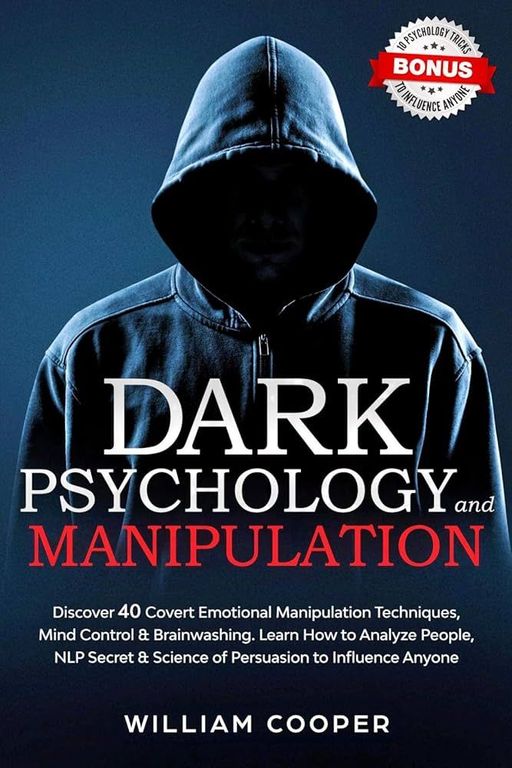
Dark Psychology and Manipulation
The Unseen Playbook: Decoding Dark Psychology
The Unseen Playbook: Decoding Dark Psychology
Nova: Welcome to the show! Imagine walking into a room and instantly knowing who holds the power, who is charming you, and who is subtly steering the conversation. That’s the world explored in William Cooper’s widely discussed book, "Dark Psychology and Manipulation." We’re not talking about textbook therapy sessions today; we’re diving into the shadows of human influence.
Nova: That’s the million-dollar question, Alex. From what the research shows, it’s the sheer volume and the explicit focus on the 'covert' nature of these tactics—the book reportedly details 40 specific techniques. It’s positioned as an encyclopedia for both recognizing manipulation and, perhaps controversially, learning how to deploy it. It’s tapping into a deep human desire: the need to feel safe and in control in social interactions.
Nova: That distinction is crucial, and it leads us right into our first deep dive. Because while the book is incredibly popular, the term 'Dark Psychology' itself isn't a formal, research-backed discipline in the way Clinical Psychology is. Let's break down what this book is actually claiming to teach.
Key Insight 1: The Context of 'Dark Psychology'
Defining the Darkness: Academic vs. Applied Psychology
Nova: Alex, the research confirms something important: Clinical Psychology is dedicated to diagnosing and treating mental health issues. It’s rigorous, evidence-based, and focused on healing. Dark Psychology, as presented in Cooper’s work and similar literature, operates in a completely different sphere.
Nova: The book zeroes in on what researchers often call the 'Dark Triad' traits—Narcissism, Machiavellianism, and Psychopathy—but frames them through actionable techniques. It’s less about diagnosing someone as a Machiavellian and more about showing you the specific linguistic patterns or emotional levers they pull. For instance, one concept often associated with this genre is exploiting cognitive biases.
Nova: Precisely. If a manipulator knows you have a strong need for social approval, they might use manufactured scarcity or flattery—a technique called 'love bombing'—to trigger that bias. They create an intense, positive feedback loop that makes you overlook red flags. Cooper’s book reportedly details how to recognize when your own brain is being tricked into compliance.
Nova: The summaries point to tactics that leverage the 'sunk cost fallacy'—making you invest time or emotion so you feel obligated to continue, even if the situation turns sour. It’s a classic move. The key takeaway here is that this 'Dark Psychology' is the application of known psychological principles, stripped of ethical considerations, for influence.
Key Insight 2: Deconstructing Manipulation Tactics
The 40 Covert Techniques: From Gaslighting to NLP
Nova: The book’s structure is built around these 40 techniques, which often blend established concepts like Neuro-Linguistic Programming, or NLP, with classic manipulation strategies. One technique frequently cited is 'Gaslighting,' but Cooper frames it within a broader context of perception control.
Nova: The 'covert' aspect is the secrecy and the intent to deceive the target about the manipulator's true motives. For example, a standard negotiation might involve anchoring a price high. A covert technique might involve 'feigned vulnerability'—pretending to be weak or in need to elicit sympathy, which then creates a sense of obligation in the target to comply with a later, unrelated request.
Nova: That’s where the critiques come in, Alex. While the book discusses techniques that behavior—like repetition, social proof, and emotional flooding—the terms 'mind control' and 'brainwashing' are often seen as hyperbole in the context of a self-help book. They are more accurately described as high-pressure, sustained forms of influence that overload a person's critical thinking faculties.
Nova: It is! NLP, or Neuro-Linguistic Programming, is about modeling successful communication. In the context of dark psychology, however, it’s often presented as a way to use specific language patterns—like embedded commands or pacing and leading—to bypass conscious resistance. Cooper’s approach seems to distill the most potent, often ethically dubious, applications of these communication models.
Key Insight 3: The Dual-Use Dilemma
The Ethical Tightrope: Defense vs. Offense
Nova: This brings us to the central ethical dilemma surrounding this genre of literature. The book is marketed heavily toward self-defense—learning to spot the manipulator so you can protect yourself. But if you teach someone 40 ways to manipulate, you’ve also taught them 40 ways to manipulate.
Nova: The reception seems split. Some readers praise it for providing the vocabulary to finally name the toxic dynamics they experienced in past relationships or workplaces. They feel empowered. Others, including some reviewers, suggest it’s a sprawling, sometimes disorganized, encyclopedia of tactics that might encourage a cynical worldview.
Nova: While I don't have a direct statistic from Cooper's work, general psychological studies on Machiavellianism suggest that those who score high on these traits often believe everyone else is manipulative too, creating a self-fulfilling prophecy of distrust. Cooper’s book, by focusing so heavily on the 'secrets,' might inadvertently reinforce that cynical framework for some readers.
Nova: The emphasis seems heavily weighted toward identification and understanding the mechanics. The defense often boils down to recognizing the pattern and disengaging. For example, if you recognize 'projection'—where the manipulator accuses you of the very thing they are doing—the defense is simply to refuse to engage with the false accusation and state your reality clearly. It’s about refusing to play their game.
Key Insight 4: Analyzing People and Persuasion Science
The Science of Influence: Persuasion vs. Control
Nova: The analysis part often involves looking for incongruence—when someone’s words don't match their non-verbal cues, or when their behavior shifts dramatically based on who they are talking to. Cooper reportedly emphasizes observing micro-expressions and baseline behavior to spot deviations when a manipulative tactic is deployed.
Nova: That’s another point of friction. The book is often described as a 'Beginner's Guide,' but mastering the nuance of reading subtle cues while simultaneously defending against complex emotional attacks is a high bar. True mastery of persuasion science, even the ethical side, takes deep practice.
Nova: Cooper’s work seems to take those natural tendencies and push them to the extreme, often by adding deception. Reciprocity in ethical persuasion means you genuinely feel grateful for a favor. In dark psychology, it’s often manufactured reciprocity—a small, unsolicited favor designed solely to create a debt that can be called in later for a much larger concession. It’s the difference between a gift and a trap.
Nova: It is. It forces you to confront the fact that the social world is not always built on good faith. The value, ultimately, seems to be in the awareness it forces upon the reader, even if the presentation is sensationalized.
Conclusion
The Takeaway: Awareness in a Complex World
Nova: We’ve covered a lot of ground today, Alex, moving from the academic distinction between Clinical Psychology and this popular concept of 'Dark Psychology,' right into the specifics of covert techniques like exploiting cognitive biases and manufactured reciprocity.
Nova: Absolutely. We learned that Dark Psychology, in this context, is the unethical application of known psychological principles to control or influence. The actionable takeaway isn't to become a master manipulator, but to become a master observer of intent. Look for consistency between words and actions, and never let manufactured urgency override your critical thinking.
Nova: A perfect summary. Understanding the darkness doesn't mean living in it; it means navigating the light with greater wisdom. This book serves as a stark reminder that awareness is the ultimate form of self-protection in social dynamics.
Nova: This is Aibrary. Congratulations on your growth!