The Tech Trap: Why Innovation Needs More Than Just Code
Golden Hook & Introduction
SECTION
Nova: What if I told you the fastest way to kill a brilliant new technology isn't bad code, or a lack of funding, but actually… too much success?
Atlas: Whoa, whoa, wait. Too much success? That just sounds like a paradox wrapped in a riddle. How can being successful be a bad thing for innovation? That completely goes against everything we're taught about business!
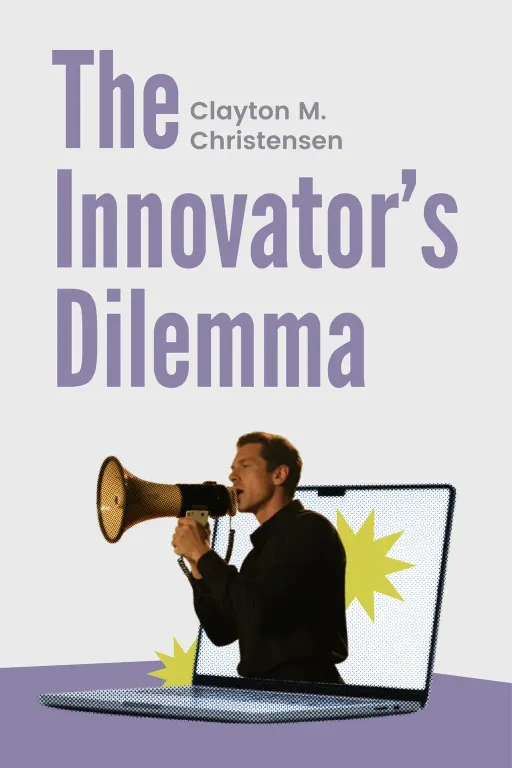
Nova: Absolutely, Atlas, and that's precisely the "Tech Trap" we're unwrapping today. It's the idea that innovation needs far more than just code or clever engineering. It requires a profound understanding of people and markets. We're drawing heavily from two titans of business strategy: Clayton M. Christensen's groundbreaking "The Innovator's Dilemma" and Geoffrey A. Moore's incredibly practical "Crossing the Chasm." These aren't just theories; they're frameworks born from rigorous research and real-world observation in places like Harvard Business School and the heart of Silicon Valley, fundamentally shifting how we view technological progress.
Atlas: Okay, so these aren't just abstract ideas. They're battle-tested. But how do these seemingly academic concepts relate to the everyday struggles of a startup, or even a curious learner trying to understand why some brilliant ideas just… fizzle out?
The Blind Spots of Success: Why Focusing on Your Best Customers Can Kill Innovation
SECTION
Nova: That's a perfect segue, because Christensen's work, "The Innovator's Dilemma," really shines a light on that fizzle. He observed something truly counterintuitive: often, great companies fail not because they do something wrong, but because they do everything.
Atlas: Doing everything right? That's going to resonate with anyone trying to navigate a competitive industry. What does "doing everything right" look like when it leads to failure?
Nova: Imagine the disk drive industry back in the 70s and 80s. You had these colossal companies, incredibly successful, making powerful, high-margin disk drives for their most demanding customers – the mainframe computer manufacturers. They were investing heavily in R&D, listening intently to their customers, and delivering exactly what the market leaders wanted: bigger, faster, more reliable drives. They were textbook examples of excellent management.
Atlas: So, they were serving their best customers perfectly. That sounds like a winning strategy. Where's the trap?
Nova: The trap was in their focus. While they were meticulously catering to the high-end, a new, much smaller disk drive technology emerged. These drives were slow, had less capacity, and were initially unreliable. Their profit margins were tiny, and frankly, they looked like toys compared to the giants. No rational, successful company would divert resources from their lucrative main business to chase these seemingly inferior products for a tiny, unproven market.
Atlas: I see. So, the established players looked at these new, smaller drives and thought, "That's not for us. Our customers don't want that." But then what happened?
Nova: Exactly. But these 'inferior' drives found a home in emerging markets – desktop PCs, then laptops. Markets that the big players initially dismissed as irrelevant. Over time, the technology improved rapidly, and those small, 'toy' drives became powerful enough to meet the needs of the mainstream. By the time the big companies noticed, it was too late. They were stuck with superior technology for a shrinking market, while the 'disruptors' had built an unassailable lead in the new, massive market.
Atlas: That's actually really inspiring, because it means the little guy can win, but it's also kind of heartbreaking for those established companies. They were following all the rules, and it still led to their downfall. So, the core lesson is that sometimes, focusing too much on your existing, high-profit customers can blind you to truly disruptive innovations.
Nova: Precisely. It's about overserving your best customers. You add features they don't necessarily need, making your product more complex and expensive, while simple, cheaper alternatives emerge to serve overlooked needs. That's the innovator's dilemma in action.
Bridging the Chasm: The Challenge of Moving from Early Adopters to the Mainstream Market
SECTION
Nova: And that naturally leads us to the second enormous challenge in innovation: even if you create a disruptive, elegant technology, getting it widely adopted is a completely different beast. This is where Geoffrey Moore's "Crossing the Chasm" comes in.
Atlas: I’ve heard that phrase, "crossing the chasm," but I always thought it just meant getting more customers. Is it more nuanced than that?
Nova: Oh, it's far more nuanced. Moore argues there’s a giant, perilous gap, a "chasm," between the "early adopters" of a technology and the "early majority" – the mainstream market. The people who eagerly snap up new tech are fundamentally different from the people who wait for it to be proven.
Atlas: So you're saying the psychology of the customer changes? Like, the person who camps out overnight for the new gaming console isn't the same person who buys it two years later when it's discounted?
Nova: Exactly! Early adopters are visionaries. They're excited by new possibilities, they tolerate bugs, and they'll even help you fix them. They're willing to take risks for a perceived strategic advantage. But then you hit the early majority – the pragmatists. They don't care about the tech for its own sake. They want proven solutions, seamless integration, and testimonials from people like them. They are risk-averse.
Atlas: That makes me wonder, how many brilliant inventions have fallen into that chasm? You know, products that early enthusiasts loved, but just couldn't break into the mainstream? What's the secret to crossing it?
Nova: Many, Atlas, many. The secret, according to Moore, isn't just more marketing or a bigger budget. It's a highly focused strategy. You have to pick a single, small beachhead market within the early majority, dominate it completely, and use that success as a springboard to attack adjacent markets. You have to tailor your entire offering – product, pricing, distribution, and messaging – specifically for that pragmatic early majority customer, not the early adopters. It means moving from selling a "vision" to selling a "solution."
Atlas: So, it's about understanding that what worked for the first few thousand customers will actively alienate the next million. You have to change your entire approach. It’s like trying to win a marathon with a sprint strategy.
Nova: A perfect analogy! It’s about building a whole product solution, ensuring it works flawlessly for a specific problem within a specific niche, and making it incredibly easy for the pragmatists to say yes. It's less about the 'what' of the tech, and more about the 'who' and the 'how' of the market strategy.
Synthesis & Takeaways
SECTION
Nova: So, bringing these two powerful ideas together, what we learn from Christensen and Moore is that the "Tech Trap" isn't a lack of brilliant minds or cutting-edge code. It's a fundamental misunderstanding of the market and the customer. Innovation isn't just about building faster; it's about understanding unarticulated needs, recognizing disruptive potential in humble beginnings, and strategically guiding a product through different customer psychologies. The insidious nature of this trap is that it seduces us into believing a better mousetrap automatically sells itself.
Atlas: That’s a powerful insight. It really reframes what we often think of as "innovation." It's less about the invention and more about the connection. For our curious listeners, what’s one tiny step they can take, right now, based on these profound insights?
Nova: The tiny step, inspired by our discussion, is this: look at one area where your current tech offering, or even your own skill set, might be 'overserving' its current best users or applications. Are you adding complexity where simplicity is needed? Are you optimizing for a niche when a broader, simpler solution could unlock new potential? Look for an opportunity to simplify, to target an overlooked need, or to bridge a gap you didn't even realize existed. It’s an exercise in humility and market empathy.
Atlas: That's a fantastic actionable takeaway. It shifts the focus from just building more, to building smarter and more empathetically. This has been a truly illuminating discussion, Nova.
Nova: Always a pleasure, Atlas. Thanks for joining us.
Atlas: This is Aibrary. Congratulations on your growth!