The 'Tech-First' Trap: Why Your Brilliant Agent Needs Strategic Adoption.
Golden Hook & Introduction
SECTION
Nova: Atlas, I've got a challenge for you. Think about the most brilliant piece of technology you've ever worked on, something truly groundbreaking.
Atlas: Oh, I've got a few candidates. The one that still makes my heart ache is this predictive analytics agent we built for supply chain optimization. It was almost clairvoyant in spotting bottlenecks before they even appeared.
Nova: Exactly! Now, how many of those brilliant, clairvoyant creations actually changed the world, or even just your company, the way they have? How many scaled beyond that initial, enthusiastic team?
Atlas: That's the painful part, isn't it? The one I'm thinking of, it never quite broke out of the pilot stage. It just... stayed brilliant, but small. It's a common story, I think.
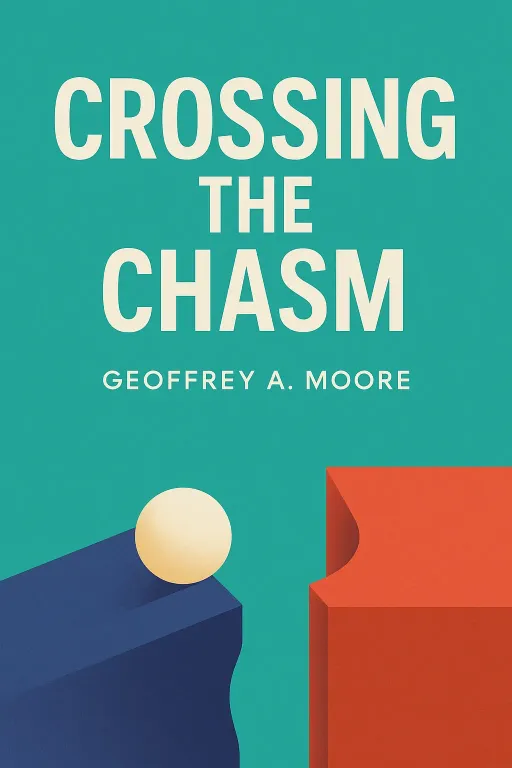
Nova: It’s more than common; it’s a cold, hard fact in the tech world. And it leads us perfectly into today's conversation, inspired by the enduring insights of Geoffrey Moore's "Crossing the Chasm" and Everett Rogers' "Diffusion of Innovations." Moore’s work, in particular, was a groundbreaking look at the practical realities of high-tech marketing, born from his observations in Silicon Valley during a period of intense technological disruption. These aren't just academic texts; they're battle plans for engineers and architects who dream of impact.
Atlas: That's fascinating. So, this isn't just about abstract theories, but about real-world struggles faced by innovators, especially in high-tech.
Nova: Precisely. Today, we're diving deep into why brilliant Agent tech often gets stuck in the 'early adopter' phase, and then we'll discuss the strategic engineering needed to help these innovations 'cross the chasm' and achieve mainstream acceptance. It’s about understanding that the journey of your Agent is as critical as the Agent itself.
The 'Chasm' of Tech Adoption: Why Great Agents Get Stuck
SECTION
Nova: So, let's go back to your clairvoyant Agent, Atlas. It was technically superior, right? Advanced algorithms, self-learning capabilities, probably cutting-edge in every way.
Atlas: Absolutely. We were so proud of the technical elegance, the sheer processing power it brought to bear on incredibly complex data sets. It was a marvel of engineering.
Nova: And yet, it didn't scale. This is where Moore's "chasm" comes in. He highlights that there's a huge psychological and practical gap between the 'early adopters' – the tech enthusiasts, the visionaries who love newness for its own sake – and the 'early majority.'
Atlas: Hold on, I can see that. Our early adopters were thrilled. They loved tinkering with it, pushing its limits. They were almost part of the development team. But then it came to getting broader buy-in…
Nova: Exactly. Imagine this: you've built an Agent, let's call it 'Aether,' designed for hyper-efficient, dynamic resource allocation in large-scale cloud infrastructures. Aether is brilliant. It learns, it predicts, it optimizes in real-time, saving companies millions. Your early adopters, the visionary CTOs and lead architects, are blown away. They see the potential, they're willing to overlook rough edges, they'll even integrate it themselves.
Atlas: I know those people. I those people, sometimes! We thrive on that cutting edge.
Nova: Right. But then you try to sell Aether to the 'early majority' – the pragmatic IT managers, the operations VPs. They don't care about technical elegance as much as they care about reliability, ease of integration, and a clear, demonstrable return on investment with minimal disruption. They’re not looking for a project; they're looking for a proven solution that fits seamlessly into their existing workflows.
Atlas: Oh, I see. So for them, it's not just about the raw power of Aether, but how much friction it introduces into their daily operations.
Nova: Precisely. For the early majority, the risk of disruption often outweighs the promise of future gains. They want to see someone else succeed with it first. They need a "whole product solution," not just a core technology. The technically superior Agent, Aether, languishes because its creators assumed its brilliance would naturally attract a broader market, neglecting these pragmatic needs. Developers get frustrated, thinking, "Why can't they see how good this is?"
Atlas: I can definitely relate to that frustration. As an architect, you spend so much time perfecting the internal logic, the scalability, the robustness. It's almost an assumption that if it's technically sound, its value will be self-evident. But you’re saying that assumption is a trap.
Nova: It’s absolutely a trap. The chasm isn't about technical flaws; it's about a mismatch in expectations and priorities. The early majority needs hand-holding, proof, and a complete package, not just a shiny new engine. They’re problem-solvers, but they want problems solved, not a new set of problems introduced by cutting-edge tech.
Strategic Engineering for Market Acceptance
SECTION
Nova: So, if technical perfection isn't enough to cross that chasm, what is? This is where strategic engineering for market acceptance comes into play, drawing insights from both Moore and Rogers. It's about shifting your focus from merely perfecting your Agent to strategically engineering its journey into the hands and workflows of your target users.
Atlas: Okay, so it’s not just about building a better mousetrap, but building a better for a specific kind of mouse. How do we even begin to 'engineer' that?
Nova: That’s a great way to put it. Rogers highlights factors like 'relative advantage,' 'compatibility,' and 'observability' that influence adoption rates. Moore takes this further with the concept of focusing on a specific niche and creating a "whole product solution." Let's revisit our Agent, Aether. Instead of trying to sell it to every cloud infrastructure company, its creators need to pick a very specific niche.
Atlas: Like, not just 'finance companies,' but 'mid-sized fintech startups in North America specializing in high-frequency trading'? Getting super granular?
Nova: Exactly. The more focused, the better. Let's say they target mid-sized manufacturing firms that are struggling with legacy ERP systems and inefficient resource allocation. Now, for niche, Aether isn't just a powerful optimization engine. It becomes part of a "whole product."
Atlas: So, the "whole product" isn’t just Aether itself, but everything that surrounds it to make it usable and valuable for those specific manufacturing firms?
Nova: You've got it. It includes pre-built integrations with their common ERP systems like SAP or Oracle. It means dedicated onboarding specialists who speak their language, not just developer jargon. It means a training program tailored to their existing IT teams, showing them how Aether enhances their current operations, not replaces them. It means robust, 24/7 support.
Atlas: That makes perfect sense! For a pragmatic IT manager at a manufacturing firm, they don't want to become an Agent expert; they want their production line to run smoother with minimal downtime. The "whole product" engineering means you’re addressing their actual pains and fears.
Nova: And you’re demonstrating 'relative advantage' – showing how Aether offers superior optimization compared to their current manual processes or older software. You're ensuring 'compatibility' by making it fit their existing tech stack and workflows. And 'observability' comes from successful pilot programs within that niche, which then become case studies. The success stories of early adopters within become the proof points for the early majority.
Atlas: That's a fundamental shift in mindset. It's not just about pushing the tech, but about pulling the users in by meeting them where they are. It’s about creating a smooth on-ramp, rather than expecting everyone to build their own ramp to your brilliant Agent. It sounds like this approach doesn't stifle innovation, but rather strategically channels it for maximum real-world impact.
Nova: It absolutely does. It’s about engineering adoption with the same rigor you apply to engineering the Agent itself. It’s about breaking down the boundaries between pure technical brilliance and the messy, human reality of market acceptance.
Synthesis & Takeaways
SECTION
Nova: So, Atlas, what’s your biggest takeaway from this dive into the 'Tech-First' Trap?
Atlas: Honestly, it’s a profound realization that as architects and value creators, our job isn't done when the code is perfect or the Agent is brilliantly designed. The real challenge, and where true value is unlocked, is in designing its into the hands of the people who need it most. It means we have to think beyond the technical specs and really understand the human and operational context.
Nova: Exactly. These insights fundamentally shift your focus from merely perfecting your Agent technology to strategically engineering its journey into the hands and workflows of your target users. It's about integrating your Agent into an entire ecosystem of support and understanding. The true breakthrough comes when you realize the market isn't just waiting to be impressed by your tech; it needs to be understood, served, and guided.
Atlas: That gives me a lot to think about. It’s about seeing the bigger picture beyond the lines of code.
Nova: Absolutely. And for our listeners, we have a tiny step to help you apply this immediately. Identify one specific early majority user segment for your Agent solution and list three specific needs they have that your current product doesn't fully address. That simple exercise can illuminate your path across the chasm.
Atlas: That's a powerful and actionable challenge. It forces you to step out of the lab and into the user's shoes.
Nova: It does. Because innovation isn't just about what you build; it's about who uses it and how.
Nova: This is Aibrary. Congratulations on your growth!