The Innovator's Paradox: Why Great Ideas Fail to Launch
Golden Hook & Introduction
SECTION
Nova: Atlas, five words. Describe the journey of a brilliant idea from inception to market success.
Atlas: Brilliant, ignored, adapted, adopted, celebrated. Maybe.
Nova: "Maybe." That's the kicker, isn't it? Because today, we're dissecting what we call "The Innovator's Paradox: Why Great Ideas Fail to Launch."
Atlas: And when you say "great ideas fail," you’re not talking about bad ideas, right? You mean genuinely groundbreaking, world-changing concepts. So why do they crash and burn? Don't these innovators have, you know, vision?
Nova: Absolutely, they have vision! And that's often part of the paradox. We're drawing heavily from the foundational works of thinkers like Geoffrey A. Moore and Eric Ries today. What's fascinating is that both of them came from engineering backgrounds. They started by building things, then realized the real challenge wasn't just in the making, but in the and.
Atlas: So this isn't just academic theory, then. These are battle-tested blueprints for anyone trying to build something new and actually make it stick.
Nova: Exactly. Because the cold, hard fact is, many groundbreaking innovations never reach their full potential. They fail to cross a crucial gap. And it's not about product quality; it's about understanding different customer psychologies and adapting your strategy to each.
Atlas: Different psychologies? So my amazing, disruptive tech might be perfect, but I'm just talking to the wrong people? That feels… counterintuitive.
The Chasm: Bridging Early Adopters to the Mainstream
SECTION
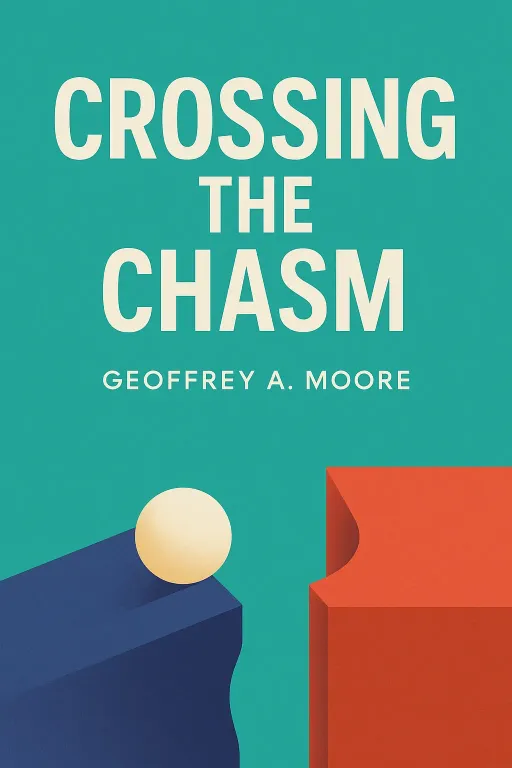
Nova: It absolutely is counterintuitive, but it's precisely what Geoffrey A. Moore illuminated in his seminal work, "Crossing the Chasm." He identifies this critical chasm, this abyss, between early adopters and the early majority.
Atlas: The early adopters, I get them. They're the enthusiasts, the visionaries, the ones who line up overnight for the new gadget. They're willing to overlook a few bugs because they see the potential, the future.
Nova: Precisely. They're driven by the sheer novelty and the competitive advantage a new technology offers. They're buying the dream. But the early majority? They're pragmatists. They're not looking for a dream; they're looking for solutions to existing problems, proven reliability, and a solid return on investment. They want references, case studies, and a clear path to integration.
Atlas: So the language you use, the value proposition, even the sales approach, has to be completely different? That’s a huge shift. For someone building a groundbreaking AI solution, how do they even begin to translate that grand vision into something a risk-averse corporation would touch?
Nova: It's an enormous shift. Think about the early days of electric vehicles. Early adopters were happy to buy a Tesla Roadster, even with its limited range and charging infrastructure challenges, because they saw it as the future of automotive. They were buying into the vision of sustainable, high-performance transportation.
Atlas: I remember that. It was a statement car. You weren't just buying a car; you were buying a piece of the future.
Nova: Right. But for the early majority, the family looking for their next sedan, they needed to know: "Can I drive it to Grandma's house without range anxiety? Is there a charger at the grocery store? Will it last as long as my gas car?" They weren't interested in being beta testers; they needed a proven, dependable solution. The chasm is the point where you stop selling the vision to enthusiasts and start selling the proven, practical solution to pragmatists.
Atlas: That makes sense. So how does an innovator, who's likely a visionary themselves, bridge that gap? It sounds like you need to completely rewire your brain.
Nova: Moore's genius was in identifying a strategy: you don't try to cross the chasm by appealing to everyone. You pick a very specific niche within that early majority, a "beachhead," and you dominate it. You become the undisputed leader in that tiny segment.
Atlas: Like a military strategy, almost. You don't invade a whole country at once; you secure a small, defensible position first.
Nova: Exactly! You focus all your resources on solving that specific niche's problems completely, becoming indispensable to them. Once you've proven your value there, you use that success as a springboard to conquer adjacent segments. It's about building credibility and a track record, one pragmatic step at a time, rather than trying to boil the ocean.
Validated Learning: The Lean Approach to Market Resonance
SECTION
Atlas: Okay, so you've identified the chasm, you've picked your beachhead. But how do you actually build that bridge without just throwing everything at the wall and hoping something sticks? That’s where it gets really tactical, isn’t it?
Nova: It does, and that's where Eric Ries's "The Lean Startup" becomes an indispensable guide. Ries emphasizes something he calls "validated learning" and continuous iteration. It’s about building, measuring, and learning your way to success.
Atlas: Validated learning. So, not just building what you people want, but actually proving it with data?
Nova: Precisely. It's about treating every aspect of your innovation as an experiment. You formulate a hypothesis about what customers want, you build a Minimum Viable Product—an MVP—the simplest thing you can create to test that hypothesis, you measure the results, and then you learn from them. Crucially, you're prepared to pivot if your assumptions are wrong.
Atlas: I love that. It’s like a scientific method for business. But that sounds great for a small app or a digital product. If you're developing, say, a new sustainable energy system, 'iterating quickly' could mean billions of dollars. How does that translate?
Nova: That’s a common misconception, Atlas. "Lean" isn't about being small or cheap; it's about being smart and efficient with your resources by reducing waste from building the wrong thing. Even for massive projects, you can break them down into smaller, testable assumptions. For a sustainable energy system, your MVP might not be the full power plant. It could be testing a small component, a specific customer interaction, or even just a detailed simulation with potential clients.
Atlas: So you're saying, before you pour billions into building the full energy system, you test your core assumption that, say, industrial users will pay a premium for carbon-neutral energy, even if it's slightly more expensive initially?
Nova: Exactly. You might create a detailed mock-up of the service, run surveys, conduct interviews, or even build a small-scale pilot project to get real data on that specific assumption, not just the technology itself. Think about Dropbox. Before they built their entire file-syncing infrastructure, they released a simple video demonstrating how it would work. That video, their MVP, generated massive interest and validated a huge market need before they wrote most of the code.
Atlas: That’s brilliant. It's about testing the riskiest assumptions first, then building. It saves you from that innovator's paradox of having a brilliant product that nobody actually or understands how to use. It’s about humility, isn’t it? Being willing to admit your initial idea might be wrong.
Nova: Absolutely. It takes immense humility to say, "My brilliant idea might be flawed, and I need to let the market tell me what it truly wants." It’s a continuous conversation with your customer, constantly adapting and refining your offering until it truly resonates.
Synthesis & Takeaways
SECTION
Nova: So, when we put these two ideas together, "Crossing the Chasm" tells you to aim – find that pragmatic early majority niche. And "The Lean Startup" tells you to refine your aim and adapt your approach to actually hit that target.
Atlas: It’s really about understanding that your brilliant idea, by itself, isn't enough. You need to be a market psychologist and a relentless experimenter. It’s not just building the future; it's strategically navigating the market's psychological landscape.
Nova: That's the perfect synthesis, Atlas. Success in innovation isn't a straight line from idea to market. It's a winding path, fraught with chasms and unforeseen detours, that demands both strategic foresight and agile adaptation.
Atlas: For our listeners who are developing complex solutions, building the future, or bridging complex ideas, here's a tiny step: identify one key feature of your current project. How would you explain its value differently to an 'early adopter' versus an 'early majority' customer?
Nova: What are the visionaries excited about? What are the pragmatists worried about or looking for? That exercise in empathy and strategic communication can unlock incredible insights.
Atlas: It makes you realize innovation isn't just about the 'what,' but the 'who' and the 'how' you connect with them.
Nova: And the willingness to keep learning.
Atlas: Always.
Nova: This is Aibrary. Congratulations on your growth!