Stop Chasing, Start Cultivating: The Guide to Organic Growth
Golden Hook & Introduction
SECTION
Nova: Alright, Atlas, quick game. If you had to sum up the core idea of "Stop Chasing, Start Cultivating" in exactly five words, what would they be? No pressure, just witty brilliance.
Atlas: Oh, I like that! Five words… hmm. "Focus your energy, grow with purpose."
Nova: Ooh, I love that. "Grow with purpose." That's excellent. Mine would probably be "Less frantic, more strategic growth." We're talking about a fundamental shift in how businesses, especially startups and growing companies, approach one of their most critical challenges: user acquisition and sustainable expansion.
Atlas: That sounds like exactly what a lot of our listeners, the strategic builders and resilient visionaries, are grappling with. Everyone feels the pressure to just, but that often means chasing every shiny new channel. Where are these insights coming from?
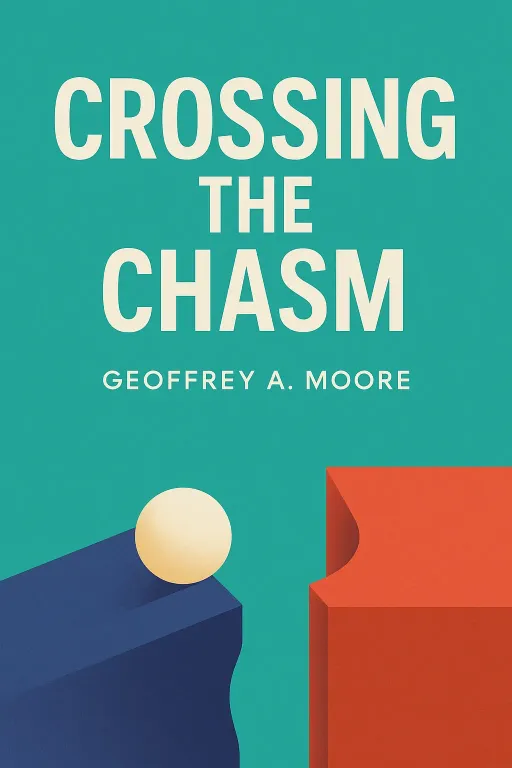
Nova: Today, we’re unpacking wisdom from two absolute foundational texts in the world of business growth. First, we’re drawing from "Traction" by Gabriel Weinberg and Justin Mares. Weinberg, of course, is the founder of DuckDuckGo, so he’s lived and breathed the challenge of growing a product against giants. And then, we’ll be looking at "Crossing the Chasm" by Geoffrey A. Moore, a Silicon Valley legend whose insights have shaped how countless tech companies navigate the treacherous waters of market adoption.
Atlas: Two giants, then. So, we're talking about how to not just get users, but how to get the users, and keep them.
Nova: Exactly. Today we'll dive deep into this from two crucial perspectives. First, we'll explore how to focus your efforts with laser precision in user acquisition, then we'll discuss the critical importance of understanding who you're actually trying to reach to build truly enduring success.
The Bullseye Framework: Precision, Not Shotgun Blasts, in User Acquisition
SECTION
Nova: So, let's start with what Gabriel Weinberg and Justin Mares lay out in "Traction." It's a cold, hard fact many founders face: they fall into this trap of chasing every single shiny new user acquisition channel. It’s like throwing spaghetti at the wall to see what sticks, right? You try social media, then SEO, then maybe some PR, then cold outreach, then content marketing… and you end up getting mediocre results everywhere.
Atlas: But wait, isn't 'trying everything' exactly what you're supposed to do as a startup or a growing business? You don’t know what works until you test it all, do you? For our listeners who are managing high-pressure teams and limited budgets, that shotgun approach might feel like the only way to cover all bases. What's the risk in that?
Nova: The risk is immense, Atlas. It's a massive waste of resources – time, money, mental energy. And worse, it rarely builds a truly loyal customer base. You get a trickle from everywhere, but no real momentum anywhere. That’s where the Bullseye Framework comes in. It urges you to test multiple channels, yes, but then to critically evaluate, and on the one or two that show the most promise.
Atlas: Okay, so it’s not about ignoring other channels forever, but about getting to critical mass in one or two first. Can you give an example of how that looks in practice? Because for a lot of people, the idea of being everywhere feels counterintuitive.
Nova: Imagine a new B2B SaaS company that’s trying to acquire users. Initially, their marketing team is stretched thin. They’re blogging, running LinkedIn ads, cold emailing, attending virtual conferences, and even dabbling in podcast sponsorships. Each channel gets a little bit of attention, but none get enough to truly shine. They’re seeing a few leads from LinkedIn, some downloads from a podcast, but nothing that moves the needle significantly.
Atlas: That sounds rough. A lot of effort for scattered, lukewarm results.
Nova: Exactly. So, they apply the Bullseye. They pick a handful of their most promising channels – say, LinkedIn ads, content marketing, and strategic partnerships – and they run small, focused experiments on each. They allocate dedicated resources for a short period, rigorously track specific metrics for success, and analyze the results. And let's say they discover that while LinkedIn ads bring in some leads, the of leads from strategic partnerships is through the roof, converting at a much higher rate and leading to larger deal sizes.
Atlas: So they don't abandon LinkedIn ads entirely, but they shift their primary focus and resources.
Nova: Precisely. They then take almost all their acquisition budget and team focus and pour it into those strategic partnerships, refining their approach, building stronger relationships, and scaling that channel. They might still do some LinkedIn ads, but it’s no longer the chaotic, unfocused scramble. It’s about achieving depth in one or two channels before spreading wide again. It fundamentally shifts your focus from broad outreach to targeted, efficient channel validation. And that, for a strategic builder, means power.
Crossing the Chasm: Understanding Your Audience for Enduring Growth
SECTION
Nova: Once you’ve found your bullseye channel, the next question is, 'who are you actually hitting?' This brings us to another foundational insight, one that often acts as a critical counterpoint to simply finding a channel: Geoffrey A. Moore’s "Crossing the Chasm." Moore explains that early adopters are fundamentally different from the mainstream market. And understanding this distinction is absolutely crucial.
Atlas: Why does that matter so much? Aren't customers just customers, looking for solutions? What makes early adopters so different that it breaks growth if you don’t understand them? For someone building a culture and aiming for sustainable impact, understanding these nuances feels crucial for internal strategy, too, not just external marketing.
Nova: It matters because early adopters are often visionaries. They crave new technology, they’re willing to tolerate bugs, and they’re eager to experiment. They’re driven by the of what a product could be. The mainstream, however, is pragmatic. They want proven solutions, they need clear benefits, and they value reliability and ease of use. They don't want to be pioneers; they want to be part of a winning solution. The "chasm" is that enormous gap between these two groups. Many innovative products gain initial traction with early adopters, but then fail spectacularly trying to jump to the mainstream because they keep talking to the pragmatists like they’re visionaries.
Atlas: Wow. So, it’s not just about finding channel, it’s about finding a channel tailoring your message and even your product for the specific type of customer segment you're targeting at that stage. That’s a bit like trying to sell a high-performance sports car to someone who just needs a reliable family minivan.
Nova: That’s a perfect example! Imagine a company that develops an incredibly innovative AI tool for data analysis. Their early adopters are data scientists and tech enthusiasts who love playing with new algorithms, even if the user interface is clunky. They're excited by the raw power and potential. The company gets great buzz in tech circles.
Atlas: But then they try to scale, and suddenly, they hit a wall.
Nova: Exactly. They keep marketing the AI tool based on its revolutionary algorithms to a wider audience of business analysts and managers. But these pragmatic users don't care about the algorithms; they care about clear, actionable insights, a user-friendly dashboard, and seamless integration with their existing systems. They don’t want to tinker; they want to solve a problem without a steep learning curve.
Atlas: Okay, so the company needs to completely re-evaluate its messaging, its sales channels, and maybe even simplify its product features to appeal to the mainstream. So, if you're a strategic builder, how do you even begin to identify if you're talking to an early adopter or a mainstream customer? What's the practical difference in approach?
Nova: Great question. The practical difference is huge. For early adopters, you might focus on thought leadership, cutting-edge features, and direct engagement with tech communities. You highlight innovation. For the mainstream, you focus on proven case studies, return on investment, ease of use, and reliability. You highlight solutions and stability. Moore suggests you have to pick a "beachhead" in the mainstream market – a specific niche segment that has a compelling reason to adopt your product, even if it's new. You cross the chasm by dominating small segment, then use that success as a springboard to adjacent segments. It helps you target your initial growth efforts more effectively, building a foundation for later scale.
Synthesis & Takeaways
SECTION
Nova: So, when you put Weinberg and Mares' Bullseye Framework together with Moore's "Crossing the Chasm," you get a powerful one-two punch for organic growth. The Bullseye tells you to find your most effective acquisition channels with precision, and "Crossing the Chasm" tells you you're actually trying to reach through those channels, and how to speak to them to build truly enduring relationships.
Atlas: This really reframes growth from a chaotic sprint to a strategic, cultivated marathon, doesn't it? It's about building something that lasts, not just something that booms and busts. For anyone who's felt the burnout of chasing every trend, this is a breath of fresh air. It's about focusing power where it matters most, and understanding your audience deeply to build a loyal culture around your product.
Nova: Absolutely. It’s about avoiding that wasteful shotgun approach and instead focusing on targeted, efficient validation. It’s about building a foundation, not just a facade of growth.
Atlas: So, for our listeners, the strategic builders and visionary leaders, what's one practical, tiny step they can take to start cultivating instead of chasing?
Nova: I love that. Here's your tiny step: List your top three current acquisition channels. For each one, identify one metric that truly defines success for, not just overall revenue. Are you looking for qualified leads, brand awareness, direct sales, community engagement? Get crystal clear on what 'success' means for each, and you'll immediately see where your focus needs to shift.
Atlas: That's powerful. Clarity in growth, right there.
Nova: Exactly.
Atlas: This is Aibrary. Congratulations on your growth!