

The Architecture of Mind: Deconstructing Our Cognitive Defaults with Prime
Golden Hook & Introduction
SECTION
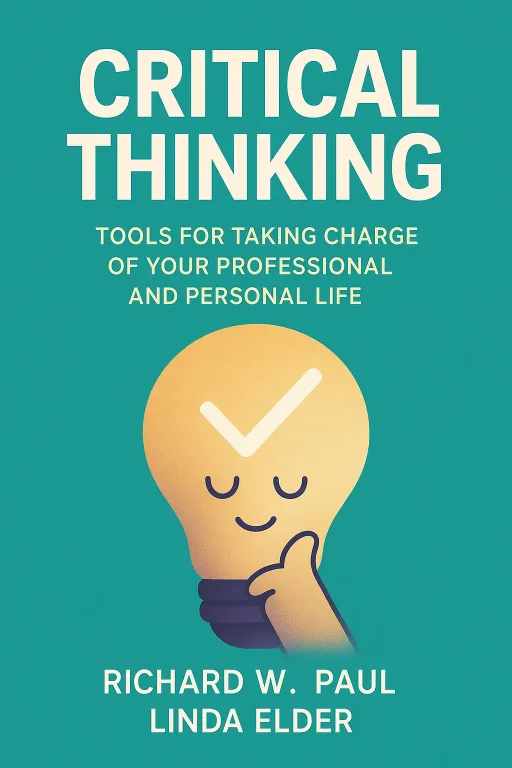
Dr. Warren Reed: If you don't actively program your mind, the world will program it for you. Most of us are running on a default cognitive operating system that we didn't write, filled with subconscious bugs, biases, and self-serving rationalizations. Welcome to the show. I'm Dr. Warren Reed, and joining me today is Prime, a project manager in finance with a deep passion for technology, space, and philosophy. Today, we are tackling Richard Paul and Linda Elder's masterwork, Critical Thinking: Tools for Taking Charge of Your Professional and Personal Life. We're going to dive deep into this from two key perspectives. First, we'll explore the default bugs in our individual cognitive operating systems, specifically egocentrism and the elements of thought. Then, we'll scale that up to look at sociocentric gravity and why professional expertise so often fails under systemic pressure. Prime, great to have you here.
Prime: Thanks, Warren. It's great to be here. You know, when I look at this book, I don't just see a text on philosophy or education. I see a system architecture manual. In project management, if your initial requirements are flawed, the entire project fails, no matter how good the execution is. The authors are essentially arguing that most of us are executing life with deeply flawed, unexamined requirements. We are our own worst enemies because we don't audit our inputs.
Dr. Warren Reed: Exactly. No-fluff reality check: most thinking is subconscious. We react. We don't analyze. The authors argue that the quality of your life is determined by the quality of your thinking. If you don't control your thoughts, you don't control your outcomes. Let's start with the individual level. The default setting of the human mind is egocentrism. It's the ultimate cognitive bug.
Deep Dive into Core Topic 1
SECTION
Prime: It really is. And what's fascinating about egocentrism is that it operates entirely below the level of conscious awareness. The mind naturally assumes that its view of the world is objective reality. In systems terms, it's a closed feedback loop. We don't see things as they are; we see things as we want to see them to protect our ego. The book breaks this down into predictable pathological tendencies, like egocentric righteousness, where we feel an inner sense of absolute correctness, and egocentric myopia, where we simply refuse to look at opposing evidence.
Dr. Warren Reed: Let's make this concrete. The authors use a brilliant, highly relatable case study in the book: Max and Maxine's Movie Night. It's a micro-level demonstration of egocentric manipulation. Every Friday, they go to the video store. Max wants action movies. Maxine wants romance. Max doesn't just say, "I want my way." He builds an entire, highly sophisticated rationalization. He tells Maxine that action movies are more thrilling, that romance movies are boring, that his choices won't make her sad. He uses his knowledge of her desire to please him to manipulate her. He gets his way, and his egocentric mind tells him he's just being logical.
Prime: Right, and that's what the authors call "successful" egocentrism. Max gets what he wants in the short term. But look at the system-level consequences. Maxine starts to feel ignored. Resentment builds. The relationship enters a state of covert warfare. Maxine might start finding subtle ways to punish Max, or she might eventually rebel, which makes Max's egocentrism "unsuccessful" in the long run because it destroys the harmony of his environment. It's a perfect example of how short-term selfish gains lead to long-term systemic failure.
Dr. Warren Reed: Yes. Dominating egocentrism. But the book also talks about submissive egocentrism. The teenage girl who pretends to love fishing just to please her boyfriend. She's sacrificing her authenticity for security and validation. Both patterns are irrational. Both avoid reality. So, how do we debug this? The authors give us a toolset: the Elements of Thought.
Prime: This is where the book gets highly analytical, which I love. Every piece of reasoning has a structure. If you can map the structure, you can find the bugs. The elements include purpose, questions, information, inferences, assumptions, concepts, and implications. As a project manager, I see this as a diagnostic checklist. When a project goes off the rails, I have to ask: What was our actual purpose? What assumptions did we make that we took for granted? What inferences did we draw from our data?
Dr. Warren Reed: Let's distinguish between inferences and assumptions. Crucial distinction. Most people confuse them. An assumption is what we take for granted we start thinking. An inference is the conclusion we draw on those assumptions. Let's look at the classic Jack and Jill analysis from the book. Jack and Jill go up the hill to fetch water. Jack falls down. Jill comes tumbling after. If we infer that Jill tripped because Jack fell, we are making an inference. But that inference is based on the unexamined assumption that they were close together, or that her fall was directly caused by his.
Prime: Exactly. And in real life, those unexamined assumptions are where the danger lies. Think about a relationship dispute. The book tells the story of Jack and Jill's disagreement after a party. Jack spends the evening talking to a woman named Susan. On the way home, Jill accuses Jack of flirting. Jack denies it, calling Jill paranoid. Jill infers that Jack is a "lady's man" who doesn't value her. Jack infers that Jill is insecure and controlling. Both are drawing completely different inferences from the exact same event because they are operating on different, unexamined assumptions and points of view.
Dr. Warren Reed: They are trapped in their own egocentric loops. To break the loop, you have to apply universal intellectual standards. Clarity, accuracy, precision, relevance, depth, breadth, logic, significance, and fairness. If Jill asks herself, "Is my inference accurate? What evidence do I actually have?" and if Jack asks himself, "Am I being fair to Jill's perspective? Am I ignoring her feelings to protect my ego?" they can move from weak-sense critical thinking to strong-sense critical thinking.
Prime: Strong-sense critical thinking requires intellectual virtues. It's not just about being clever or winning arguments. That's weak-sense—using critical thinking skills selfishly to defeat others. Strong-sense requires intellectual humility, courage, empathy, and integrity. You have to be willing to challenge your own most sacred beliefs. For an analytical thinker, this is the ultimate challenge. It's easy to use logic to defend your biases. It's incredibly hard to use logic to dismantle them.
Deep Dive into Core Topic 2
SECTION
Dr. Warren Reed: Let's scale this up. Individual egocentrism is bad enough. But when it multiplies across a group, it becomes sociocentrism. Sociocentric gravity. Groups, organizations, and entire nations define their own reality. They create "in-house" truths that cannot be questioned. No-fluff truth: sociocentrism is a pathology amplified by group sanction.
Prime: This is highly visible in corporate and financial history. The book discusses how organizations develop self-serving representations of reality. They create a "mob mentality" where dissent is silenced. If you question the dominant ideology, you are viewed as disloyal. In finance, we see this during market bubbles. Everyone convinces themselves that "this time is different." The group validates the irrationality, and because everyone is doing it, it feels safe. It's a massive failure of intellectual autonomy.
Dr. Warren Reed: Look at the case study of the American Auto Industry's decline from 1960 to 1980. Detroit dominated the world. The Big Three—General Motors, Ford, and Chrysler—were making massive profits. But Japanese automakers started producing smaller, fuel-efficient, high-quality cars. How did the American executives react? They dismissed the threat. They rationalized. They assumed American consumers would always want big, gas-guzzling cars. They blamed their declining market share on lazy American workers rather than their own poor management. They were blinded by their own sociocentric success.
Prime: It's a classic case of what the authors call "activated ignorance." They possessed information, but they interpreted it through a biased, self-serving framework. They ignored the changing consumer preferences and the superior efficiency of Japanese manufacturing. By the time they recognized the reality, they had lost massive market share and had to undergo painful restructuring. Their bureaucratic routine had completely stifled independent, critical judgment.
Dr. Warren Reed: And it's not just manufacturing. Let's look at the financial sector. The U. S. Savings and Loan Debacle. The S&L industry lobbied Congress to remove regulatory restrictions, wanting to make high-risk loans without holding adequate collateral. They promoted the ideology of "deregulation" as an absolute good. The public was forced to guarantee their solvency while the institutions made reckless, self-serving decisions. The system collapsed, leaving a massive debt burden—approximately nine thousand dollars for every citizen. That is sociocentric greed rationalized as economic progress.
Prime: It shows the incredible power of language in sociocentric systems. The industry didn't call it "reckless gambling." They called it "financial innovation" and "deregulation." The book emphasizes how groups use language to justify unethical acts. We choose self-serving names for our actions and paint our competitors or critics as the enemy. It's a complete lack of intellectual integrity. We hold others to standards we refuse to apply to ourselves.
Dr. Warren Reed: This brings us to the power and limits of professional knowledge. The book dedicates an entire chapter to this. We trust professionals—doctors, lawyers, financial advisors, engineers. But there is a massive gap between the ideal of professional knowledge and its actual application. Professionals are human. They are subject to the same egocentric and sociocentric forces as everyone else.
Prime: Yes, the book points out that many professions fall short of their promised benefits due to vested interests and self-deception. Take the medical field, for example. The authors cite a report by the National Academy of Sciences stating that medical mistakes cause up to ninety-eight thousand unnecessary deaths per year in the U. S. alone. That's a staggering number. The report suggested that these errors could be reduced by fifty percent if healthcare providers simply collected and analyzed data on unsafe practices, much like the aviation industry does. But professional ego and fear of litigation often prevent that level of transparency.
Dr. Warren Reed: And look at the historical resistance to new ideas within the medical establishment itself. The book mentions Ignaz Semmelweis in the 1850s. He discovered that physicians' unwashed hands were causing fatal infections in new mothers at the University of Vienna. Did the medical community thank him? No. They ostracized him. He lost his position. Or Barry Marshall in 1983, who discovered that ulcers were caused by bacteria, not stress. His peers ignored him for seven years. Professional groups often act like guilds, protecting their established dogmas and status rather than pursuing the objective truth.
Prime: It's a powerful warning for anyone working in a specialized field. True loyalty to a profession doesn't mean uncritically defending its current practices. That's false loyalty. True loyalty means holding the profession to its highest ethical and intellectual standards, ensuring it actually serves the public interest. In finance, that means questioning models that ignore systemic risk. In project management, it means being willing to report that a project is failing, even when leadership wants to hear that everything is on track.
Synthesis & Takeaways
SECTION
Dr. Warren Reed: Let's synthesize. We've covered a lot of ground. We've looked at the individual battle against egocentrism and the collective battle against sociocentrism. The core message of Paul and Elder's book is that critical thinking is a daily, lifelong practice. It's not a switch you turn on; it's a skill you build through deliberate effort.
Prime: Absolutely. The authors outline six stages of development. Most people start as Unreflective Thinkers—completely unaware of the biases shaping their thoughts. To move to the Challenged Thinker stage, you have to acknowledge your own cognitive blind spots. Then comes the Beginning Thinker, who actively tries to improve, followed by the Practicing Thinker, who commits to a regular regimen of mental practice. It's a long-term project. There are no shortcuts.
Dr. Warren Reed: No pain, no gain. Just like physical fitness. If you want to build intellectual muscle, you have to endure the discomfort of challenging your own assumptions. Let's leave our listeners with some direct, actionable strategies they can apply immediately.
Prime: First, perform a daily cognitive audit. At the end of each day, ask yourself: When did I think worst today? Did I allow my ego or anger to dictate my reactions? Did I make unexamined assumptions? Second, practice intellectual empathy. When you disagree with someone, try to write out their argument as clearly and fairly as possible, using their assumptions. If you can't state your opponent's case to their satisfaction, you don't truly understand the issue.
Dr. Warren Reed: Excellent. My addition: analyze the logic of your decisions before you make them. Write down your purpose, your information sources, your assumptions, and the potential implications of your choices. Make the subconscious conscious. Don't let default programming run your life. Prime, thank you for bringing your analytical perspective to this discussion.
Prime: Thank you, Warren. It's been a pleasure. It's a framework that definitely keeps you honest with yourself.
Dr. Warren Reed: To our listeners, the challenge is simple: pick one decision you have to make this week and run it through the Elements of Thought. Audit your assumptions. Question your inferences. Take charge of your thinking, and you'll take charge of your life. Until next time, keep thinking critically.









