

Mastering the Art of Reason
Golden Hook & Introduction
SECTION
Nova: Atlas, quick, first thing that comes to mind: "complex problem." Go!
Atlas: Oh man. Headache. Dead end. More coffee. My taxes. Definitely my taxes.
Nova: Absolutely! And what if I told you that gut reaction, that feeling of overwhelm, is precisely what's holding us back from truly clear, incisive thinking?
Atlas: That sounds rough, but I can definitely relate. It feels like my brain just hits a wall sometimes when I’m trying to untangle something big. So, how do we get past the "more coffee" stage?
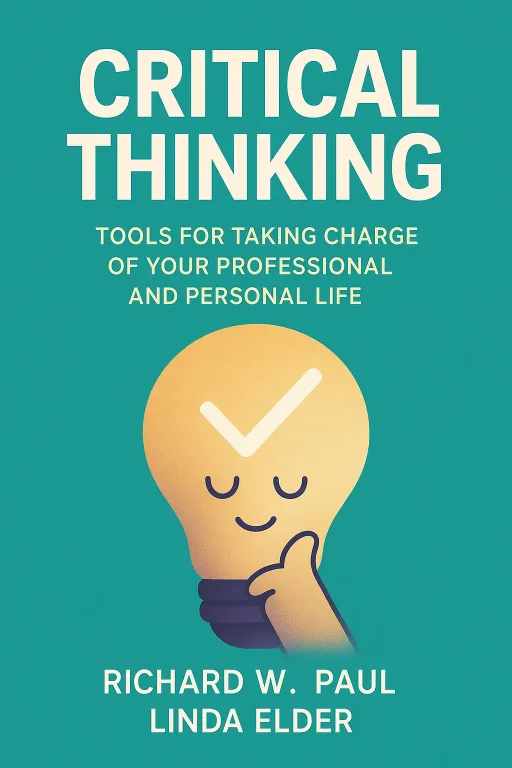
Nova: Well, today, we're diving into the art of mastering reason, pulling wisdom from some incredible thinkers. We'll explore frameworks from Richard W. Paul and Linda Elder, who emphasize dissecting problems with their 'Elements of Thought,' and then jump into the surprisingly liberating ideas of Edward B. Burger and Michael Starbird from "The 5 Elements of Effective Thinking," especially their concepts of 'Failing Forward' and 'Understanding Deeply.'
Atlas: Ooh, 'Failing Forward' always sounds good in theory, but I'm curious how it actually works. And 'Elements of Thought' – that sounds like a secret weapon for anyone who feels swamped by decisions or new information. I imagine a lot of our listeners, especially those who love exploring new ideas and building better habits, are constantly wrestling with complex choices, whether it's a career pivot or just trying to understand a new trend.
Nova: Exactly! It’s about transforming that initial "headache" into a clear pathway. These aren't just academic theories; they're practical tools for anyone driven by growth and seeking mental clarity.
Deconstructing Complexity: The Elements of Thought
SECTION
Nova: So, let's start with those "Elements of Thought" from Paul and Elder. Imagine you're standing in front of a giant, tangled knot. Most of us just tug at one strand, get frustrated, and give up. Paul and Elder suggest something different: systematically identifying every single strand, every loop, every tension point.
Atlas: That makes sense. It’s like trying to fix a complex machine without knowing what any of the parts are. But what these elements? Give me the breakdown.
Nova: Absolutely. They propose eight fundamental elements present in thinking. Think of them as the DNA of any thought process. First, every thought has a – a goal or objective. What are you trying to accomplish? Second, it addresses a – the problem you’re trying to solve. Third, it uses – data, facts, observations. Fourth, it’s based on certain – theories, definitions, ideas.
Atlas: Okay, so purpose, question, information, concepts. That already feels more organized than my usual "panic and Google everything" method.
Nova: Right? And we’re only halfway there! Fifth, all thinking rests on – beliefs you take for granted. Sixth, it leads to – conclusions you draw. Seventh, it's shaped by a – your perspective. And finally, it has – what follows from your thinking.
Atlas: Wow, that’s a lot to unpack. I’m curious, how does someone actually this? Let's say I'm trying to decide if I should switch careers, which is a huge, complex decision for many people focused on long-term growth. Where do I even begin applying these eight elements?
Nova: That’s a perfect scenario, Atlas. Let's take your career choice example. Most people approach this with a vague "I need a new job" or "I'm unhappy." But if you apply the Elements of Thought, you’d start by asking:
Nova: What is my in considering a career change? Is it more money? More fulfillment? Better work-life balance? Be specific.
Nova: What is the primary? Is it "Which industry is hiring?" or "How can I leverage my current skills into a more meaningful role?" or "What kind of impact do I want to make?"
Atlas: Okay, I see. Immediately, it forces you to define what you're actually trying to solve, instead of just feeling generally dissatisfied.
Nova: Exactly. Then, what do you have? Your current salary, industry trends, job descriptions, feedback from mentors. What are at play? Ideas about "passion," "security," "career ladder," "disruption."
Atlas: That makes me wonder about assumptions. I bet a lot of people assume they can’t switch fields because they don’t have the "right" experience. Or they assume a new field will automatically solve all their problems.
Nova: You've hit on a critical point. Many career decisions are derailed by unexamined. Perhaps you assume you need a specific degree, or that a certain industry is inherently stable. By consciously listing these, you can then question them. Maybe you need that degree; maybe transferable skills are more valuable.
Nova: Then you look at your: "If I switch to tech, I'll be happier and make more money." Is that inference sound, given your information and assumptions? And your: are you seeing this from a scarcity mindset, or an abundance mindset? From a place of fear, or opportunity?
Atlas: So, it’s like creating a mental blueprint of your decision-making process. It forces you to be incredibly honest with yourself. And I suppose the implications part is crucial for long-term vision.
Nova: Absolutely. Finally, what are the of this decision? Both positive and negative, short-term and long-term. If you pursue X, what doors close, what doors open? What is the domino effect? By laying all this out, what felt like an insurmountable, emotional quagmire becomes a structured problem to analyze. It's about moving from gut feeling to deliberate thought.
Atlas: That’s actually really inspiring. It takes the abstract anxiety of a huge decision and makes it almost like a checklist. I can see how that would give someone a much clearer path forward, rather than just spinning their wheels. It's about empowering that "Clear Thinker" in all of us.
Mastering Understanding: Failing Forward & Deep Explanation
SECTION
Nova: And that naturally leads us to the second key idea we need to talk about, which often acts as the ultimate test of whether you've truly mastered those elements of thought. Once you've deconstructed a problem, how do you know you understand it? This is where Burger and Starbird's insights come in, especially 'Failing Forward' and the 'Understanding Deeply' rule.
Atlas: Okay, 'Failing Forward' – my ears are perked. I think a lot of us, myself included, have been conditioned to avoid failure at all costs. It feels like a personal flaw. How does embracing it actually lead to deeper understanding?
Nova: It challenges that very notion! Burger and Starbird argue that failure isn't the opposite of success; it's a crucial stepping stone. We often aim for perfect understanding from the get-go, but real learning is iterative. 'Failing Forward' means you're not afraid to try, make mistakes, and then to refine your approach. It's about seeing errors as data points, not personal failings.
Nova: Imagine someone trying to learn a new, complex skill, like a data scientist trying to master a new machine learning algorithm. They could read all the textbooks, watch all the tutorials. They they understand it. But then they try to implement it, and it crashes, or the results are nonsensical.
Atlas: Oh, I've been there! That's the moment of truth, right? Where the theory meets the messy reality.
Nova: Exactly. That "failure" isn't a sign they're unintelligent. It's an opportunity. What specifically went wrong? Was it a misunderstanding of the data? A coding error? A conceptual flaw in their approach? By diligently analyzing these failures, they deepen their understanding in a way that simply reading never could. They're failing, using each misstep to propel them closer to mastery.
Atlas: So, it's not just "try again." It's "try again, but smarter, because you just learned what work." That sounds much more aligned with building effective habits, actually. It's about refining the process.
Nova: Precisely. And this leads directly to their ultimate test of 'Understanding Deeply.' The takeaway they offer is incredibly powerful: Can you explain the basics of this new field, this complex problem, this intricate algorithm, to a child? If not, you haven't mastered the core concept yet.
Atlas: Wait, so you’re saying if I can't break down, say, quantum physics into terms a 10-year-old could grasp, I don't really understand it myself? That sounds a bit out there. What if the child just doesn't get it because they're, well, a child?
Nova: It’s not about the child’s comprehension level, Atlas; it’s about ability to strip away jargon, simplify complexity, and distill the essence. When you try to explain something simply, you immediately expose the gaps in your own knowledge. You realize where you've been relying on buzzwords or superficial definitions.
Nova: Think of it this way: to explain quantum physics to a child, you can’t just recite formulas. You have to find analogies, relate it to their world, explain the and the in fundamental terms. If you can do that, it means you've moved beyond memorization to genuine insight. You understand the foundational principles so well that you can re-package them for any audience.
Atlas: That’s a great way to put it. It’s not about dumbing it down, it’s about clarifying it up. I’ve been thinking about how this applies to a lot of leaders or experts in their fields. Sometimes they struggle to communicate their vision because they’re so deep in the weeds, they can’t articulate the basic 'why' to someone outside their immediate team.
Nova: Absolutely! It's a fantastic litmus test for true mastery in any domain, from engineering to philosophy, from career strategy to personal habits. If you can’t explain the of it to a curious beginner, you’re likely still operating on a surface level. It forces you to connect the dots in a profound way.
Atlas: That’s actually really inspiring. It gives you a clear goal, a tangible way to measure if you've truly grasped something. It’s about building a solid foundation of understanding, which is what every explorer needs.
Synthesis & Takeaways
SECTION
Nova: So, when we bring these two powerful ideas together – the systematic deconstruction of problems using the 'Elements of Thought' and the rigorous testing of our understanding through 'Failing Forward' and the 'explain to a child' rule – we get a potent recipe for mental clarity and genuine growth.
Atlas: I can see that. First, you break down the overwhelming into manageable parts. Then, you test your understanding of those parts, not just by rote learning, but by actually trying, failing, and explaining. It takes the fear out of complexity and replaces it with a structured approach.
Nova: Precisely. It’s about cultivating a mindset where challenges aren't roadblocks but opportunities to sharpen your thinking. For our listeners who are clear thinkers, habit builders, and explorers, these aren't just concepts; they're actionable strategies to navigate their world with greater confidence and insight.
Atlas: So, what's one small step our listeners can take to start applying this today? What's that focused habit we can build?
Nova: Here’s my challenge: For just five minutes a day, pick one slightly complex decision or concept you're grappling with. Apply just one of Paul and Elder’s 'Elements of Thought' to it. For instance, just identify the of that decision. Or, try to explain a basic concept from a new field you're exploring to an imaginary 7-year-old. You'll be amazed at what clarity emerges.
Atlas: That sounds like a powerful way to start building that muscle. It’s about making complex thought a habit, not just a reaction.
Nova: It is. The journey of exploration, of building better habits, is deeply intertwined with the journey of clear thinking. Embrace the process, welcome the learning from your stumbles, and always strive for that deep, explainable understanding.
Atlas: What a fantastic way to look at it. Thank you, Nova.
Nova: Thank, Atlas.
Nova: This is Aibrary. Congratulations on your growth!









