

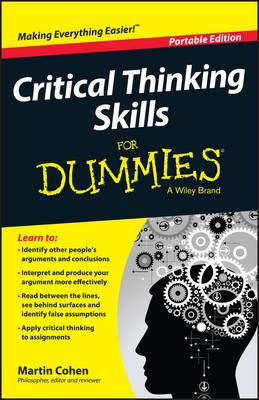
CRITICAL THINKING SKILLS FOR DUMMIES
Introduction: Why We Need to Think Smarter
Introduction: Why We Need to Think Smarter
Nova: Welcome to Mind Over Matter, the podcast where we dissect the tools that sharpen your intellect. Today, we’re diving into a book that promises to take one of the most elusive skills—critical thinking—and make it accessible to everyone: Critical Thinking Skills for Dummies by Martin Cohen.
Nova: : That title always makes me chuckle. 'For Dummies.' It sounds almost insulting, yet the 'Dummies' series is famous for taking incredibly dense subjects—like statistics or coding—and breaking them down into something you can actually use. So, Nova, what makes critical thinking so essential that it warrants the bright yellow and black treatment?
Nova: That’s the perfect starting point. Critical thinking isn't just about being smart; it’s about being. Research shows that strong critical thinking skills are the vital foundation for academic success and, crucially, for being a better communicator. It’s the difference between just absorbing information and actively it. The book promises to equip us with the tools for sound reasoning and textual analysis, which sounds far less 'dummy' and much more 'master strategist.'
Nova: : I like the sound of 'master strategist.' But let’s be honest, Nova, why is this skill so hard to master in the first place? We all think we’re critical thinkers, right? We look at the news, we form opinions. What are we missing?
Nova: We are missing the rigor. The search results confirm that critical thinking requires seeing both sides, demanding evidence, and reasoning dispassionately. The difficulty, as one source put it, lies in overcoming our inherent cognitive biases and emotional influences. We naturally take mental shortcuts. This book, by adopting the 'Dummies' approach, aims to force us to slow down, identify those shortcuts, and replace them with structured, analytical habits. It’s about building a proven path to clarity, not just having a gut feeling.
Nova: : So, we’re not just learning to think, but to think, systematically. It sounds like this book is less about content and more about process. I’m ready to see the process. Let’s break down the core mechanics they lay out.
Key Insight 1: Moving Beyond Surface Reading
The Foundation: Deconstructing Arguments and Evidence
Nova: Chapter one in any good critical thinking guide has to tackle the building blocks: arguments and evidence. Cohen’s book emphasizes that we need to move past simply reading text to actively analyzing it. It’s about reflective thinking skills—the ability to step back and examine your own thought process.
Nova: : Reflective thinking. That sounds very internal. Can you give us a concrete example of what that looks like in practice, perhaps something we encounter daily? Because when I read an article, I usually just think, 'Yeah, I agree' or 'No, that’s wrong.'
Nova: Exactly. That agreement or disagreement is the surface level. Reflective thinking forces you to ask: What is the author? What evidence are they presenting, and is that evidence sufficient? For instance, if a headline screams, 'New Study Proves Coffee Cures Baldness!' the surface reaction is excitement. The critical thinker pauses and asks: Who funded the study? How many participants were there? Was it a randomized, double-blind trial, or just ten guys in a coffee shop? The book stresses that evaluating the of the evidence is paramount.
Nova: : That’s a great distinction. It’s like being a detective, not just a spectator. I remember reading that critical thinking involves analysis, evaluation, and inference. Are these three steps distinct, or do they flow together?
Nova: They are deeply interconnected, but the book likely separates them for teaching purposes. Analysis is breaking the argument down into its components—the claim, the premises, the conclusion. Evaluation is judging the strength of those premises—are they true, relevant, and sufficient? Inference is the final step, drawing a logical conclusion based on that evaluation. If the premises are weak, your inference must also be weak, regardless of how much you the conclusion to be true.
Nova: : So, if I’m trying to decide on a major purchase, say a new car, and the salesperson only shows me glowing reviews from their own website, that’s a failure in evaluation, right? The evidence is biased.
Nova: Precisely. That’s a classic failure to seek independent, verifiable data. The Dummies approach, I imagine, would suggest mapping this out. They mention concept mapping. How does mapping help you evaluate an argument?
Nova: : Concept mapping, I’ve seen that used in project planning. It forces you to visualize relationships. If you map out an argument, you can visually see if the supporting points actually connect logically to the main conclusion, or if there are gaps where the author just jumped from Point A to Point Z without showing B through Y.
Nova: That’s the power of visualization in reasoning! It externalizes the internal process. You can literally draw a line between two ideas and ask, 'Is this line strong enough to hold the weight of this conclusion?' It combats the tendency to accept a smooth narrative without checking the structural integrity. The book aims to make you a better communicator too, so this mapping technique likely helps you structure your arguments just as rigorously.
Nova: : It sounds like the first major hurdle is simply accepting that most of the information we consume daily is structurally unsound or incomplete. It’s a slightly depressing realization, but a necessary one for growth.
Nova: It is, but the book frames it as empowering. Once you see the flaws, you gain control. You stop being manipulated by slick rhetoric and start making decisions based on solid ground. It’s about moving from passive acceptance to active engagement with every piece of information you encounter, whether it’s a scientific paper or a political soundbite.
Nova: : I’m starting to see why this is a sought-after skill. It’s mental self-defense in the information age. Let’s move on to the next layer of defense: the actual traps we fall into.
Key Insight 2: Spotting the Tricks of Bad Reasoning
The Minefield: Identifying Logical Fallacies
Nova: This is where the rubber meets the road, and where the 'Dummies' format truly shines—by giving us clear labels for common errors. We’re talking about logical fallacies. These are the sneaky rhetorical moves that make a weak argument strong.
Nova: : I’ve heard of a few, like the Straw Man, where you misrepresent someone’s argument to make it easier to attack. But I suspect this book covers a much wider arsenal of these mental traps. What are the heavy hitters they likely detail?
Nova: Based on standard critical thinking curricula, we can expect detailed breakdowns of fallacies that rely on emotion or distraction rather than logic. Think about the attack—arguing against the person instead of their argument. Or the, which suggests something must be true because everyone believes it. The search results hinted at fallacies like and the.
Nova: : The False Dilemma—that’s the one where they present only two options when, in reality, there are many possibilities, right? Like, 'You’re either with us or against us.' It’s a powerful tool for polarization.
Nova: Exactly. It artificially limits the scope of debate. If you can spot that, you immediately force the conversation back to the actual spectrum of solutions. The is just as common: concluding something about an entire group based on one or two isolated examples. For instance, meeting two rude people from a specific city and concluding everyone in that city is rude. It’s a failure of sample size.
Nova: : It’s fascinating how often these fallacies are used intentionally by persuaders. It implies that the book isn't just teaching us to avoid making these mistakes ourselves, but to recognize when others are trying to manipulate our reasoning. It’s about recognizing the behind the words.
Nova: Absolutely. And the book likely provides practical exercises, which is the Dummies hallmark. They probably give you a flawed argument and ask you to name the fallacy. This active recall is what embeds the knowledge. It’s not enough to know what a is; you need to be able to spot it instantly when a politician suddenly changes the subject during a debate to something emotionally charged but irrelevant to the core policy question.
Nova: : I wonder if they cover the more subtle ones, like the —arguing something is true because it hasn't been proven false. That one always trips me up because it feels intuitively plausible, like arguing for the existence of something unseen.
Nova: That’s a sophisticated trap! The burden of proof always lies with the person making the positive claim. If I claim there’s an invisible teapot orbiting Mars, it’s not up to you to prove it there; it’s up to me to provide evidence that it. The Dummies guide likely frames these fallacies not as academic terms, but as everyday conversational roadblocks. They want you to be able to say, 'Wait a minute, that sounds like an attack, let’s stick to the data,' without sounding pretentious.
Nova: : That’s the key to becoming a better communicator, as the summary mentioned. If you can identify the logical error politely and accurately, you elevate the entire discussion. It shifts the focus from personal conflict to intellectual rigor. So, we’ve learned to analyze structure and spot traps. What’s the final step in putting this all together practically?
Key Insight 3: From Analysis to Actionable Insight
Active Application: Tools for Clear Communication
Nova: We’ve established that critical thinking is about analysis and avoiding fallacies. But the book promises tools for insights, not just dismantling others’ arguments. This is where the active instruction comes in—things like concept mapping and brainstorming techniques.
Nova: : I’m intrigued by concept mapping again. If I’m researching a complex topic, say, the ethics of AI development, how does mapping help me think rather than just organize what I already know?
Nova: It forces synthesis. When you map, you aren't just listing facts; you are actively drawing the connections between disparate ideas. You might start with 'AI Ethics' in the center, branch out to 'Bias,' 'Autonomy,' and 'Job Displacement.' But then, you realize that 'Bias' heavily influences 'Autonomy' in ways you hadn't articulated before. The map reveals the hidden architecture of your understanding. It turns vague concerns into testable relationships.
Nova: : That’s powerful. It’s like the map itself becomes a tool for discovery, not just documentation. It helps you see the forest the trees simultaneously. What about brainstorming? That usually feels like the opposite of rigorous, critical thought—it’s supposed to be free-flowing, right?
Nova: That’s the genius of integrating it. Critical thinking isn't just about tearing things down; it’s about building better ideas. The book likely advocates for a two-stage process: Stage one is divergent thinking—unfettered brainstorming to generate a wide array of potential solutions or arguments. Stage two is convergent thinking—applying the critical filters we just discussed—evaluation, evidence checking, fallacy hunting—to narrow down and refine the best ideas from that initial burst.
Nova: : So, you use the creative, expansive side of your brain first, and then you bring in the logical, skeptical side to prune the garden. It prevents you from prematurely shutting down a potentially brilliant, but initially messy, idea.
Nova: Exactly. You don't want your inner critic to silence your inner inventor. Furthermore, the book emphasizes becoming a better communicator. If you’ve done the rigorous analysis and used concept mapping to structure your thoughts, your communication becomes inherently clearer and more persuasive because it’s built on a solid, defensible foundation.
Nova: : I can see how that translates directly to professional life. Whether you’re writing a proposal, leading a meeting, or even just explaining a complex problem to a colleague, having that structured thought process means your message lands with authority, not just opinion.
Nova: It’s about intellectual hygiene. Cohen’s work, by being part of the 'Dummies' line, suggests that this level of rigor is achievable by anyone willing to put in the structured effort. It’s not an innate talent; it’s a set of learnable, repeatable skills—analysis, evaluation, fallacy recognition, and structured idea generation.
Nova: : It sounds like the ultimate takeaway is that critical thinking is a, not a destination. You have to keep testing your assumptions and seeking out the evidence that might prove you wrong. It’s a commitment to intellectual humility.
Conclusion: The Path to Intellectual Growth
Conclusion: The Path to Intellectual Growth
Nova: We’ve journeyed through the core promise of Critical Thinking Skills for Dummies. We learned that it’s not about being cynical; it’s about being discerning. It’s the essential skill for navigating a world saturated with information, where every claim demands scrutiny.
Nova: : Indeed. The key insights were threefold: First, we must engage in reflective thinking to evaluate the quality of evidence, not just the surface claim. Second, we must arm ourselves with the vocabulary to spot logical fallacies—the shortcuts that derail honest debate. And third, we must use active tools like concept mapping to structure our own thoughts before we try to communicate them.
Nova: And that synthesis is the actionable takeaway. Don't just consume information passively. When you read something compelling, pause. Ask: What is the underlying assumption? Where is the proof? If you can’t find the proof, you’ve found a fallacy or a gap in reasoning. That pause is where the power lies.
Nova: : It’s a commitment to intellectual humility, as we said. The willingness to be wrong is the first step toward being right. This book, despite its approachable title, seems to be a manual for upgrading our entire mental operating system.
Nova: It truly is. It’s about moving from being a passive recipient of ideas to an active architect of your own understanding. That is the ultimate goal of sound reasoning, and it’s accessible to everyone willing to learn the rules of the game.
Nova: : A fantastic deep dive into a book that promises clarity in a confusing world. Thank you, Nova, for guiding us through the essentials of critical thinking.
Nova: My pleasure. Keep questioning everything, and keep building those strong arguments. This is Aibrary. Congratulations on your growth!