

Cultivating an Innovative EdTech Culture
Golden Hook & Introduction
SECTION
Nova: Catmull's Genius: Build. Trust. Create. Repeat.
Atlas: Pixar's Secret: Fail. Learn. Iterate. Win. Boom.
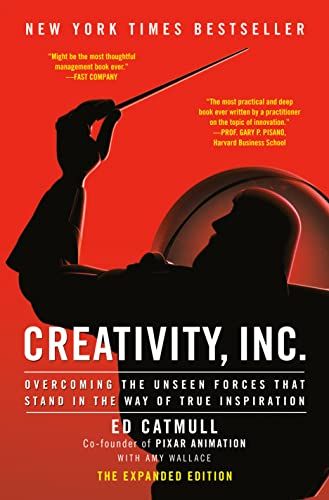
Nova: I love that! Short, punchy, and pretty much sums up the brilliance we're diving into today. We're cracking open "Creativity, Inc.: Overcoming the Unseen Forces That Stand in the Way of True Inspiration" by the incredible Ed Catmull.
Atlas: Oh, I like that! It sounds like a secret manual for sustained genius. Catmull, as in, the co-founder of Pixar and later the president of Disney Animation? That's quite the resume for someone writing about "unseen forces."
Nova: Exactly! His journey from computer graphics pioneer to leading two of the most creatively successful animation studios in history gives him unparalleled, real-world insight. This isn't just theory; it's a blueprint forged in the fires of actual creative production. The book itself is widely acclaimed, often cited as a masterclass in fostering creativity in a corporate environment. It's incredibly candid, offering an inside look at how Pixar managed to maintain its creative edge despite immense growth and pressure.
Atlas: Right, so it's not just about making pretty pictures, it's about engineering an environment where those pretty pictures, and the stories behind them, consistently come to life.
Nova: Precisely. And that's what we're exploring today. The magic wasn't magic; it was deliberately engineered.
The Pixar Playbook: Building a Foundation for Creative Innovation
SECTION
Nova: So, let's talk about that engineering. Catmull’s core idea, the engine of innovation at Pixar, was built on a foundation of radical transparency and candid feedback. He didn't just want creative people; he wanted a system that creativity.
Atlas: That makes me wonder, how do you even begin to cultivate that kind of psychological safety in a high-stakes environment? I imagine a lot of our listeners, especially those building EdTech platforms, feel every move is critical. Isn't candid feedback just a recipe for endless arguments or hurt feelings in most companies?
Nova: That’s a great question, and it’s where Catmull’s genius truly shines. His solution wasn't just "be honest." It was the "Braintrust." This wasn't some casual critique session. It was a structured, peer-to-peer meeting where directors presented their works-in-progress, no matter how rough, to a group of their most trusted and talented peers.
Atlas: Okay, so it’s like a supercharged focus group, but with colleagues?
Nova: Kind of, but with a critical difference. The Braintrust's sole purpose was to help, not to criticize or dictate. The rules were clear: candor without cruelty. They focused on the work, not the person. And crucially, the director presenting didn't have to take any of the advice. The Braintrust offered problems and potential solutions, but the final decision, the ownership, remained with the director.
Atlas: Wow. So the power dynamic is completely flipped. It’s not about a boss telling you what to fix, but peers offering insights, and you get to choose what resonates. That sounds incredibly empowering.
Nova: It is. This system created an environment where people felt safe taking risks because they knew they wouldn't be judged harshly for early failures. They knew they'd get honest, invaluable feedback that would help them elevate their story. It wasn't about finding fault; it was about finding the hidden potential.
Atlas: I can see how that would encourage people to bring their rough drafts to the table, instead of trying to perfect something in isolation and then being crushed when it’s not received well. That’s a huge psychological shift.
Nova: Exactly. Catmull understood that early work is inherently flawed. It's a "buggy baby," as he'd say. The goal isn't to avoid the buggy baby phase, but to get it out there quickly, expose it to smart, trusted eyes, and iterate rapidly. This fosters a continuous cycle of learning and improvement, which is the true engine of sustained innovation.
Atlas: So, it’s not just about being creative, it's about creating a system where creativity can survive and thrive through constructive challenges.
Translating Genius: Applying Pixar's Lessons to EdTech Breakthroughs
SECTION
Atlas: Okay, so the magic isn't magic, it's deliberate culture. That makes sense. But how does this translate from animated blockbusters to, say, developing the next breakthrough EdTech platform? I mean, the stakes feel different, the products are different.
Nova: That's the beauty of Catmull's insights, Atlas. They're universal. The principles of transparent communication, candid feedback, and empowering teams are absolutely critical in EdTech. Think about it: EdTech is all about continuous innovation, adapting to new learning styles, new technologies, new pedagogies. You a culture that embraces change and rapid iteration.
Atlas: I get the theory, but what does that look like on the ground? For our listeners who are building these companies, what's one small change they could implement today to encourage more open feedback and creative risk-taking within their team? That's the deep question Catmull himself poses.
Nova: A fantastic question. One immediate step is to establish a robust "post-mortem" culture, not just for failures, but for projects. When a new learning module launches, or a new AI tutor feature goes live, don't just move on. Dedicate time to deeply analyze: What went well? What could have been better? What did we learn? And make sure everyone feels safe to speak up, not just the leaders.
Atlas: So it’s not about assigning blame, but extracting lessons. That sounds like a Braintrust for every project, essentially. But isn't there still a fear of taking risks? Especially when resources are tight, every decision feels like it has to be the right one.
Nova: That fear of risk is exactly what Catmull addresses. He argues that the "fear of failure" is often far more damaging than actual failure. If people are afraid to try new things because they might get reprimanded, innovation dies. Instead, leaders need to create environments where "failure is not a necessary evil, but an inherent consequence of doing new things."
Atlas: Like, you can't learn to ride a bike without falling a few times.
Nova: Exactly. In EdTech, this could manifest as dedicated "innovation hours" or "experimentation sprints" where teams are explicitly encouraged to explore novel approaches, even if they don't immediately pan out. The goal isn't necessarily a finished product, but insights, prototypes, and learning. And when these experiments "fail," the post-mortem focuses on the from that failure.
Atlas: That's actually really inspiring. So it’s about making the process of trying and failing a part of the job description, not a black mark. That’s how you get breakthroughs, not by avoiding risk, but by managing the learning from it.
Synthesis & Takeaways
SECTION
Nova: And that's the profound insight Catmull offers: innovation isn't about individual genius; it's about cultivating an environment where collective genius can thrive. It's an ongoing journey of discovery, not a destination.
Atlas: That gives me chills. The real breakthrough isn't just a new EdTech product; it's the culture that consistently those new products. It’s building a system resilient enough to embrace the unknown, which is crucial for staying relevant in such a rapidly evolving field.
Nova: Absolutely. It's about empowering every person on your team to not just execute, but to think, to challenge, to improve. It's about designing a workplace where creativity isn't a fluke, but an expectation.
Atlas: So, for our listeners today, the challenge isn't just to innovate in their product, but to innovate in their culture. What's one small cultural change you can initiate this week to foster more candid feedback or creative risk-taking?
Nova: Think about it. Maybe it's starting a mini-Braintrust for a tricky problem, or simply being more transparent about a recent challenge your company faced. Start small, but start building that culture.
Atlas: Powerful stuff. This is Aibrary. Congratulations on your growth!