The Architecture of Adaptive Innovation
Golden Hook & Introduction
SECTION
Nova: The most dangerous thing you can do for your career is build a perfect plan.
Atlas: That sounds like a recipe for disaster. Most people spend their entire lives trying to build the perfect plan. You’re saying that’s the trap?
Nova: Exactly. Because a perfect plan assumes the world is going to stay exactly the way it is right now. And the moment the world shifts, that perfect plan becomes a cage. We’re talking today about the architecture of adaptive innovation. We’re looking at why some people and organizations don’t just survive change, but actually use it as a springboard.
Atlas: I like that. A springboard instead of a cage. But let’s be real, most of us feel like we’re just reacting to the next fire drill. How do we move from reacting to actually building something that lasts?
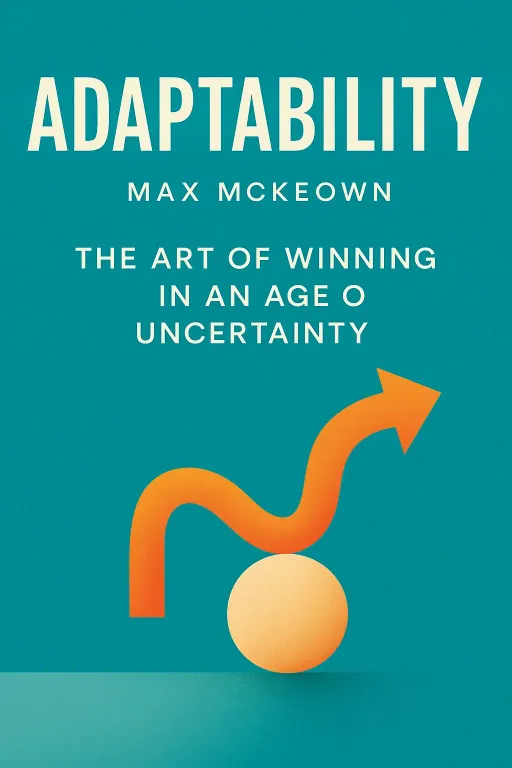
Nova: That is the central question. To get there, we’re looking at two titans of thought. We are diving into The Rules of Adaptability by Max McKeown and the seminal work on creativity by Mihaly Csikszentmihalyi.
Atlas: I know Csikszentmihalyi. He’s the flow guy, right? The psychologist who figured out that sweet spot where you lose track of time?
Nova: Precisely. And McKeown is the strategist who argues that adaptability is a skill you can actually systematize. When you put them together, you get this incredible framework. McKeown gives you the structural blueprint for how to handle the chaos of the outside world, and Csikszentmihalyi gives you the psychological engine to actually do the work.
Atlas: So, one is the external system, and the other is the internal state.
Nova: You nailed it. It’s the difference between having a fast car and knowing how to drive it on a winding road.
The Structural Agility of Adaptive Systems
SECTION
Atlas: Let’s start with the external system then. I want to know about Max McKeown. You mentioned he treats adaptability like a system. Most people treat adaptability like a personality trait—you’re either flexible or you’re rigid.
Nova: That is a common misunderstanding. McKeown’s research shows that adaptability is a measurable, learnable competency. He argues that most organizations and individuals are stuck in a cycle of what he calls success-trap behavior. They find a way that works, they optimize it, they lock it down, and then they stop looking for the next shift.
Atlas: That makes sense. It’s like the Kodak effect, right? They were so good at film that they couldn’t adapt to digital, even though they invented it.
Nova: Exactly. The structural agility McKeown talks about is the ability to recognize that the ground is moving before you fall into a crevice. He suggests that you need to transform challenges into strategic advantages.
Atlas: But how do you actually do that without being frantic? My mind goes to the "Analytical Architect" listener who wants a blueprint. If I’m a developer, or a manager, or a strategist, how do I build an adaptive system?
Nova: You start by building feedback loops that prioritize data over ego. McKeown emphasizes that you need to create a system where you are constantly testing your assumptions. Think of it like a sailor adjusting the sails. You don’t decide on your destination and then lock the rudder. You keep adjusting based on the wind speed and the current.
Atlas: So, the system is the rudder, not the destination.
Nova: Precisely. If you are a technical professional, your system should involve regular, scheduled check-ins where you ask: "What is the most significant change in my industry this week, and how does that render my current approach obsolete?"
Atlas: That sounds exhausting. Does he suggest we just spend all day looking for changes?
Nova: The key factor is efficiency. It’s not about constant panic. It’s about creating "structural agility." This means you design your work processes so that you can pivot without having to tear down the whole building. It’s modularity. If you’re building a piece of software, you don’t hard-code everything. You create APIs. If you’re building a career, you don’t specialize in one dying technology. You build a stack of skills that are transferable.
Atlas: I see where you’re going. It’s about building in the ability to change, rather than trying to predict the change.
Nova: Yes. Think of it as the difference between a rigid oak tree and a bamboo stalk. The oak tree tries to withstand the storm with sheer strength, and when the wind is too strong, it snaps. The bamboo bends with the wind. It has a structural agility. McKeown’s argument is that we need to stop trying to be the oak and start being the bamboo.
Atlas: That’s a powerful visual. But let’s play devil’s advocate for a second. If I’m always bending, how do I ever get anything done? If I’m constantly pivoting, aren't I just a leaf blowing in the wind?
Nova: That is the perfect question. And that brings us to the second half of our equation. You can be as agile as you want, but if you don’t have the psychological focus to actually execute in the moment, your agility is useless. You’ll just be a leaf that’s moving very quickly, but going nowhere.
The Psychological Flow of Creativity
SECTION
Atlas: And that’s where Csikszentmihalyi comes in.
Nova: Right. This is where we talk about the psychological flow. If McKeown is the architect designing the flexible building, Csikszentmihalyi is the master craftsman working inside it. He spent his career studying why people feel most alive and productive when they are deeply immersed in a task.
Atlas: I’ve felt that. When I’m deep in a project and I look up and realize four hours have passed, and I haven't checked my phone, haven't eaten, and I’m actually energized by the work. That’s flow, right?
Nova: That is exactly it. And the fascinating thing about Csikszentmihalyi’s research is that he found flow isn't just for artists or athletes. It’s for anyone solving complex problems. It requires a very specific set of conditions: clear goals, immediate feedback, and a balance between the challenge of the task and your own skill level.
Atlas: The challenge-skill balance. I remember reading about that. If the task is too hard, you get anxious. If it’s too easy, you get bored.
Nova: Exactly. And innovation happens in that narrow band between anxiety and boredom. That is the channel of flow. When you are in that channel, your brain is actually optimizing for creativity. You aren’t just processing information; you are synthesizing it.
Atlas: So, how do we apply this to the "Purposeful Learner"? They want to build a foundation for future growth. How do they engineer this flow state?
Nova: You have to curate your environment. Most people treat their work environments like a chaotic storm of notifications, emails, and interruptions. That is the enemy of flow. If you want to innovate, you have to protect your cognitive bandwidth. You need to create a sanctuary for deep work.
Atlas: Wait, let me stop you there. That sounds like good advice, but it sounds like a luxury. If I’m working in a high-pressure team, I can’t just turn off notifications. My boss expects me to be responsive.
Nova: That is a real constraint. But here is the secret that high performers have figured out: They negotiate their flow. They communicate to their teams that they are unavailable for a specific block of time because they are working on a high-value, complex task. It’s not about being antisocial; it’s about being effective.
Atlas: So, you’re saying that the "Analytical Architect" needs to treat their focus as a scarce resource, not a renewable one?
Nova: That is the core insight. We waste so much potential by fragmenting our attention. Csikszentmihalyi’s work proves that creativity is not a lightning bolt that strikes you. It’s a process that you enter. You have to build the structure—the McKeown side—to allow for the focus—the Csikszentmihalyi side.
Atlas: Okay, I’m starting to see the connection. The structural agility is the calendar and the workflow that gives you the time. The flow is what you do with that time.
Nova: Exactly. When you combine them, you get something really special. You get a professional who is capable of rapidly adapting to external feedback—because they have the structural system—but who also has the deep, sustained focus to solve the complex technical problems that others are too distracted to crack.
The Synthesis of Adaptive Innovation
SECTION
Atlas: This is starting to feel like a complete blueprint. But let’s make this concrete. Let’s say I’m a listener. I’m a senior analyst, or a software engineer, or a project manager. What is the very first thing I should do tomorrow morning to start this process?
Nova: Start with the ten-minute rule.
Atlas: Ten minutes. That’s manageable. What do I do with it?
Nova: You dedicate those ten minutes to what McKeown would call a "strategic scan." You don’t check email. You don’t look at your to-do list. You look at your project or your career path and you ask: "What is the one assumption I am making that might be wrong?"
Atlas: That’s uncomfortable.
Nova: It is supposed to be. That discomfort is the beginning of agility. You are testing your own structure. And then, once you’ve done that, you set your intention for the day. You pick one high-impact, complex task—the one that actually moves the needle—and you guard your time for it. That is where you apply the flow.
Atlas: So, the morning scan is the agility check, and the deep work session is the flow state.
Nova: That is the synthesis. It’s how you become an "Adaptive Architect." You are constantly surveying the horizon, but you are also capable of going deep into the work that actually creates value.
Atlas: I think a lot of people struggle because they do the opposite. They spend their day in a state of anxious reaction—which is neither agile nor focused—and then they wonder why they aren't making progress.
Nova: You hit on the most important point. Anxious reaction is just noise. It’s high energy, but low signal. True innovation requires the calm of flow and the clarity of a flexible structure.
Atlas: It’s interesting, when you look at the history of innovation, you see this pattern over and over. You see people who had the discipline to protect their focus, but also the humility to pivot when the data showed they were wrong.
Nova: That humility is the secret sauce. It’s realizing that your plan is not your identity. If your plan fails, you haven’t failed. You’ve just learned something new about the terrain.
Atlas: That takes a lot of the pressure off, doesn't it? If I’m not my plan, then I can change it without feeling like I’m losing myself.
Nova: And that is the ultimate goal. When you detach your ego from your current plan, you become unstoppable. You can adapt to anything.
Synthesis & Takeaways
SECTION
Atlas: This has been a fascinating deep dive. We’ve gone from the structural, external world of McKeown to the internal, psychological world of Csikszentmihalyi.
Nova: And the beauty is that they are two sides of the same coin. You cannot have one without the other. Without structural agility, your flow is misdirected. Without flow, your agility is shallow.
Atlas: So, if our listeners take one thing away from this episode, what should it be?
Nova: The realization that innovation is not a talent you are born with. It is an architecture you build. You build it by creating systems that allow for change, and by cultivating the psychological space where deep work can happen.
Atlas: And remember, don't try to build the whole skyscraper in a day. Start with that ten-minute scan. Ask yourself what assumption you’re making that might be wrong. That small crack in your current thinking is where the light gets in.
Nova: That is a perfect way to put it. The light is where the innovation happens.
Atlas: I love that. We’ve covered a lot of ground today, from the macro systems of organizational change to the micro-moments of individual creativity.
Nova: It’s the kind of synthesis that defines true mastery. Whether you are in tech, finance, or any complex field, these principles apply. They are the foundation for long-term growth.
Atlas: And for those who want to take this further, we’ve laid out the path. Start with the systems thinking to organize your expertise, then use that efficiency to build your own version of wealth architecture, and finally, apply it all to get real professional results.
Nova: You have all the tools. Now, it’s just about building the architecture.
Atlas: I’m definitely going to try that ten-minute scan tomorrow morning. It’s a small price to pay for a much more agile day.
Nova: It’s the best investment you can make. Thank you for joining us on this journey into the architecture of innovation.
Atlas: This is Aibrary. Congratulations on your growth!