Future-Proofing Innovation Through Flow and Tech
Golden Hook & Introduction
SECTION
Nova: If you think creativity is just a lightning bolt that strikes a lone genius in a dark room, you have been sold a bill of goods. The reality is far more structural, and honestly, a lot more manageable if you know how the machine works.
Atlas: That is a bold opening. I have always liked the romantic image of the starving artist in the attic, though. It feels so much more poetic than admitting that creativity might actually be a, dare I say, repeatable process.
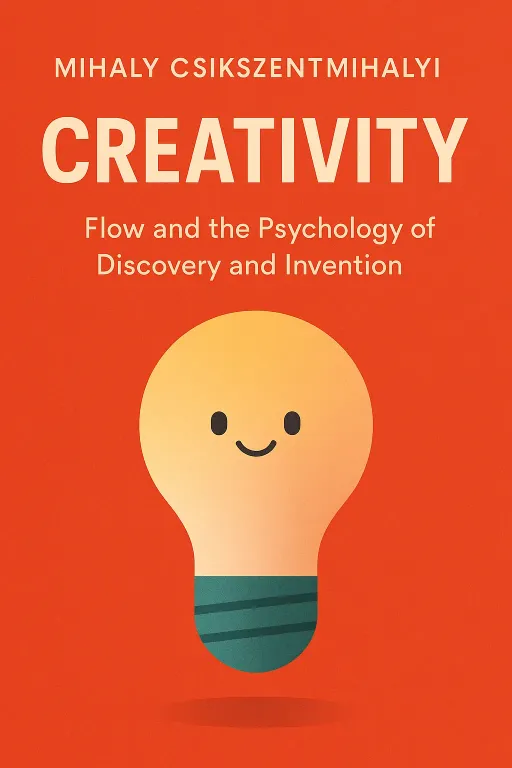
Nova: Poetry is fine for the weekend, but if you want to survive the next decade of professional life, you need to drop the romance. Today, we are dissecting the mechanics of innovation by looking at two heavy hitters. We are diving into the work of Mihaly Csikszentmihalyi, specifically his book Creativity, and pairing that with Klaus Schwab’s outlook in The Fourth Industrial Revolution.
Atlas: Those are two very different worlds. Csikszentmihalyi is the godfather of the flow state, the guy who made us obsess over how we work. And Schwab? He is the one telling us that the floor is falling out from under our feet because of the way physical, digital, and biological systems are merging. It feels like you are trying to combine a psychology lecture with a panic-inducing briefing on the future of global industry.
Nova: That is exactly the point. The friction between those two ideas is where the insight lives. Csikszentmihalyi spent his life studying the psychology of optimal experience, and his research into the systems of creativity is legendary. He was not just looking at paintings; he was looking at why some ideas survive and others vanish. And Schwab, as the founder of the World Economic Forum, gives us the macro view of why that creativity is no longer a luxury, but a survival skill.
Atlas: So, we are looking at the micro-psychology of the individual and the macro-reality of the global economy. I am curious how these two actually talk to each other. Because if the world is automating everything, does the individual even matter anymore? Or are we just trying to optimize ourselves to be better cogs in a machine that is already being run by algorithms?
The Systemic Nature of Creativity
SECTION
Nova: Let’s start with Csikszentmihalyi. He posits that creativity is not an internal trait. It is a system. He breaks it down into three parts: the domain, the field, and the individual. If you want to understand why a breakthrough happens, you have to look at all three.
Atlas: Okay, break that down for me. When you say domain, field, and individual, what are we talking about? This sounds like a sociological model, not a creative one.
Nova: That is the crucial realization. The domain is the set of symbolic rules and procedures. It is the language of music, the mathematics of physics, or the code of software engineering. It is the existing knowledge base. You cannot be creative in a vacuum; you have to master the domain first.
Atlas: That makes sense. You cannot break the rules of jazz until you know how to play the scales. You are just making noise otherwise.
Nova: Exactly. Then you have the field. The field includes all the gatekeepers, the experts, the peers, the people who decide what is an innovation and what is just garbage. They are the ones who legitimize the work. And finally, the individual. The individual is the person who brings a new idea, enters a state of flow, and pushes the boundary of the domain.
Atlas: So, the individual is the catalyst, but the field is the judge. That feels a bit restrictive. Does this mean you can’t be truly creative unless the field agrees with you?
Nova: It means your work won’t be recognized as creative by society unless the field accepts it. Think about Van Gogh. He was an individual working in the domain of painting. But the field of his time? They rejected his work. It took a changing of the field—a shift in the cultural and critical environment—for his work to be classified as revolutionary.
Atlas: That is a tough pill to swallow. It suggests that your creative output is at the mercy of the gatekeepers. But let’s bring this back to the professional world. If I am sitting in a corporate office, how do I apply this? Am I just stuck waiting for the field to validate me?
Nova: Not at all. You use it to map your strategy. If you want to innovate in your team, you first need to master the domain. Stop trying to reinvent the wheel before you understand how the axle works. But more importantly, you need to understand who your field is. Who are the stakeholders? What are the criteria for success in your organization? If you are trying to push a creative project through, you are not just selling the idea; you are engaging with the field.
Atlas: I see where you are going. It is about understanding the ecosystem. But wait, I want to go back to the individual part. You mentioned flow. That is Csikszentmihalyi’s bread and butter. How does flow fit into this systemic view?
Nova: Flow is the engine. It is the state of total immersion where the challenge matches your skill level perfectly. When you are in flow, you are not worried about the field; you are entirely focused on the domain. You are pushing the boundaries of what you are capable of. The systemic creativity comes from the tension between the individual’s flow and the field’s resistance.
Atlas: That is fascinating. So, the individual in flow is the source of the new idea, but the system decides if that idea actually becomes an innovation. And that brings us to the second half of our equation today, doesn't it? The Fourth Industrial Revolution. Because if the domain—the rules of the game—is changing faster than ever, doesn't that make it harder for the field to keep up?
The Fourth Industrial Revolution and the Human Edge
SECTION
Nova: You hit the nail on the head. Klaus Schwab’s argument in The Fourth Industrial Revolution is that we are witnessing a fusion of technologies. Physical, digital, and biological systems are blurring. We are not just talking about better computers; we are talking about AI, gene editing, and the internet of things all converging.
Atlas: Right. And that convergence changes the domain. The rules of business, the rules of problem-solving, they are being rewritten by algorithms that can process data faster than any human ever could. If the domain is being automated, where does the individual fit in?
Nova: That is the central anxiety of our time. But Schwab argues that this is actually an opportunity. The more we automate the analytical, the more we elevate the human. The machines are incredible at processing existing domains—they can master the rules of chess or the rules of data analysis in seconds. But they struggle to create new domains. They struggle with the truly systemic shifts that require human judgment, ethics, and nuance.
Atlas: I am hearing this a lot lately. People say, just be more human. But that feels like a platitude. What does that actually mean in a practical sense? If I am an analyst or a strategist, what does it mean to be human in a way that an algorithm cannot replicate?
Nova: It means synthesis. An AI can analyze a million data points to tell you the most probable outcome. But it cannot tell you which outcome matters to a human being. It cannot synthesize disparate fields—like ethics, art, and technology—to create a new path forward. That is the creative skill that the Fourth Industrial Revolution demands.
Atlas: So, the human edge is not about being a better calculator than the computer. It is about being the architect who decides what the computer should calculate in the first place.
Nova: Exactly. And that brings us back to Csikszentmihalyi’s model. The Fourth Industrial Revolution is shifting the field. The gatekeepers of the future are not just going to be the experts who know the most; they are going to be the ones who can navigate the ambiguity of these merging systems.
Atlas: I like that. It moves the goalposts. Instead of competing on speed or data volume, you compete on the ability to synthesize meaning. But let’s get into the friction again. If the field is constantly changing, how do you maintain flow? Flow requires a stable challenge-skill balance. If the domain is shifting under your feet, how do you stay in that zone?
Nova: You treat the change as the challenge. The people who are going to thrive in this era are the ones who treat the instability of the Fourth Industrial Revolution as their primary creative domain. They are not waiting for the rules to stabilize; they are learning how to play the game while the board is being redesigned.
Atlas: That sounds exhausting. But it also sounds like the only way forward. It is the difference between being a passive recipient of the change and an active participant in it. I am thinking about the teams I see in my own work. Most of them are just trying to keep their heads above water. They are reacting to the tech, not directing it.
Nova: That is the classic trap. You are focusing on the task, not the system. If you spend your day doing tasks that are easily automatable, you are effectively training yourself to be replaced. But if you spend your day identifying the patterns that the AI is missing, or the human needs that the AI is ignoring, you are building a career that is insulated from automation.
Synthesis, Takeaway, and The Deep Question
SECTION
Atlas: This is starting to feel like a blueprint. If I am listening to this, I am thinking, okay, I understand the system. I have the domain, the field, and the individual. And I understand that the world is changing. So, what is the one thing I do tomorrow morning?
Nova: You ask yourself the Deep Question. And this is the one that really gets to the core of what we are discussing. As automated systems handle more and more of our analytical workflows, what is the single most creative, non-automatable skill you can cultivate in your team this quarter to ensure long-term strategic leverage?
Atlas: That is a heavy question. If I have to answer that, I would say it is the ability to ask the right questions. We are so obsessed with finding the right answers, but AI is great at answers. It is terrible at asking the questions that actually matter.
Nova: That is a powerful answer. And it fits perfectly with the idea of synthesis. Asking the right question is an act of framing. You are defining the problem. And defining the problem is a human-centric, creative act. The machine can solve for X, but it cannot tell you why X is the variable that matters for your business or your life.
Atlas: It is about the context. The machine lacks context. It has information, but it lacks the wisdom to apply that information to a specific human situation.
Nova: Exactly. And if you can teach your team—or yourself—to focus on that framing, on that synthesis of context and data, you are no longer just an operator. You are an architect. You are the one who is shaping the domain, not just playing within it.
Atlas: I want to push on that for a second. Is there a way to practice this? How do you practice "framing" or "synthesis" as a daily habit?
Nova: You start by micro-dosing the practice. Instead of accepting the first answer a report gives you, ask three different questions about the context of that data. Ask, who is this for? What is the second-order consequence of this decision? What is the human element that is missing from this spreadsheet? It sounds simple, but it is incredibly difficult to do consistently. It requires you to slow down in a world that is demanding you speed up.
Atlas: It is the opposite of the "efficient strategist" trap. We think efficiency is about speed. But sometimes the most efficient thing you can do is stop, reframe the problem, and realize you were running in the wrong direction the whole time.
Nova: Precisely. That is the ultimate strategic leverage. You stop being a commodity and start being a catalyst. You are not just processing the domain; you are expanding it. And that is how you stay relevant in the age of the Fourth Industrial Revolution.
Atlas: I love that. It takes the pressure off of "being creative" in the artistic sense and puts it on "being creative" in the strategic sense. It is about design, not just decoration.
Nova: It is about systemic intelligence. You are looking at the whole board. You are acknowledging the domain, you are working with the field, and you are maintaining your own individual flow by constantly challenging yourself with the right problems.
Atlas: This has been a massive shift in perspective for me. I think I went into this expecting a conversation about how to get better at brainstorming, and I am leaving with a framework for how to survive—and thrive—in a world that is becoming increasingly automated.
Nova: That is the beauty of these frameworks. They don't just give you a tip; they give you a lens. Once you see the world through the lens of domain, field, and individual, you cannot unsee it. You start to see why some projects fail and why others reshape industries.
Atlas: And you start to realize that the most dangerous thing you can do is become a specialist who only knows the domain but ignores the field. Or an individual who thinks they are a genius but ignores the domain. You need all three.
Nova: And you need the courage to keep evolving as those three elements shift. The landscape is moving, Atlas. But if you have the framework, you are not just floating; you are navigating.
Atlas: That is a great note to end on. We have covered a lot today. We talked about the systemic nature of creativity, the reality of the Fourth Industrial Revolution, and the critical importance of framing and synthesis. For anyone listening, I challenge you to take that Deep Question we posed and apply it to your team this week. What is the one thing you are doing that an AI could do better? And if you find it, how do you pivot toward something that requires your uniquely human, creative, systemic perspective?
Nova: And remember, this is not about working harder. It is about working with a deeper understanding of the system you are operating in. Mastery is not about page counts or hours logged; it is about the quality of the insights you can apply to the problems that actually matter.
Atlas: I am definitely going to be thinking about my own "framing" process after this conversation. It is a good reminder that the most valuable tool in the office is still the one between our ears.
Nova: Absolutely. And with that, we have reached the end of our deep dive. Thank you for joining us in this exploration of how to future-proof your creativity. This is Aibrary. Congratulations on your growth!