Stop Guessing, Start Innovating: The Guide to Creative Problem-Solving.
Golden Hook & Introduction
SECTION
Nova: Forget what you think you know about creativity. That spark of genius? That 'aha!' moment? It's not magic, it's a muscle. And most of us aren't even trying to flex it.
Atlas: Whoa, Nova, that's a bold claim right out of the gate! So, you're saying my inability to draw a straight line isn't a life sentence?
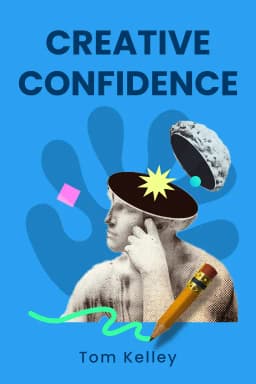
Nova: Absolutely not, Atlas. Today, we're dissecting an idea that's often misunderstood, drawing inspiration from works like "Creative Confidence" by the legendary design thinkers Tom Kelley and David Kelley, and "The Innovator's Dilemma" by the late, influential Harvard professor Clayton M. Christensen. Both books, widely acclaimed and foundational in their fields, challenge our assumptions about innovation and success.
Atlas: These are authors who truly reshaped how we think about business and design. So we're talking about taking creativity out of the mystic realm and putting it squarely into the practical toolkit? That sounds incredibly relevant for anyone trying to navigate a complex career path.
Nova: Precisely. And that leads us straight into our first core idea: Unlocking Creative Confidence. It's about realizing creativity isn't a gift, but a learnable process.
Unlocking Creative Confidence: The Process, Not the Gift
SECTION
Nova: For too long, society has told us creativity belongs to a select few – the artists, the musicians, the 'idea people.' But Tom and David Kelley, through their work at Stanford's d. school and IDEO, really blew that myth out of the water. They argue that everyone is inherently creative, and what holds us back is a lack of 'creative confidence.' It's like a muscle that atrophies if you don't use it, or if you're told it's not there.
Atlas: Oh man, I know that feeling! I imagine a lot of our listeners have been in meetings where someone says, "We need a creative solution," and everyone immediately looks at the one person who doodles in their notebook. But how do you actually 'unleash' it? What does this 'design thinking' involve?
Nova: It's a structured approach, Atlas. It starts with empathy – truly understanding the user or the problem. Then comes ideation – generating as many ideas as possible without judgment. And finally, rapid prototyping – quickly building rough versions of solutions to test and learn from. Think about the early days of Apple's mouse. It wasn't born perfect. It was a result of countless iterations, testing, and refining based on user feedback. That wasn't a single stroke of genius; it was a disciplined process of creative problem-solving.
Atlas: So, it's like a scientific method for ideas? Test, learn, iterate? That sounds much more approachable than waiting for a lightning bolt of inspiration. But wait, isn't there a risk of losing that 'magic' if you over-process creativity? I mean, sometimes the best ideas just, right?
Nova: That's a fantastic point, and it's a common misconception. The 'magic' often appears you've created conditions for it, not despite the process. The structure of design thinking doesn't stifle creativity; it channels it. It gives you a framework to explore, to fail safely, and to discover those unexpected connections. It's about 'structured exploration,' as the book suggests. It's about building a playground for your ideas, not a rigid factory.
Atlas: That’s a great analogy – a playground for ideas. So, for someone who feels stuck, or like they're just 'not a creative person,' this is a roadmap to start building that muscle?
Nova: Exactly. It's about small, consistent efforts, just as the authors advocate. It’s about being willing to challenge existing norms, even your own internal narrative about what you're capable of. It’s an invitation to grow.
The Innovator's Imperative: Why Continuous Creative Adaptation is Not Optional
SECTION
Nova: And that naturally leads us to our second core idea, which often acts as a critical counterpoint to simply having creative confidence: the absolute necessity of continuous creative adaptation. Clayton Christensen, in "The Innovator's Dilemma," showed us something profound and often painful: even hugely successful companies can fail precisely they're so good at what they do. They get so focused on optimizing their existing products and serving their current best customers that they ignore 'disruptive innovations' – the smaller, simpler, often cheaper solutions that eventually displace them.
Atlas: Oh man, I've seen that play out so many times in various industries. It's like the blockbuster video store ignoring Netflix, or traditional media outlets being slow to embrace digital. It sounds like a paradox – success breeds failure. But for our listeners striving for career readiness, how does this translate to an individual level?
Nova: It means you can't rest on your laurels, Atlas. Your 'current best practices' might be your future undoing. For an individual, continuous creative adaptation means constantly learning new skills, challenging your own assumptions about how things 'should be done,' and being open to new tools or methodologies even if your current approach is working. It's about developing an 'innovator's mindset' for your own career.
Atlas: So, if I'm an analyst, for example, and I'm really good at using one specific software, this book would tell me to still keep an eye on emerging tools, even if they seem less powerful?
Nova: Precisely. Christensen's work highlights that disruptive innovations often start in niche markets, or appear 'inferior' to existing solutions. But over time, they improve rapidly and eventually overtake the incumbents. For you, that could be a new data analysis tool, or even a different way of presenting insights. If you're not continuously exploring and adapting, you risk becoming the 'successful company' that missed the next wave.
Atlas: That’s actually really inspiring, but also a little terrifying. It means continuous learning isn't just a nice-to-have; it's a survival mechanism. It ties directly into that 'career readiness' point.
Nova: Exactly. It's about what we call 'continuous creative adaptation' – a willingness to challenge existing norms and embrace structured exploration, not just for the sake of novelty, but for sustained relevance and growth. It's the ultimate form of self-improvement for future readiness.
Synthesis & Takeaways
SECTION
Nova: So, what we’ve really unpacked today is that creativity isn't a mystical art for the chosen few. It's a skill, like any other, that can be honed through empathy, ideation, and rapid prototyping. And perhaps more importantly, this learned creativity isn't just about making pretty things; it's a fundamental requirement for navigating a world of constant disruption.
Atlas: That’s a powerful reframing. It shifts the burden from 'Am I creative?' to 'Am I willing to creativity?' And that's a much more empowering question. For our listeners who are aspiring analysts or practical learners, this isn't just theory; it's a call to action for real-world impact and self-discipline.
Nova: Absolutely. And to make it concrete, here's your 'tiny step' for the week: Pick one small problem you face. It could be anything from 'what to cook for dinner' to 'how to organize your inbox.' Now, brainstorm five truly unusual solutions for it. Don't censor yourself. Just let the ideas flow, no matter how wild. It's about flexing that creative muscle.
Atlas: Five unusual solutions… I love that. It’s a low-stakes way to start building that creative confidence and practicing continuous adaptation. It's embracing the journey of discovery, one tiny step at a time. I'm going to try that myself.
Nova: Fantastic. Because in a world that never stops changing, the ability to creatively solve problems isn't just an asset; it's the ultimate superpower. This is Aibrary. Congratulations on your growth!