Stop Guessing, Start Innovating: The Guide to Creative Problem-Solving
Golden Hook & Introduction
SECTION
Nova: Forget everything you thought you knew about creativity. It's not some mystical spark reserved for artists. It's a muscle, and most of us just haven't been taught how to flex it. Especially when it comes to solving real-world problems in digital marketing.
Atlas: Whoa, Nova. That's a bold claim right out of the gate. I mean, my brain usually associates 'creative' with 'artist' or 'mad scientist' in a lab coat, not necessarily with, say, optimizing conversion funnels. Are you saying I've been selling myself short all this time?
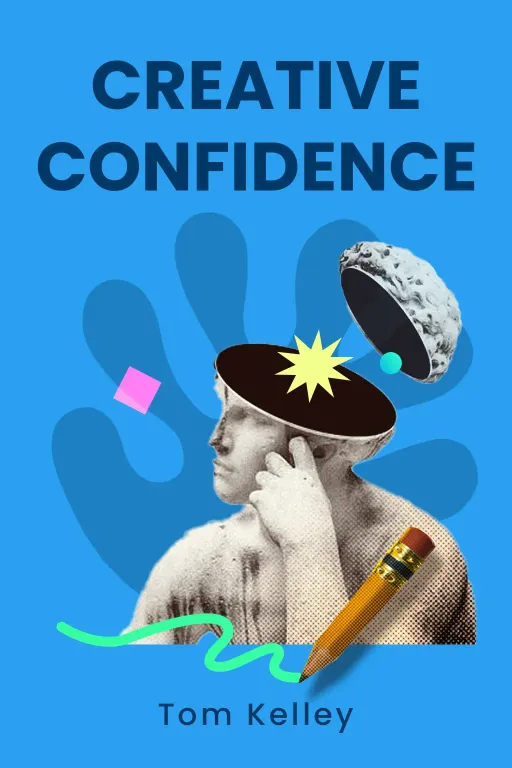
Nova: Absolutely, Atlas! And it's a misconception that holds so many people back. Today, we're diving into this with the help of "Creative Confidence" by Tom Kelley and David Kelley. These brothers aren't just theorists; they're the minds behind Stanford's legendary d. school, which is a global hub for design thinking. They've built a whole curriculum around making innovation systematic.
Atlas: Stanford's d. school, that’s serious pedigree. So, they're basically saying you don't have to be born a Picasso to innovate. You can learn it, like, step-by-step? For someone who builds practical pathways, that sounds incredibly appealing.
Nova: Exactly. They argue that fear often blocks our innate creativity. The fear of judgment, the fear of failure, the fear of looking silly. But creativity, they say, is a skill, a mindset. And once you overcome that fear, you open up a world of possibilities.
Unlocking Your Innate Creative Confidence
SECTION
Atlas: So you're saying the first step to being a digital marketing innovator isn't a new software, it's... therapy for my inner critic? How do the Kelley brothers actually define 'creative confidence' beyond just 'not being scared'? What's the practical side of it?
Nova: It's more than just not being scared, Atlas. It's the belief that you can come up with original ideas and have the courage to act on them. They share methods from the d. school, emphasizing empathy and rapid prototyping. Imagine an e-commerce architect, right? They're trying to launch a new line of sustainable home goods. They've got the product, it's great, but their marketing just isn't cutting through the noise. They're stuck, thinking they need some 'genius' campaign idea.
Atlas: Oh, I know that feeling. The market is saturated, everyone's doing sustainability. You feel like you've tried every angle, every ad copy. It's exhausting.
Nova: Precisely. Instead of waiting for a lightning bolt moment, the Kelley brothers would suggest they apply design thinking. First,. Instead of just guessing, they'd actively talk to their target customers. Not just surveys, but deep interviews. What are their hopes, their fears, their daily routines? What are their real pain points when trying to live sustainably?
Atlas: So, it's not just about what marketers customers want, but what they? How do you even figure that out effectively in a fast-paced environment? Is this different from just 'good customer service'?
Nova: It goes deeper, Atlas. It's about uncovering unarticulated needs. For instance, our e-commerce architect might discover that customers are overwhelmed by too many sustainable choices, or they distrust greenwashing. This leads to the phase: clearly articulating the core problem based on those insights. Maybe it's "How might we help busy consumers easily identify truly sustainable, trustworthy home goods?"
Atlas: Okay, that's a much clearer problem statement than "How do we sell more eco-friendly stuff?" So, once you have that defined problem, then what? Brainstorming?
Nova: That's where comes in. Yes, brainstorming, but with specific rules. Quantity over quality initially. No bad ideas. Then, crucially,. This is where rapid prototyping comes in. Instead of spending months building a full-blown ad campaign, they might create a quick mock-up of a new website section that highlights certifications, or a simple video explaining their vetting process. It's about getting something tangible in front of users quickly.
Atlas: So, a 'rapid prototype' in a digital context isn't a fancy piece of software, it could be a sketch on a napkin, a PowerPoint presentation, or even just a few wireframes? Just enough to get feedback?
Nova: Exactly! And then you it. You put that quick prototype in front of real customers and observe their reactions. Does it solve their problem? Does it build trust? This iterative process, moving quickly from empathy to testing, builds creative confidence because you're constantly learning and improving, rather than fearing one big, make-or-break launch. It takes the pressure off.
Designing for Humans: The Empathy-Driven Solution
SECTION
Nova: And this idea of profoundly understanding the user naturally leads us to our next key insight, one that often acts as the bedrock for true innovation: designing for humans.
Atlas: Designing for humans. That sounds intuitive, but I suspect it's harder than it sounds. What are we talking about here?
Nova: We're talking about "The Design of Everyday Things" by Don Norman. Norman is a cognitive psychologist, and he practically invented the field of user-centered design. His book highlights how understanding human psychology and behavior is absolutely key to creating intuitive and effective solutions. It's about designing for people, not just products or features.
Atlas: Oh, I know that book! It's famous for talking about things like door handles that confuse you, or stovetop controls that make no sense. So, in the digital world, that would be like a clunky e-commerce checkout flow, or an app that's impossible to navigate?
Nova: Precisely. Norman shows us that when something is difficult to use, it's usually not the user's fault; it's a design flaw. Take an e-commerce site, for example. Many focus on showcasing as many products as possible, or adding the latest AI-powered recommendation engine. They're product-centric. But Norman would argue you need to be user-centered.
Atlas: So, it's not just about what marketers customers want, but what they? How do you even figure that out effectively in a fast-paced environment? Is this different from just 'good customer service'?
Nova: It's definitely different from just good customer service, though it certainly impacts it. Good customer service reacts to problems; good design them. Imagine an online dropshipping store with a fantastic product, but customers keep abandoning their carts. The owner might initially think, "My prices are too high," or "My product descriptions aren't good enough."
Atlas: That's a classic e-commerce headache. You pour all this effort into getting traffic, and then they bounce at the last step.
Nova: Right. A Norman-inspired approach would involve observing users. They might find that the shipping cost is hidden until the very last step, or the form fields are confusing, or there’s no clear progress indicator. These are all human behavior insights. People get frustrated by surprises, they need clear signaling, and they like a sense of progress.
Atlas: So, instead of adding more features, you'd simplify, make things more transparent, and guide the user intuitively. It's about removing friction, anticipating their mental model. That sounds incredibly powerful for refining dropshipping strategies, where every click counts.
Nova: Absolutely. Norman's work proves that when you design with a deep understanding of human behavior—their cognitive processes, their emotional responses, their natural tendencies—you create solutions that aren't just functional, but delightful. Solutions that feel "right" because they align with how we naturally think and interact.
Atlas: And that ties back directly to the Kelley brothers' idea of empathy, doesn't it? Understanding your user isn't just a nice-to-have; it's the foundation for any innovation that actually works.
Nova: Exactly! Structured creativity, rooted in understanding people, is the most powerful tool for innovation.
Synthesis & Takeaways
SECTION
Nova: So, what we've really explored today is how innovation isn't this mysterious lightning bolt. It's a process. It's a skill you learn and apply. And at its heart is empathy.
Atlas: That's actually really inspiring. For any practical innovator or e-commerce architect out there, it means you're not waiting for a stroke of genius. You're building a system, a mindset, that genius. It's about trusting your unique blend of creativity and practicality, which is a powerful combination.
Nova: It truly is. And our tiny step for you this week, straight from the book's philosophy, is to pick one small problem you face. Maybe it's a social media content block, or a conversion rate dip on a specific product page. And then, apply a 'design thinking' approach to it.
Atlas: Empathize – really understand who you're solving this for. Define – clearly state the problem. Ideate – generate wild solutions. Prototype – make a quick, dirty version. And test – see what happens. It's a cycle of learning, not a one-shot gamble.
Nova: It's about moving from guessing to innovating. As David Kelley once said, "Creative confidence is like a muscle; the more you use it, the stronger it gets." It's a skill you can cultivate, and it will transform how you approach every challenge, especially in digital marketing and e-commerce.
Atlas: That gives me chills. It's about empowering others' success, starting with your own ability to solve problems creatively. What a powerful way to look at it.
Nova: This is Aibrary. Congratulations on your growth!