

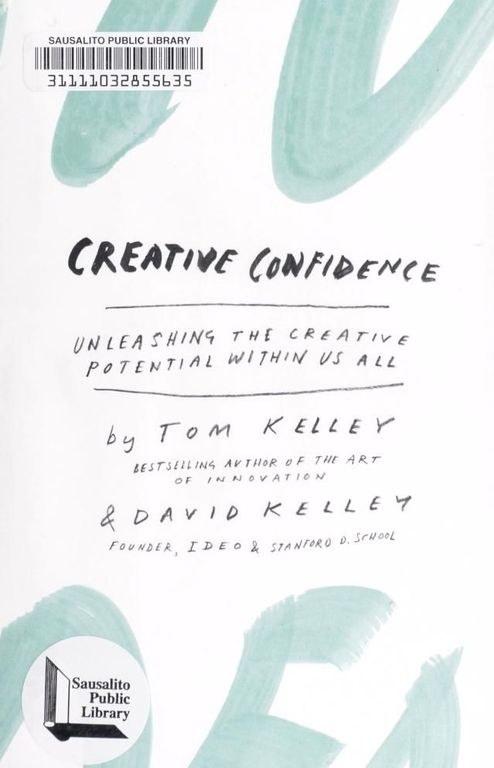
Creative Confidence
Unleashing the Creative Potential Within Us All
Introduction
Nova: Think back to when you were a kid in kindergarten. If a teacher asked the class, how many of you are artists, what happened? Every single hand went up, right? We were all painters, builders, and storytellers. But then, something happens as we grow up. By the time we hit high school or the corporate world, if you ask that same question, only a few people tentatively raise their hands. Most of us have decided we are just not the creative type.
Atlas: It is like there is this invisible line drawn in the sand. On one side, you have the designers, the musicians, the people with the messy desks and the big ideas. On the other side, you have the rest of us, the spreadsheets and logistics people. We have been told, or we have told ourselves, that creativity is a gift you are either born with or you are not.
Nova: Exactly. And that is the exact myth that Tom and David Kelley set out to shatter in their book, Creative Confidence. David is the founder of IDEO and the Stanford d. school, and Tom is a partner at IDEO and the author of The Art of Innovation. These guys are the heavyweights of design thinking, and their message is simple but radical: creativity is not a talent. It is a muscle. And most of us just let it atrophy.
Atlas: So, they are saying that even the most analytical, data-driven person in the room has a hidden creative genius waiting to be unleashed? That sounds like a tall order. How do you actually convince someone who has spent twenty years in accounting that they are creative?
Nova: It starts by redefining what creativity actually is. It is not just about oil painting or writing poetry. It is about a way of looking at the world and having the courage to act on your ideas. Today, we are going to dive into how the Kelley brothers use psychology, empathy, and some pretty wild case studies to show us how to reclaim that childhood confidence and apply it to everything we do.
Key Insight 1
The Psychology of Fear
Nova: To understand why we lose our creative confidence, we have to look at fear. The Kelleys point to the work of Albert Bandura, one of the most influential psychologists in history. Bandura is famous for his work on self-efficacy, which is basically the belief that you have the power to change the world around you.
Atlas: Self-efficacy. That sounds like a fancy word for just being confident, but I am guessing there is more to it than just positive thinking.
Nova: Much more. Bandura found that people who have high self-efficacy set higher goals, work harder, and persist longer in the face of failure. But here is the kicker: he discovered a way to help people overcome deep-seated phobias using a process called guided mastery. He would take people who were deathly afraid of snakes and, through a series of small, manageable steps, get them to the point where they were actually holding a snake.
Atlas: Wait, are you saying that being afraid to share an idea in a meeting is the same as being afraid of a king cobra?
Nova: In the brain, the fear of judgment or failure can feel just as paralyzing. Bandura would start by having the person look at a snake through a window. Then, they would watch someone else touch it. Then, they would put on a heavy glove and touch it themselves. Eventually, the fear evaporated because they had a series of successful experiences. The Kelleys argue we need the same guided mastery for creativity.
Atlas: So, instead of jumping into the deep end and trying to reinvent a whole industry, you start with small, low-stakes creative acts? That makes sense. It lowers the barrier to entry. But what does that look like in a business setting?
Nova: It looks like giving yourself permission to fail in small ways. The Kelleys talk about how we often self-censor because we are afraid of looking stupid. We kill our best ideas before they even leave our heads. Guided mastery in creativity means practicing the act of generating ideas without judgment, starting with things as simple as how to improve your morning commute or redesigning your desk layout.
Atlas: It is about breaking that cycle of perfectionism. I think a lot of people feel like if the idea is not perfect, it is not worth sharing. But Bandura's research shows that once you gain confidence in one area, it spills over into others. If you realize you can solve a small problem creatively, you start believing you can tackle the big ones.
Nova: That is the bridge to creative confidence. It is the transition from I am not creative to I can figure this out. And once that shift happens, the way you approach your work and your life changes completely. You stop being a passive observer and start being an active designer of your own experience.
Key Insight 2
The Power of Empathy
Nova: One of the most powerful stories in the book involves a man named Doug Dietz. Doug was a principal designer at GE Healthcare, and he had spent two and a half years designing a state-of-the-art MRI machine. He was incredibly proud of it. It was sleek, high-tech, and efficient.
Atlas: I have seen those machines. They look like something out of a sci-fi movie. Very impressive engineering. I am guessing there is a but coming.
Nova: A huge but. Doug went to a hospital to see his machine in action, and he saw a little girl crying on her way to the MRI suite. He realized that for a child, that sleek, high-tech machine looked like a terrifying, giant monster that made loud, clanking noises. In fact, the hospital had to sedate about eighty percent of pediatric patients just to get them through the scan.
Atlas: That is heartbreaking. He built this amazing piece of technology, but he completely missed the human experience of using it. He focused on the specs, not the feelings.
Nova: Exactly. Doug was devastated, but instead of giving up, he went to the Stanford d. school to learn about design thinking and empathy. He realized he needed to stop looking at the machine and start looking at the children. He used empathy to step into their shoes. He observed them, talked to child life specialists, and really tried to understand what they were feeling.
Atlas: So, what did he do? Did he redesign the entire multi-million dollar machine from scratch?
Nova: No, and that is the brilliant part. He used what the Kelleys call a low-fidelity prototype. He used decals and paint to turn the MRI machines into adventures. One became a pirate ship where the kids had to lie still so the pirates would not find them. Another was a space station. He even added scents and sounds to match the theme.
Atlas: That is incredible. It is such a simple shift, but it changes the entire narrative for the kid. It goes from a medical procedure to a game.
Nova: The results were staggering. The sedation rate dropped from eighty percent to nearly zero. And the best part? One little girl, after finishing her scan, actually asked her mom if they could come back tomorrow. That is the power of empathy-driven creativity. It is not about the technology; it is about solving a human problem.
Atlas: It strikes me that Doug had to be humble enough to admit his first design failed the user. That takes a lot of confidence in itself, to look at your own work and say, I missed the mark, let me try again. It shows that empathy is not just a soft skill; it is a hard-core innovation tool.
Nova: It really is. The Kelleys emphasize that empathy is the starting point for all great innovation. If you want to be creative, stop looking for ideas in your head and start looking for them in the lives of other people. When you solve a real pain point for someone else, the creativity flows naturally because you have a clear purpose.
Key Insight 3
Prototyping and Failing Forward
Nova: If empathy is the heart of creative confidence, then prototyping is the hands. The Kelleys talk a lot about the importance of building to think. Instead of spending months planning and theorizing, you build something messy and cheap as fast as possible.
Atlas: This sounds like the move fast and break things mantra, but maybe a bit more intentional. Why is it so important to build something early if you know it is going to be wrong?
Nova: Because you learn more from a twenty-minute prototype than a twenty-page business plan. Take the story of the Embrace infant warmer. A group of Stanford students were tasked with designing a low-cost incubator for premature babies in developing countries. Traditional incubators cost up to twenty thousand dollars and require constant electricity, which many rural clinics do not have.
Atlas: Twenty thousand dollars is impossible for a small village clinic. So, how did they approach it? I am guessing they did not just try to make a cheaper version of the big machine.
Nova: They did not. They went to Nepal and talked to mothers and doctors. They realized that the real problem was not just the cost of the incubator, but the distance. Babies were dying on the way to the hospital because they could not stay warm. So, they prototyped a sleeping bag-like pouch with a wax-based insert that could stay warm for hours after being dipped in hot water.
Atlas: A sleeping bag instead of a high-tech box. That is a massive shift in thinking. And they probably went through dozens of versions of that bag before they got it right.
Nova: Hundreds. They failed forward. The Kelleys argue that the faster you fail, the faster you succeed. If you treat every idea as a precious masterpiece, you will be too afraid to change it when you find a flaw. But if it is just a piece of cardboard and tape, you do not mind throwing it away and starting over.
Atlas: It is about lowering the cost of failure. If failure is cheap, you can afford to do it often. I think we often get stuck in analysis paralysis because we want the first version to be the final version. But the Kelleys are saying that the first version is just a question you are asking the world.
Nova: I love that. A prototype is a question. And the feedback you get is the answer. They suggest using a simple framework for feedback called I like, I wish. When you show someone a prototype, they start with what they like, and then they frame their critiques as I wish it did this or I wish it felt like that. It keeps the conversation constructive and keeps the creative momentum going.
Atlas: It removes the sting of criticism. It is not this is bad, it is I wish it were better in this specific way. That seems like a great way to build a culture where people actually feel safe sharing their half-baked ideas.
Nova: Exactly. And that safety is where creative confidence lives. When you know that your team is going to help you iterate rather than shut you down, you are much more likely to take the risks necessary for a real breakthrough.
Key Insight 4
The Creative Toolbox
Nova: So, how do we actually start building this muscle? The book is full of practical exercises. One of my favorites is called the Thirty Circles exercise. You take a piece of paper with thirty blank circles on it, and you have three minutes to turn as many of those circles as possible into recognizable objects.
Atlas: Three minutes for thirty circles? That is only six seconds per circle. You do not have time to think, you just have to draw. I bet most people get stuck after the first ten.
Nova: They do. The first few are easy: a clock, a smiley face, a donut. But then you hit a wall. That is where the real work begins. You have to push past the obvious and start being truly divergent. You might see a circle and think of a porthole on a submarine, or a cell under a microscope, or the eye of a needle.
Atlas: It forces you to stop self-editing. When you are in a rush, your internal critic cannot keep up. It is a great way to show people that they actually have a lot of ideas if they just get out of their own way.
Nova: Another tool they recommend is mind mapping. Instead of writing a linear list, you put your central idea in the middle of a page and branch out with related thoughts, images, and connections. It mimics the way our brains actually work, which is through association rather than hierarchy.
Atlas: I have used mind maps before, and they really do help you see connections you would have missed otherwise. It is like seeing the whole landscape of a problem at once. But what about people who say they just do not have time for these exercises? Our lives are so busy already.
Nova: The Kelleys suggest a concept called the creative spark. It is about finding small moments to inject creativity into your day. It could be taking a different route to work, or trying a new food, or simply observing people in a coffee shop and wondering about their stories. It is about staying curious.
Atlas: So, it is a lifestyle, not just a workshop you attend once a year. It is about keeping your eyes open and constantly asking, why is it this way? and how could it be better?
Nova: Precisely. They also talk about the importance of your environment. If you want to be creative, you need a space that supports it. That does not mean you need a slide in your office like Google, but it might mean having whiteboards everywhere, or bringing in objects that inspire you, or even just changing the lighting. Your physical surroundings send signals to your brain about whether it is safe to play or if it needs to be in serious mode.
Atlas: It is about creating a permission structure. If the environment says it is okay to experiment, people will. If it says stay in your lane and do not make mistakes, people will do exactly that. It sounds like creative confidence is as much about the culture we create as it is about our individual mindset.
Conclusion
Nova: We have covered a lot of ground today, from the psychology of fear and Albert Bandura's snakes to the life-saving empathy of Doug Dietz and the Embrace infant warmer. The core takeaway from Creative Confidence is that you are already creative. You were born that way. You just might have forgotten how to use that part of yourself.
Atlas: It is a powerful reminder that creativity is not a luxury for the few, but a necessity for the many. Whether you are a CEO, a teacher, a parent, or a student, having the confidence to act on your ideas is what allows you to make a meaningful impact. It is about moving from being a passenger in your life to being the pilot.
Nova: And it starts with small steps. Use guided mastery to face your fears. Use empathy to understand the people around you. Build prototypes to test your ideas quickly. And most importantly, stop waiting for permission to be creative. You already have it.
Atlas: I am definitely going to try that thirty circles exercise later today. I want to see what my brain comes up with when I stop giving it time to be bored. It is exciting to think that we all have this untapped potential just waiting for a little bit of exercise.
Nova: That is the spirit. The world needs your ideas, even the messy, half-baked ones. Because those are the ones that eventually grow into the solutions we all need. Thank you for joining us on this deep dive into the work of Tom and David Kelley.
Atlas: It has been an eye-opening journey. I am feeling a lot more confident already.
Nova: This is Aibrary. Congratulations on your growth!