

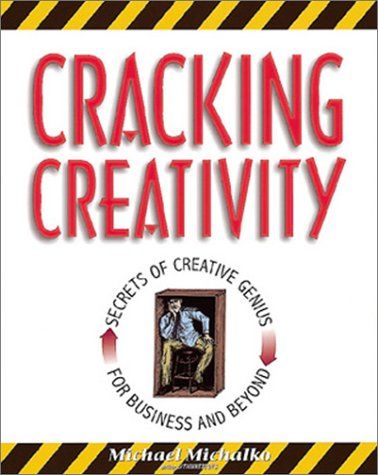
Cracking creativity
The Secrets of Creative Genius
Introduction
Nova: Have you ever sat at your desk, staring at a blank screen, just waiting for that lightning bolt of inspiration to strike? We have this cultural obsession with the idea that creativity is this mystical, rare gift that only people like Steve Jobs or Leonardo da Vinci were born with. But what if I told you that creativity isn't a gift at all, but a mechanical process that anyone can master?
Atlas: I would say that sounds like a very bold claim. I mean, I have definitely had those days where I feel about as creative as a brick. Are you telling me there is actually a manual for this?
Nova: Exactly. And that manual is Michael Michalko's book, Cracking Creativity. Michalko is a fascinating guy. He was actually a lead researcher for the U. S. Army's intelligence division, where he specialized in creative thinking techniques. He spent years analyzing the greatest minds in history—people like Einstein, Edison, and Darwin—to figure out exactly how they thought.
Atlas: Wait, the Army has a creativity division? That is not the first place I would look for innovation. But I guess if you are trying to outthink an opponent, you need to be pretty creative. So, what did he find? Is there a secret sauce?
Nova: There is. He discovered that geniuses don't necessarily have higher IQs or better brains. They just use specific thinking strategies that the rest of us usually ignore. Today, we are going to break down those strategies so you can start cracking your own creativity.
Key Insight 1
The Trap of Reproductive Thinking
Nova: The first big hurdle Michalko identifies is something he calls reproductive thinking. This is how most of us operate 99 percent of the time. When we face a problem, we look into our past experiences and ask, what have I done before that worked? We reproduce a solution that already exists.
Atlas: That sounds efficient, though. Why reinvent the wheel every time you need to get somewhere? If I know how to fix a leaky faucet because I did it last year, why would I want to think about it differently?
Nova: For a leaky faucet, you are right. Reproductive thinking is great for routine tasks. But the problem is that it creates mental ruts. Michalko explains that our brains are designed to be efficient, so they categorize information into patterns. Once a pattern is formed, we stop seeing the actual problem and only see the pattern. This is why experts often struggle to innovate—they are so good at the old way that they literally cannot see a new way.
Atlas: So, it is like driving on a highway. It is fast and easy, but you never see the scenery off the beaten path. What is the alternative then?
Nova: Productive thinking. Instead of asking how I have solved this before, a productive thinker asks, how many different ways can I look at this? They don't look for the right answer; they look for all possible answers. Michalko uses the example of Richard Feynman, the Nobel Prize-winning physicist. When he got stuck, he would reinvent the entire problem from scratch, even if the solution was already known, just to see if he could find a different path to it.
Atlas: That sounds exhausting, honestly. But I see the point. If you only look for the right answer, you stop as soon as you find one. If you look for all answers, you might find something much better that was hidden behind the obvious one.
Nova: Precisely. Michalko says that the goal of productive thinking isn't to be right; it is to be prolific. He argues that the main difference between a genius and a regular person is simply the volume of ideas they generate. Geniuses produce a massive amount of junk, but because they produce so much, they are statistically more likely to hit on something brilliant.
Key Insight 2
The Power of the Idea Quota
Nova: This brings us to one of the most practical tools in the book: The Idea Quota. Michalko suggests that if you want to solve a problem, you should set a rigid daily quota for ideas. For example, tell yourself you must come up with 40 ideas for a new marketing campaign before you can leave for the day.
Atlas: Forty? I feel like I would run out of good ideas by number five. What do you do for the other thirty-five?
Nova: That is actually the point! Michalko says the first five or ten ideas are just your reproductive thinking kicking in. They are the clichés, the easy stuff, the things you have seen before. Once you exhaust those, your brain starts to panic a little. It has to start reaching for weird connections and strange possibilities to meet the quota. That is where the real creativity happens.
Atlas: It is like a workout for your brain. You have to push past the point of fatigue to actually build muscle. Did any of the famous geniuses actually do this?
Nova: Absolutely. Thomas Edison is the poster child for this. He had a personal quota of one minor invention every ten days and a major invention every six months. He held over a thousand patents! But here is the kicker: for every successful invention like the lightbulb, he had thousands of failures that nobody ever hears about. He didn't just have one great idea; he had a mountain of ideas and picked the best ones.
Atlas: I think we often forget that part. We see the lightbulb and think he was a wizard, but we don't see the nine thousand ways he found that didn't work. It makes genius feel a lot more like manual labor, which is actually kind of encouraging.
Nova: It really is. Michalko calls this blind variation. It is the same way evolution works. Nature doesn't know which mutation will be beneficial, so it just produces millions of variations and lets the environment select the winners. To be creative, you have to be your own evolutionary engine. You have to be willing to produce a lot of bad work to get to the good work.
Key Insight 3
Seeing What Others Don't
Nova: Another strategy Michalko highlights is making your thoughts visible. He points out that many geniuses, like Leonardo da Vinci and Galileo, didn't just think in words. They used diagrams, sketches, and maps.
Atlas: I am a terrible artist, Nova. If my creativity depends on my ability to draw, I am in big trouble.
Nova: It is not about being an artist; it is about spatial reasoning. When you write a list of ideas, your brain processes them linearly—one after the other. But when you draw a mind map or a diagram, you can see relationships between ideas that aren't next to each other. You start to see the architecture of the problem.
Atlas: Okay, so it is like looking at a map of a city instead of just following GPS directions. You see how the different neighborhoods connect.
Nova: Exactly. Da Vinci used to doodle in the margins of his notebooks to explore different perspectives of a single object. Michalko suggests a technique called restructuring. If you are stuck, try to describe your problem in a completely different way. Instead of saying, how can I sell more of this product?, try asking, how can I make people want to tell their friends about this product? Or even, how could I make people hate this product?
Atlas: Wait, why would I want to make people hate it? That seems counterproductive.
Nova: It is a technique called reversal. By looking at the opposite of your goal, you often uncover hidden requirements or obstacles you hadn't considered. If you know exactly how to make someone hate a product—say, by making it hard to open or confusing to use—you suddenly have a checklist of things you must get right to make them love it.
Atlas: That is clever. It is like looking at the negative space in a painting. Sometimes what is not there tells you more than what is.
Key Insight 4
The SCAMPER Method
Nova: Now, we have to talk about the most famous tool in Michalko's arsenal: SCAMPER. It is an acronym that helps you manipulate an existing idea into something new. It stands for Substitute, Combine, Adapt, Modify, Put to another use, Eliminate, and Reverse.
Atlas: Okay, let's break that down. Give me an example. How would I SCAMPER, say, a standard office chair?
Nova: Great. Let's start with Substitute. Could you substitute the legs for wheels? Or the fabric for mesh? Combine: Could you combine the chair with a massage unit or a desk? Adapt: Could you adapt the design of a car seat for an office chair?
Atlas: I see where this is going. Modify: Make it giant or tiny. Put to another use: Could it be a piece of exercise equipment? Eliminate: Get rid of the backrest, and suddenly you have a stool.
Nova: You got it! And Reverse: What if the person stands and the chair moves? That leads you to things like standing desks or leaning stools. SCAMPER is powerful because it gives you a specific set of questions to ask when your brain feels stuck. It forces you to look at the object or problem from angles you would never naturally consider.
Atlas: It is basically a checklist for brainstorming. It takes the pressure off of having to be inspired and gives you a process to follow. I like that. It feels much more manageable than just waiting for a muse to show up.
Nova: Michalko also talks about forced connections. This is where you take two completely unrelated things and force them together. Like, take a skyscraper and a beehive. How could a skyscraper be more like a beehive? Maybe it has modular units that can be added or removed? Maybe it has a centralized climate control system based on airflow?
Atlas: That is actually how a lot of biomimicry works in architecture, right? Looking at nature to solve human problems. It is all about connecting the unconnected.
Conclusion
Nova: We have covered a lot today, from the trap of reproductive thinking to the power of the SCAMPER method. The biggest takeaway from Michael Michalko's Cracking Creativity is that creativity is a choice. It is a choice to look longer, to look deeper, and to produce more than anyone else.
Atlas: It is really a shift in mindset. Instead of seeing ourselves as either creative or not, we should see ourselves as people who either have a process or don't. I am definitely going to try that Idea Quota tomorrow. Even if the first thirty ideas are garbage, I am curious to see what number thirty-one looks like.
Nova: That is the spirit. Remember, the goal isn't to find the perfect idea on the first try. It is to create a massive field of possibilities and then use your judgment to pick the winners. As Michalko says, genius is often just the result of a very high rate of failure combined with the persistence to keep going.
Atlas: I love that. It makes the whole process feel much more human. You don't have to be a genius; you just have to be prolific and a little bit brave.
Nova: Well said. If you want to dive deeper, I highly recommend picking up the book. It is filled with hundreds of exercises and stories that we couldn't even touch on today. But for now, start with a quota, try a reversal, and see what happens when you stop looking for the right answer and start looking for all the answers.
Atlas: Thanks for walking me through this, Nova. I feel a lot less like a brick and a lot more like a scientist in a lab.
Nova: That is exactly what you are. This is Aibrary. Congratulations on your growth!