The Grand Unified Blind Spot: Connecting the Cosmic Dots
Golden Hook & Introduction
SECTION
Nova: Universe. Connected. Magic. Insight. Perspective.
Atlas: Big. Ideas. Hard. To. Grasp?
Nova: Ha! Atlas, I think you just perfectly encapsulated the challenge and the thrill of what we're diving into today. It's about seeing the universe not as a collection of separate puzzle pieces, but as one magnificent, interconnected whole.
Atlas: I like that. It’s like, we spend so much time specializing, becoming experts in one tiny corner, that we forget there’s a whole landscape out there.
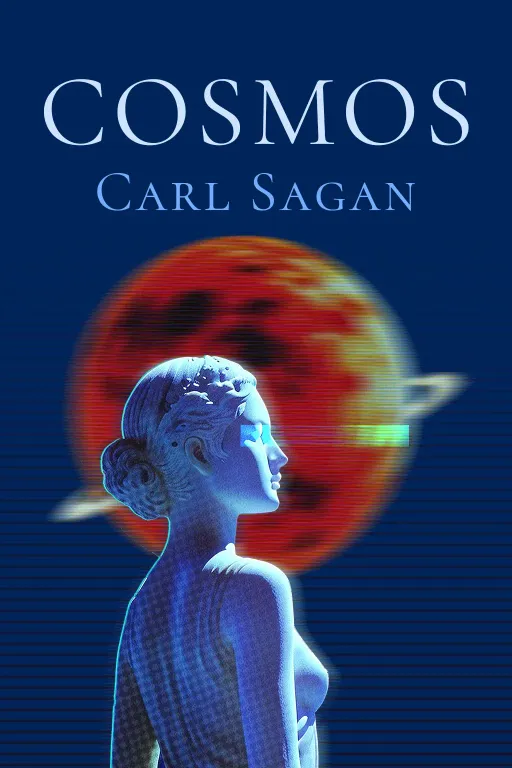
Nova: Exactly! And that's where the real magic happens, at those intersections. Today, we're exploring what I call the "Grand Unified Blind Spot," and how some incredible thinkers have helped us overcome it. We're going to journey through the ideas of two giants: Carl Sagan, with his seminal work "Cosmos," and David Deutsch, with "The Fabric of Reality." Sagan, of course, was a master at weaving together astrophysics, biology, and the history of science into this poetic, accessible narrative that truly showed humanity's place in the vast cosmic tapestry. He was a storyteller par excellence, making the universe feel both grand and intimately personal.
Atlas: I can definitely see how his approach would resonate. It’s one thing to know facts, but another entirely to feel where you fit into the grand scheme.
Nova: Absolutely. And then Deutsch takes that interconnectedness to a foundational level, arguing that four seemingly disparate strands form the very fabric of existence. It’s a bold claim, and it challenges us to look beyond our disciplinary silos.
Deep Dive into Core Topic 1: The Grand Unified Blind Spot
SECTION
Nova: So, let's talk about this "Grand Unified Blind Spot." Think of it like this: imagine a brilliant mechanic. This person can rebuild any engine part, diagnose any electrical fault, perfectly tune a carburetor, or even design a new transmission from scratch. They are an absolute expert in every single component of a car.
Atlas: Okay, I’m with you. Sounds like someone you’d want working on your vintage muscle car.
Nova: Precisely. But here's the blind spot: this mechanic has never actually driven a car. They understand every nut and bolt, every system in isolation, but they've never experienced the car as a unified machine moving through the world, reacting to the road, or performing a journey. They miss the of the car, its purpose, its integrated function.
Atlas: Oh, I see. So, they know all the pieces, but not the symphony they create.
Nova: Exactly! And that’s often how we approach knowledge. We specialize, we become incredibly good at one discipline—biology, physics, history—but we sometimes miss how these disciplines intertwine to create a grander, more unified picture of reality. Carl Sagan’s "Cosmos" was a monumental effort to tear down those disciplinary walls. He wasn't just teaching astronomy; he was showing how the elements forged in distant stars, through astrophysics, are the very building blocks of life, which is biology. And how our slow, often stumbling discovery of these facts is part of our human intellectual history.
Atlas: That’s a great way to put it. For anyone who’s deeply invested in a specific research area, or even just working in a very specialized field, how do they even begin to "connect cosmic dots" without feeling completely overwhelmed or, honestly, a bit superficial? Isn't specialization necessary for deep expertise?
Nova: It’s a fantastic question, and you're right, deep expertise is absolutely critical. But Sagan's genius was showing us that true depth isn't just about going further down one particular well; it's also about understanding the aquifer that connects all the wells. He illustrated how, for instance, the carbon in our bodies was forged in the heart of an ancient star. That's astrophysics, yes, but it's also fundamental to biology. And the story of how we figured that out—the scientific method, the trial and error, the leaps of insight—that's history and epistemology. He didn't ask us to become experts in everything, but to appreciate the profound, often unexpected connections. It’s about cultivating an interdisciplinary mindset, even if your daily work remains specialized. It’s the difference between knowing the ingredients and understanding the entire culinary tradition.
Deep Dive into Core Topic 2: The Fabric of Reality – Four Fundamental Strands
SECTION
Nova: Now, if Sagan showed us the magnificent tapestry of interconnected knowledge, David Deutsch, in "The Fabric of Reality," gives us the very threads. He proposes that existence itself is woven from just four fundamental strands: quantum physics, evolution, computation, and epistemology.
Atlas: Oh, I love that imagery. The threads of reality. But wait, for someone who just heard the word "epistemology," can you break that down a bit? And how do these four seemingly disparate ideas actually connect? Because on the surface, quantum physics and, say, the theory of knowledge, don't exactly scream "intertwined."
Nova: Great point, Atlas. Epistemology, in its simplest form, is the theory of knowledge—how we know what we know, how we acquire it, and how we justify our beliefs. It's the study of knowledge itself. And Deutsch argues these four are not just related, but fundamentally interdependent. Take quantum physics: it's the most accurate description we have of reality at its most fundamental level. But without our ability to its implications, which is the computation strand, our understanding would be severely limited. Think of the complex calculations needed to predict particle behavior.
Atlas: Okay, so computation helps us understand quantum physics. That makes sense.
Nova: And then, consider evolution. We often think of it in biological terms, but Deutsch extends it far beyond that. He argues that ideas themselves evolve, much like biological organisms. Successful ideas propagate, mutate, and adapt, while less effective ones die out. This applies to scientific theories, cultural memes, even the development of technology. And how do we which ideas are better, which theories are more robust? That's where epistemology comes in—our methods of critical thinking, experimentation, and error correction.
Atlas: So, evolution applies not just to DNA, but to the very way our knowledge progresses. That’s a great way to put it. So, let me check if I got that right: quantum physics describes the universe, computation allows us to model and predict it, evolution explains how both life and ideas change over time, and epistemology is how we refine our understanding of all of it?
Nova: Perfectly summarized! And the truly profound insight is that these aren't just parallel lines; they're interwoven. For example, the very possibility of universal computation, which is the bedrock of our digital world, relies on the principles of quantum mechanics. And our ability to develop these sophisticated theories—quantum physics, evolution, computation—is itself an evolutionary process of ideas guided by epistemological principles.
Atlas: That makes me wonder, how does understanding these four strands fundamentally change our approach to a complex problem, like, say, climate change or even developing new AI? Those seem to touch on all these areas.
Nova: It’s a powerful shift in perspective. If you're tackling climate change, you're not just looking at atmospheric physics or ecological systems. You're also considering how computational models predict future scenarios, and critically, how our about climate change evolves, how we gather evidence, and how we persuade others. For AI, it’s even more direct: it's built on computation, draws inspiration from biological evolution, and its very ability to learn and acquire knowledge is an epistemological challenge. By seeing these connections, you start to ask bigger, more fundamental questions, and you unlock solutions that might be invisible if you only looked through a single disciplinary lens. It's about seeing the entire engine, not just the spark plugs or the pistons.
Synthesis & Takeaways
SECTION
Nova: What both Sagan and Deutsch highlight, in their own unique ways, is that our biggest blind spot isn't a lack of information within a field, but a lack of connection fields. The universe, and our understanding of it, is a unified whole.
Atlas: That’s actually really inspiring. It means that the next big breakthrough might not come from digging deeper into one tiny niche, but from someone brave enough to step back and ask how their niche connects to something completely different. It's less about knowing more, and more about connecting what we already know in new ways.
Nova: Exactly. It's about creative synthesis, seeing the bigger picture. It's about realizing that the cosmos isn't just out there; it's within us, it's in our thoughts, and it's in the very fabric of how we understand everything. And recognizing that unified blind spot isn't a deficiency; it's an invitation to a more profound, more holistic understanding of reality.
Atlas: So, for our listeners, I’d ask: what’s a current problem or research area you’re grappling with, and how might connecting it to a seemingly unrelated scientific concept, or one of Deutsch’s four strands, reveal a new truth or perspective you hadn't considered?
Nova: A fantastic question to leave everyone with.
Atlas: This is Aibrary. Congratulations on your growth!