The Cosmic Scale: How Space Exploration Redefines Human History
Golden Hook & Introduction
SECTION
Nova: Carl Sagan: Humanity's grand cosmic story.
Atlas: Tiny blue dot, massive responsibility.
Nova: Exactly! And that, Atlas, is the perfect five-word review for our journey today. We're diving deep into the profound legacy of Carl Sagan, specifically how his groundbreaking works like "Cosmos" and "Pale Blue Dot" absolutely revolutionize our understanding of human history.
Atlas: Oh, I love that. I mean, Sagan is just… he's a legend. But what makes the one to truly redefine history? We've had historians for centuries, right?
Nova: Well, that's the magic of Sagan. He wasn't just an astronomer; he was a poet of the cosmos, a brilliant astrophysicist who could translate the most complex scientific ideas into accessible, almost spiritual prose. He saw science not just as facts, but as a human story, a quest for origins. It’s this unique blend of scientific rigor and philosophical insight that allowed him to connect our terrestrial past to the vastness of the universe in a way no one else truly had. He didn't just study stars; he showed us how we are made of them.
Atlas: That makes me wonder… I mean, for most of us, history is about kings and queens, wars and empires, right here on Earth. So, how does Sagan even begin to connect that to, say, exploding stars or distant galaxies? It feels like we've got this huge blind spot.
The Terrestrial Blind Spot & Cosmic Connection
SECTION
Nova: Precisely, Atlas! You’ve hit on Sagan’s central argument: our "terrestrial blind spot." We've traditionally viewed human history as a purely Earth-bound phenomenon. We study the rise and fall of civilizations, technological advancements, cultural shifts—all confined to this blue marble. But Sagan argues this perspective is fundamentally limiting. It's like reading a single chapter of an epic saga and thinking you understand the entire plot.
Atlas: Yeah, I can definitely relate. My history classes never started with the Big Bang, you know? It was always Mesopotamia, then Egypt, then Greece…
Nova: Exactly! But Sagan, especially in "Cosmos," masterfully weaves the story of the universe with humanity's intellectual evolution. He shows how our scientific discoveries aren't just isolated breakthroughs; they're deeply tied to our innate desire to understand our origins, to ask "where did we come from?" Think about the earliest astronomers, charting the stars, building Stonehenge. They weren't just curious; they were trying to understand their place in the cosmos, to predict seasons, to connect to something larger. Their innovations, like the invention of the calendar, were direct responses to cosmic observations.
Atlas: So you're saying that the very act of looking up, of questioning the heavens, was a driving force in early human history? Like, our scientific discoveries about the universe are actually a of human history, not a separate story?
Nova: Absolutely. Take something as fundamental as the origin of the elements. Before we understood stellar nucleosynthesis, the idea that the atoms making up our bodies—the carbon, the oxygen, the iron in our blood—were forged in the hearts of ancient stars and scattered across the galaxy by supernovae… that was unimaginable. Understanding this scientific fact isn't just about physics; it's about our cosmic genealogy. It means that the very building blocks of the pyramids, the ink on ancient scrolls, the DNA in our cells, literally came from space. Our history is, in a very real sense, a cosmic history.
Atlas: Wow, that’s actually really inspiring. It feels like it adds this incredible depth to everything. But wait, how does knowing we're stardust change my perception of, say, the Napoleonic Wars, or the invention of the printing press? I mean, those events feel very human, very earthly. Does this cosmic view diminish their significance, or make them more profound?
Nova: It doesn't diminish them; it reframes them. The ambition of Napoleon, the ingenuity behind the printing press – these are still remarkable human endeavors. But when you place them against the backdrop of billions of years of cosmic evolution, suddenly that ambition, that ingenuity, becomes part of a grander, ongoing narrative of consciousness emerging from the universe to understand itself. It's not just a story of power or progress; it's a story of a small, fragile consciousness grappling with its existence on a tiny speck in an unimaginable void. It adds a layer of humility, yes, but also a profound sense of awe at what life, what life, has managed to achieve against such odds.
Atlas: I guess I never thought of it that way. It's like, the scale of the universe makes our earthly triumphs and failures simultaneously tiny and monumental. It's a humbling thought, for sure.
The Pale Blue Dot: Fragility, Isolation, and Universal Stewardship
SECTION
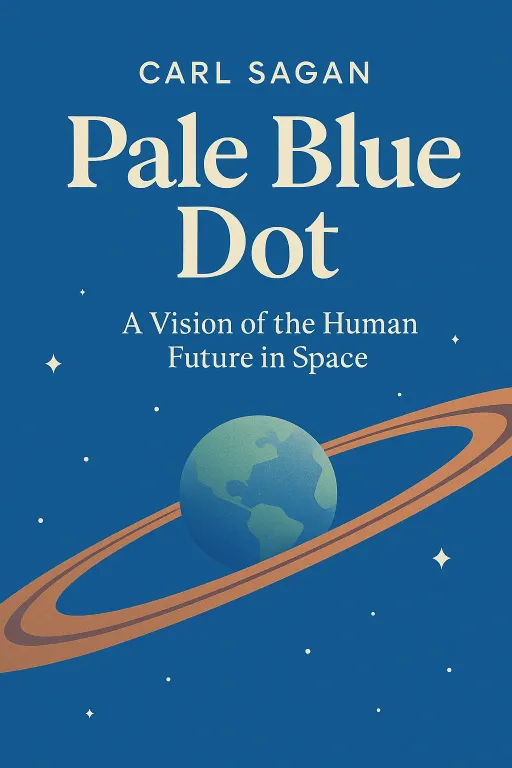
Nova: And that naturally leads us to the second key idea we need to talk about, which often acts as a powerful counterpoint to the grand sweep of cosmic history we just discussed. It's the iconic image and the philosophy behind it: the "Pale Blue Dot."
Atlas: Oh, I know that image! It’s Earth, seen from Voyager 1, right? Just a tiny speck. It’s beautiful, but also kind of… lonely.
Nova: Exactly. In 1990, the Voyager 1 probe, having completed its primary mission, was commanded to turn its camera back towards Earth from about 3.7 billion miles away. The resulting image showed our home planet as a tiny, faint blue pixel, almost lost in a beam of scattered sunlight. Sagan’s reflection on that image in his book "Pale Blue Dot" is one of the most powerful calls to action ever written. He saw in that speck the profound fragility and isolation of our world.
Atlas: That makes me wonder, what did he mean by "fragility and isolation"? I mean, we feel pretty substantial down here.
Nova: He meant that everything we cherish—every human ambition, every historical event, every joy, every sorrow—occurred on that one tiny pixel. He wrote, "Our posturings, our imagined self-importance, the delusion that we have some privileged position in the Universe, are challenged by this point of pale light." When you see Earth as this solitary, vulnerable sphere, suspended in the cosmic abyss, it profoundly shifts your perspective. There’s no help coming from elsewhere. This is our only home, and it’s incredibly precious and delicate.
Atlas: So, when we look at that image, it’s not just a scientific observation, it’s a moral imperative? That’s a bit like seeing a tiny boat in the middle of a vast, empty ocean. If we don’t take care of it, there’s nowhere else to go.
Nova: Precisely. Sagan argued that this cosmic perspective should inspire greater cooperation and stewardship among humanity. All our conflicts, our divisions, our resource battles—they seem utterly trivial when viewed from that cosmic distance. The "pale blue dot" is a powerful reminder that we are all on this tiny, shared vessel together, and our survival depends on how well we treat each other and our shared home. It's a call to transcend our petty differences and recognize our universal commonality and responsibility.
Atlas: But when we look at the world today, with all its geopolitical tensions and environmental crises, does that cosmic perspective inherently make us better stewards, or is it just a beautiful but abstract idea? What about the inherent human drive for competition or expansion? Does the "pale blue dot" overcome that, or just highlight the challenge?
Nova: It definitely highlights the challenge, Atlas. Sagan was not naive. He understood the powerful, immediate drivers of human behavior. But he believed that the cosmic perspective, this profound understanding of our shared predicament, could be a powerful catalyst for change. He hoped that by seeing ourselves as inhabitants of this one small world, we might begin to act as a single species, united by our common vulnerability and our common future. It’s about cultivating a long-term vision that extends beyond national borders or immediate self-interest, to embrace a planetary consciousness.
Atlas: That's a great way to put it – a planetary consciousness. It's a huge ask, but that image definitely makes you feel the weight of it.
Synthesis & Takeaways
SECTION
Nova: So, what Sagan ultimately gives us, through "Cosmos" and the "Pale Blue Dot," is not just scientific knowledge, but a profound re-evaluation of what it means to be human. He connects our terrestrial history to a cosmic history, showing us that our story is intertwined with the universe's story. And then, he zooms in, revealing that within that vastness, our home is a singular, fragile jewel that demands our collective care. It's a humbling, awe-inspiring, and deeply urgent message.
Atlas: It really is. It makes you realize that our human ambition, when viewed through this lens, shouldn't just be about conquering new lands or building bigger empires, but about preserving that tiny, precious speck we call home. It’s the ultimate interconnectedness.
Nova: Exactly. It's the ultimate synthesis. So, Atlas, for our listeners, how does understanding our cosmic context—this blend of grand history and fragile isolation—change perception of historical events and human ambition?
Atlas: That’s a powerful question, Nova. For me, it reframes every human endeavor. It makes me see every historical achievement, every moment of conflict, every act of cooperation, as part of this improbable, precious, and ongoing experiment on a solitary blue dot. It doesn't make our history less important, but it makes our infinitely clearer.
Nova: A profound shift in perspective, indeed.
Atlas: Absolutely.
Nova: This is Aibrary. Congratulations on your growth!