

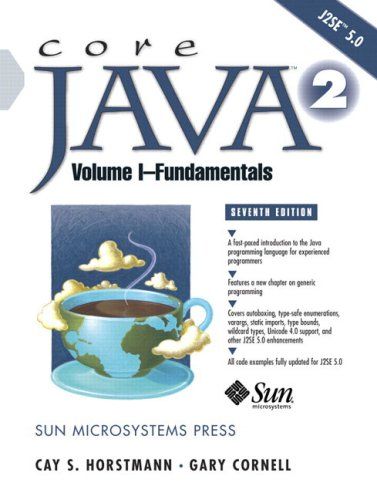
Core Java 2.
Fundamentals
Introduction
Nova: Welcome to Aibrary, where we turn books into conversations. I'm your host, Nova, and today we're diving into a book that won the 2003 Jolt Productivity Award, has gone through fourteen editions, and has been called "the definitive work on the Java language" by no less than Andrew Binstock. We're talking about "Core Java 2" by Cay S. Horstmann and Gary Cornell.
Nova: That's exactly the right question, and the answer is fascinating. "Core Java 2" refers not to the version of the book but to the Java 2 Platform — the monumental re-branding that happened when Sun Microsystems released J2SE 1.2 in December 1998. This was the moment Java transformed from a promising curiosity into an enterprise powerhouse. And the Horstmann-Cornell book was the guide that took a generation of programmers through that transformation.
Nova: That's what we're unpacking today. The authors had a philosophy: no hype, no toy code, no language lawyering. Just solid facts and in-depth research to help you write real programs. And that philosophy turned a technical manual into a classic that's still in print, now in its 14th edition, published by Oracle Press in 2026.
Why Two Volumes?
The Architecture of Knowledge
Nova: Let's start with the structure because it's one of the most distinctive things about Core Java. It was a two-volume set — Volume I covering fundamentals and Volume II covering advanced features. Together they spanned roughly 1,900 pages. That's a serious commitment.
Nova: It was a deliberate pedagogical choice. Volume I — subtitled "Fundamentals" — was designed for programmers who already knew another language and wanted to get productive in Java fast. It covered the core language, object-oriented programming, Swing GUI development, exception handling, streams and files, and later editions added generics and concurrency. At around 760 to 860 pages depending on the edition, it was substantial but manageable.
Nova: Volume II — "Advanced Features" — was the deep dive. We're talking threading, collections, security, XML processing, database connectivity with JDBC, networking, internationalization, JavaBeans, and the Java 2D API. One reviewer on JavaRanch, Michael Ernest, gave it a rare ten out of ten and called it "a monster book" that was "several months of steady work to get through."
Nova: Exactly. The 7th edition of Volume II alone ran 1,024 pages. David O'Meara, reviewing it for JavaRanch, noted that the examples struck "the right balance between length and detail so that you're onto the next topic before getting bogged down." That pacing was crucial for a book this dense.
Nova: Java 2, codenamed "Playground," was a monster release. It brought us the Swing GUI toolkit, the Collections Framework, the Java 2D API, accessibility APIs, and the just-in-time compiler that dramatically improved performance. Before Java 2, the platform had about 500 classes. After Java 2, it ballooned to over 1,500. You simply couldn't cover everything in one book anymore. The two-volume structure was a direct response to the platform's explosive growth.
Horstmann and Cornell
The Minds Behind the Masterpiece
Nova: Now let's talk about the two authors because their backgrounds explain a lot about why this book turned out the way it did. Cay S. Horstmann grew up in Northern Germany, in the harbor town of Kiel, and attended the Christian-Albrechts-Universität there before coming to the United States. He earned a Master's in computer science from Syracuse University and then — here's the surprising part — a Ph. D. in mathematics from the University of Michigan.
Nova: It is, but it makes sense when you read his writing. There's a mathematical rigor to his explanations. He doesn't just tell you how something works — he explains why a specific solution was chosen. One reviewer on JavaRanch noted, "What I especially liked about the book is that the authors explained why a specific solution was chosen. They did not just leave me in the dark." That's the mathematician's instinct.
Nova: Gary Cornell has an equally impressive but different pedigree. He earned his Ph. D. from Brown University, was a visiting scientist at IBM Watson Laboratories, and became a professor at the University of Connecticut. But here's the key: he later co-founded Apress, the technical publishing company. So he understood both the academic side and the publishing business. He authored or co-authored fourteen popular computer books.
Nova: And it worked brilliantly. Horstmann brought the deep technical expertise — he was VP and CTO of an internet startup called Preview Systems that went from three people in a tiny office to a public company. So he wasn't just an academic; he had real industry scars. Cornell brought publishing savvy and broad technical perspective. Together, they produced a book that was rigorous without being dry, comprehensive without being bloated.
Nova: Yes, and that mattered. Sun Microsystems Press was the official publishing arm of the company that created Java. Being published under that imprint gave Core Java an authority that other Java books couldn't match. It was, in effect, the semi-official guide to the platform. After Oracle acquired Sun, it became Oracle Press. That lineage has continued unbroken for almost three decades.
The Core Java Philosophy
No Hype, No Toy Code
Nova: Let's talk about what really set Core Java apart from every other Java book on the shelf. The philosophy is stated right on the book's website: "No hype, no toy code, no language lawyering, just solid facts and in-depth research to help you write real programs."
Nova: It means the authors never got lost in obscure edge cases of the language specification just to show how clever they were. Instead, they focused on what programmers actually needed to know to build real applications. The examples were deliberately simple but never fake. As the book description says, "they aren't fake and they don't cut corners." Every example was a legitimate starting point for production code.
Nova: The contrast was stark. Many Java books were filled with contrived "Hello World" style examples that taught syntax but not real programming. Others were so dense with language specification details that only compiler writers would find them useful. Core Java found the sweet spot. Grady Booch — yes, the Grady Booch of UML fame — praised it for making "the details of this powerful and expressive language understandable" while also furnishing "a conceptual model for its object-oriented foundations."
Nova: Yes, and that's crucial context. In the late 1990s, the primary audience for Java books was C and C++ programmers who needed to transition to the new language. Core Java assumed you already understood programming concepts — loops, variables, data structures — and focused on what made Java different. The early editions explicitly referenced C++ throughout, pointing out differences and potential confusion points.
Nova: Definitely not. One reviewer put it perfectly: the book is "fast-paced and detailed and aimed for the experienced programmer." If you didn't know what an object was before opening the book, you'd be lost. But if you were a working programmer who needed to get productive in Java quickly, it was the gold standard.
Nova: Exactly. The Jolt Productivity Award was given by Software Development magazine, and winning it placed Core Java in the company of classics like "Design Patterns" by the Gang of Four and "Code Complete" by Steve McConnell. This was recognition that Core Java wasn't just another technical manual — it was a landmark contribution to the craft of software development.
From Java 2 to the 14th Edition
Living History
Nova: Here's what I find most remarkable about Core Java: it didn't just document a moment in Java's history — it evolved with the language through every major transformation for nearly thirty years.
Nova: The first edition came out around 1996-1997, covering Java 1.0 and 1.1. By the fifth edition in 2000, it was fully rebranded as "Core Java 2" covering J2SE 1.3. The seventh edition in 2004 updated everything for J2SE 5.0 — a massive release that introduced generics, annotations, autoboxing, and enhanced for loops. Then came Java SE 6, 7, 8 with lambdas and streams, the module system in Java 9, and so on. Each edition tracked a major Java release.
Nova: That's what made the series special — they didn't. Jeanne Boyarsky, reviewing the 8th edition for JavaRanch, noted that the authors "integrated features as they made sense" and "updated existing examples to reflect the way they would be written if they were initially written today." That takes enormous discipline. Most revised technical books just bolt new content onto old frameworks. Horstmann and Cornell rewrote from the inside out.
Nova: Right, and some of that growth came from moving the threading chapter from Volume II into Volume I, because concurrency had become so fundamental that you couldn't call yourself a Java programmer without understanding it. The book reflected how the language was actually being used in the real world.
Nova: Yes. The 14th edition of Volume I is published by Oracle Press for 2026, and Volume II reached its 13th edition updated for Java 21. After all these years, the two-volume structure endures. The subtitle "Fundamentals" still graces Volume I, and "Advanced Features" still anchors Volume II. The book that started as a guide for C++ programmers transitioning to a new language has become the reference for generations of developers who have never written a line of C++ in their lives.
Nova: He taught computer science at San Jose State University for over thirty years, became a Java Champion, and received the Java Community Lifetime Achievement Award. He's still actively writing and speaking about Java. The book's longevity is a testament to both the language and the author's commitment. As he once said in an interview, when Java came along in 1996, he thought: "No garbage collection? Cross-platform libraries that actually do stuff? Where do I sign?" That enthusiasm never faded, and it shines through in every edition.
Conclusion
Nova: So what do we take away from Core Java 2 and the legacy it spawned? First, it's a reminder that great technical writing isn't about being clever — it's about being clear, rigorous, and relentlessly practical. Horstmann and Cornell proved that a programming book could be comprehensive without being overwhelming, and authoritative without being pedantic.
Nova: That's the second lesson: timeless fundamentals matter more than trendy features. The book always focused on core principles — object-oriented design, solid API usage, real-world patterns — and those principles survived everything from applets to microservices. The Java 2 platform is ancient history now, but the programming wisdom in those pages remains relevant.
Nova: Beautifully said. From a two-volume doorstop covering Java 2 to a living reference now in its 14th edition, Core Java has been the quiet constant in a language and an industry defined by relentless change. Grady Booch called it "the definitive work on the language." David Wall praised its "sharp, fact-rich commentary on how to get things done with Java." And generations of programmers — from C++ veterans in the late 90s to new developers today — have built their careers on its foundation.
Nova: Neither would I. This is Aibrary. Congratulations on your growth!