The Strategic Echo Chamber: Why Your Influence Needs a Broader Audience.
Golden Hook & Introduction
SECTION
Nova: You’ve poured your heart and soul into a brilliant idea – a groundbreaking cybersecurity policy, a revolutionary defense strategy. It's objectively superior. So, why is it collecting dust? Why isn't everyone clamoring for it? We're diving into why good ideas often fail to spread and how to fix it.
Atlas: Oh man, that's a question that hits home for so many of our listeners. Especially those pushing for critical new approaches in security. You see the merit, you know the data, but it just… doesn't move.
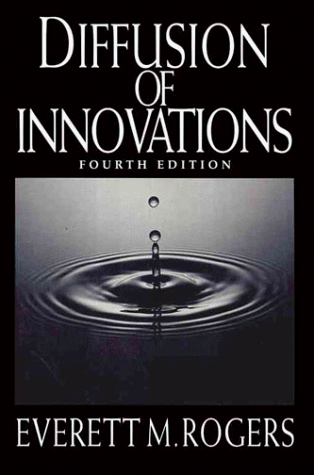
Nova: Exactly! Today, we're dissecting the critical space between brilliant innovation and widespread adoption, drawing insights from the foundational work of Everett Rogers' "Diffusion of Innovations" and Jonah Berger's "Contagious: Why Things Catch On."
Atlas: And I think for anyone building robust defenses or shaping cybersecurity policy, this isn't just theory; it's the difference between a strategy that just exists and one that actually protects. It's about moving from just creating an idea to seeing it truly implemented.
Nova: Absolutely. And what often stands in the way of that implementation, especially for those of us deeply embedded in the technical world, is what we call "The Strategic Echo Chamber."
The Strategic Echo Chamber – Why Brilliant Ideas Fail to Spread
SECTION
Nova: The "Strategic Echo Chamber" is that blind spot many technical experts have. It's the assumption that a good idea, a logically sound policy, or a perfectly engineered defense will simply spread on its own merit. That truth, clarity, and superiority are enough to win the day.
Atlas: Okay, but for someone who's spent years building these robust systems, isn't that just incredibly demoralizing? You've engineered perfection, you've solved a critical problem, and it's met with... crickets? Or worse, resistance?
Nova: It is. It’s incredibly frustrating. Imagine a cybersecurity architect, let's call her Dr. Anya Sharma. She designs a revolutionary, quantum-safe encryption protocol. It's mathematically elegant, offers unparalleled protection against future threats, and would save organizations billions in potential breaches. She presents it with meticulous detail, irrefutable evidence.
Atlas: Sounds like a slam dunk. The kind of solution that defines a career.
Nova: You'd think so. But months later, it's barely moved past the proof-of-concept stage. Teams are still using older, vulnerable systems. Policy-makers nod politely, but no one champions it. It's not that the idea is bad; it's that Dr. Sharma, like many technical brilliant minds, assumed its inherent goodness would be self-evident and self-propagating.
Atlas: So, the blind spot is focusing solely on the technical 'what' and 'how,' and completely missing the social 'who' and 'why' of adoption? Why do we, as technical people, often overlook that crucial social dynamic?
Nova: It's often because our training, our very discipline, rewards precision and objective truth. We're taught to optimize, to create the most efficient, secure, or powerful solution. The human element, the messiness of persuasion, the irrationality of adoption patterns – that feels... secondary, or even irrelevant, to the core technical challenge. But strategic influence, especially in policy-making, is inherently about human behavior and group dynamics.
Atlas: That sounds rough, but I can totally see it. You've got this incredible solution, but if you don't understand how people actually innovations, it just stalls. It means even the most brilliant initiatives can get stuck, failing to make the real-world impact they were designed for.
Nova: Exactly. It's like building the most powerful engine, but then forgetting to put wheels on the car. The engine is magnificent, but it's going nowhere.
Orchestrating Influence – From Technical Excellence to Widespread Adoption
SECTION
Nova: So, if technical brilliance isn't enough, what? This is where the intentional orchestration of influence comes in, drawing directly from the insights of Rogers and Berger. They provide the wheels for our magnificent engine.
Atlas: Okay, so it’s about strategically designing the spread, not just the solution itself. What do these frameworks tell us?
Nova: Let's start with Everett Rogers' "Diffusion of Innovations." Rogers mapped out how new ideas spread through cultures and organizations. He identified five crucial adopter categories: Innovators, Early Adopters, Early Majority, Late Majority, and Laggards.
Atlas: Wait, so it's not just a single, monolithic "audience" you're trying to convince? You have to tailor your approach to different groups?
Nova: Precisely. Innovators are the adventurous ones, eager to try new things. Early Adopters are opinion leaders, often respected for their judgment. The Early Majority are pragmatic, waiting for proof of concept. The Late Majority are skeptical, adopting only when most others have. And Laggards are tradition-bound, often the last to change. Dr. Sharma, with her quantum-safe protocol, likely targeted the Innovators with her technical brilliance, but she missed everyone else.
Atlas: I see. So, for someone trying to implement a new cybersecurity policy across a large organization, how do you even begin to identify these "early adopters"? Are they the tech-savvy department heads, or the influential team leads?
Nova: Often, they're not just the tech-savvy, but those who are both open to new ideas have influence within their social circles. They're the ones who will try something new and then talk about it, vouch for it. You find them by listening, observing who others look to for advice, who is respected for their forward-thinking.
Nova: But knowing to target is only half the battle. You also need to know to make your idea "contagious." This is where Jonah Berger's "Contagious: Why Things Catch On" comes in. Berger breaks down six powerful principles for making anything spread.
Atlas: Six principles? Lay them on me. Because if we can make cybersecurity policy "contagious," that's a game-changer.
Nova: First,: we share things that make us look good. Make adopting your policy feel like being in the know, being cutting-edge. Second,: associating your idea with something people encounter often. Think about how a jingle can instantly bring a product to mind. Third,: high-arousal emotions drive sharing. Fourth,: making the adoption visible helps it spread. Think of those "I Voted" stickers. Fifth,: offering something genuinely useful. And sixth,: embedding your idea within a compelling narrative.
Atlas: That’s a great way to put it. So, it's about designing the of the idea, not just the idea itself. It's about making it feel less like a mandate and more like something people or find valuable. Like a grassroots security awareness campaign that uses a relatable story about a phishing scam instead of just a dry memo.
Nova: Exactly! Imagine a different scenario. A small team wants to implement a new "zero-trust" security framework. Instead of just rolling out technical specifications, they create a short, humorous video showing what happens when trust is implicitly granted, featuring a relatable office character making a hilariously bad security decision. That hits Social Currency, Emotion, and Stories. They make participation public with an internal leaderboard, leveraging Practical Value by showing how it streamlines workflows.
Atlas: Wow. That's a powerful contrast. But what about the "laggards" – the ones who resist any change? How do these principles help overcome entrenched skepticism, especially in high-stakes environments like cybersecurity?
Nova: You don't usually start with the laggards. You focus on the Innovators and Early Adopters first. Once the Early Majority starts to move, driven by the social proof and practical value, the Late Majority often follows. For laggards, it often comes down to necessity or mandate, but by then, the idea has gained so much momentum that their resistance is a smaller hurdle. The principles help you build that momentum. It's about creating an undeniable wave.
Atlas: So, it's about understanding the psychology of adoption and using these tools to build advocacy and make the policies actually stick. It’s about not leaving your brilliant ideas to chance.
Synthesis & Takeaways
SECTION
Nova: Precisely. The core insight here is that strategic influence and policy-making aren't about the inherent perfection of an idea; they're about understanding and actively engaging with the social dynamics of adoption. It’s about moving beyond just presenting a solution to intentionally orchestrating its widespread acceptance.
Atlas: That’s actually really inspiring, because it gives us a roadmap. It takes the frustration out of seeing good ideas fail and replaces it with a set of actionable strategies. You're not just hoping your idea spreads; you're making it spread.
Nova: It’s about embracing the dance between technical mastery and human connection. One fuels the other. It means practicing active listening, understanding perspectives beyond your own, and then consciously designing the of your brilliant work.
Atlas: And that leads to a deep question for all our listeners: Consider a recent cybersecurity policy you advocated for. Which of Rogers' adopter categories did you primarily target, and how might you have adjusted your approach to reach others? Think about how you could apply Berger’s principles to make your next big idea not just brilliant, but truly contagious.
Nova: Because your vision for a more secure future, your innovative defense strategies, and your mentorship frameworks deserve not just to exist, but to thrive and transform the landscape.
Atlas: This is Aibrary. Congratulations on your growth!