

The Unseen Architects: How Social Networks Shape Innovation.
Golden Hook & Introduction
SECTION
Nova: We all love the image of the lone genius, the apple falling on Newton's head, the eureka moment in a secluded lab. The individual innovator, toiling away, then – world-changing idea. But what if that entire narrative around innovation is fundamentally, wonderfully, gloriously wrong?
Atlas: Oh, I like that. You're already challenging my entire worldview, Nova. I mean, we're conditioned to think of brilliance as this solitary, almost monastic pursuit. Are you saying it's more like... a group project?
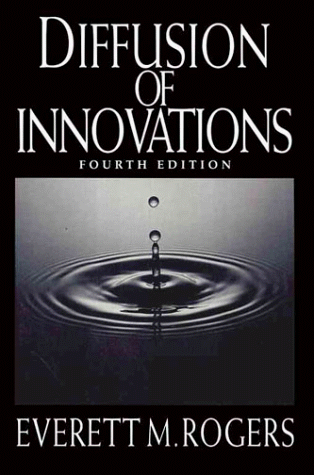
Nova: Absolutely! And a group project where the 'group' is often invisible, yet profoundly influential. Today, we’re tearing down that myth of the solitary genius by looking at two foundational texts that reveal the true architects of innovation: Everett M. Rogers's groundbreaking work, "Diffusion of Innovations," and Nicholas A. Christakis and James H. Fowler's eye-opening book, "Connected." Rogers, for example, started his career as a rural sociologist, bringing scientific rigor to understanding how agricultural practices spread – which then became a universal model for ideas. It's a fascinating origin story for such an impactful theory.
Atlas: That makes me wonder, if innovation isn't just about the 'aha!' moment, but about how it spreads, then we’ve got a massive blind spot, don't we? It's like we're only looking at the seed, not the soil, the water, or the wind.
Nova: Exactly. And that's what we're here to illuminate. These books fundamentally shift our perspective, showing us that innovation isn't just about creation; it's about connection. It's about understanding the unseen social networks that determine whether a brilliant idea thrives, or simply… withers.
The Hidden Pathways of Idea Diffusion & Compelling Case Study
SECTION
Nova: So, let's start with Rogers and his "Diffusion of Innovations." He essentially mapped out how new ideas, technologies, and practices move through cultures. He identified five categories of adopters, almost like characters in a play. You have your Innovators, the brave souls who are first in line, then your Early Adopters – the opinion leaders who actually influence others. After them come the Early Majority, then the Late Majority, and finally, the Laggards.
Atlas: So you’re saying it's not just a straight line from idea to adoption? It’s more like a staggered race with different groups jumping in at different times? And crucially, it's not about the individual, but about how these groups influence each other?
Nova: Precisely. And for a vivid example, let's go back to Rogers's own research: the spread of hybrid corn seeds among Iowa farmers in the 1930s and 40s. Before hybrid corn, farmers used traditional open-pollinated varieties. The innovators, a tiny percentage, tried the hybrid seeds first, often with mixed results and a lot of skepticism from their neighbors.
Atlas: I can totally imagine that. Farmers are notoriously practical, right? They're not going to switch to something new just because a guy in a lab coat tells them to. They need to it work.
Nova: That's the key. The early adopters were those respected, well-connected farmers in the community. They saw the innovators trying it, and then, after careful observation, they adopted it themselves. They became the living proof. They'd implement it on a small portion of their land, and when their yields soared, their neighbors—the early majority—started to notice.
Atlas: So, it's like a ripple effect. The early adopters are the ones who create the social proof, making it acceptable, even desirable, for the larger group. That’s a great way to put it.
Nova: It's more than just acceptable; it becomes the new standard. Farmers would see their neighbors' fields flourishing, hear them talking about the higher yields, and that social validation was incredibly powerful. The early majority then adopted it, followed by the late majority, who were often more skeptical or resource-constrained but eventually succumbed to the social pressure and obvious benefits. The laggards, well, they were the last holdouts, sometimes adopting only when the old methods were no longer viable.
Atlas: That’s fascinating. It really paints a picture of a social process, rather than just an individual decision. But how does that apply to, say, a new app, or even a new way of thinking in a company? It seems a bit abstract to categorize people into 'laggards' in a modern context.
Nova: It's the same fundamental dynamic, just with different "crops." Think about a new software tool in a company. The "innovators" are the tech-savvy early experimenters. The "early adopters" are the team leads or influential managers who see the potential and champion it, often becoming internal evangelists. Their success then encourages the "early majority" of employees to try it, and so on. The 'laggards' might be those who resist until forced to adopt by company policy. The core insight is that is the engine, not just the inherent quality of the innovation itself.
The Power of Network Effects and Key Connectors & Illuminating Case Study
SECTION
Nova: And that naturally leads us to the second key idea we need to talk about, which often acts as a counterpoint to what we just discussed: the profound power of network effects, as illuminated by Christakis and Fowler in "Connected." While Rogers showed ideas spread, Christakis and Fowler reveal is connected to whom, and how those connections create ripples far beyond our immediate circle.
Atlas: Oh, I've heard whispers about this. It's like, your friends influence you, but your friends' friends influence you too, right? It feels a bit like six degrees of separation, but with a punch.
Nova: It’s exactly that, but with measurable impact. They demonstrate that everything from our happiness and health to our financial decisions and, yes, the adoption of new ideas, is profoundly affected by our social ties. And not just our direct ties, but our friends' friends, and even our friends' friends' friends. They call it the 'three degrees of influence' rule.
Atlas: Wow. So, I’m not just influenced by my immediate circle; there's this invisible web stretching out, pulling me in different directions? That’s kind of mind-blowing, and a little unsettling, to be honest. It sounds like ideas can spread almost... without conscious effort.
Nova: They absolutely can. Consider their research on the spread of obesity. They found that if your friend becomes obese, your own chances of becoming obese increase by 57%. But here's the kicker: if your friend's friend becomes obese, your chances still increase by 20%, and even a friend's friend's friend increases your chances by 10%. It's not about direct contact often; it’s about the subtle shifts in social norms and behaviors that ripple outwards.
Atlas: That's incredible. So, it's not just about what you eat, but what your friend's friend's friend eats? That gives me chills. So, if we're trying to spread a new, beneficial idea, say, a new approach to mental wellness, we shouldn't just target individuals. We need to understand these network effects.
Nova: Precisely. And this is where identifying "key connectors" becomes crucial. Christakis and Fowler highlight that certain individuals are disproportionately important in these networks. They're not necessarily the most popular, but they might be the "central nodes" with many connections, or the "bridge-builders" who connect otherwise disparate groups. These are the people whose adoption of an idea can trigger a cascade.
Atlas: Okay, but then how do you identify these key connectors? And how do you "engage" them without it feeling manipulative? Because for a curious learner who wants to genuinely make a positive impact, that's a fine line.
Nova: It’s not about manipulation; it’s about understanding the natural pathways. Think of it as mapping the water flow, not diverting the river. Key connectors often have a high "betweenness centrality" – they sit between many different groups. Or they have high "degree centrality" – they simply know a lot of people. You identify them by observing who people go to for advice, who introduces people to each other, or who seems to be "in the know" across different circles. Engaging them means sharing your idea with genuine enthusiasm, showing its value, and letting their natural influence do the rest. It's about making it easy and desirable for them to spread it.
Synthesis & Takeaways
SECTION
Nova: So, when we combine Rogers's understanding of adopter categories with Christakis and Fowler's insights into network effects, we get a much richer picture. Innovation isn't a solitary spark; it's a social wildfire. It's a dance between a novel idea and the intricate web of human connections that either nurtures it or extinguishes it.
Atlas: That's a profound shift in perspective. It moves us from thinking about individual genius to collective intelligence, and from isolated acts to interconnected movements. It means we all have a role to play, both in generating ideas and in helping them spread.
Nova: And that brings us back to the deep question from our main content: Considering the networks around you, where is the greatest potential for a new idea to spread, and who are the key connectors you should engage? The answer isn't just to shout your idea louder. It's to understand the social terrain.
Atlas: So, for anyone listening, whether you're trying to introduce a new process at work, a new hobby to your friends, or even just a new recipe to your family, the first step isn't just perfecting the idea. It's looking at your network. Who are your innovators? Who are your early adopters? Who are those central connectors that can bridge different groups?
Nova: Absolutely. Start by mapping out your own "diffusion network." Identify those early adopters who are open to new things and those central figures who can amplify your message. Engage them not just with information, but with an experience, a story, a compelling reason to share. Because ultimately, the strength of an idea isn't just in its brilliance, but in the strength of the connections it can forge.
Atlas: That's a truly actionable insight for anyone who's ever felt their good ideas get stuck. It’s about being a social architect, not just an inventor.
Nova: It truly is. And understanding this gives you the power to intentionally participate in shaping how ideas move and impact the world around you.
Nova: This is Aibrary. Congratulations on your growth!