

The Invisible Hand: How Social Networks Shape Your Decisions and Success.
Golden Hook & Introduction
SECTION
Nova: You think you're in charge of your own choices, right? That you're the master of your destiny? I'm here to tell you, that's probably your biggest blind spot.
Atlas: Whoa, Nova. That's a bold claim right out of the gate! Are you saying I'm just a puppet on the strings of my social circle? Because honestly, I pride myself on making independent decisions.
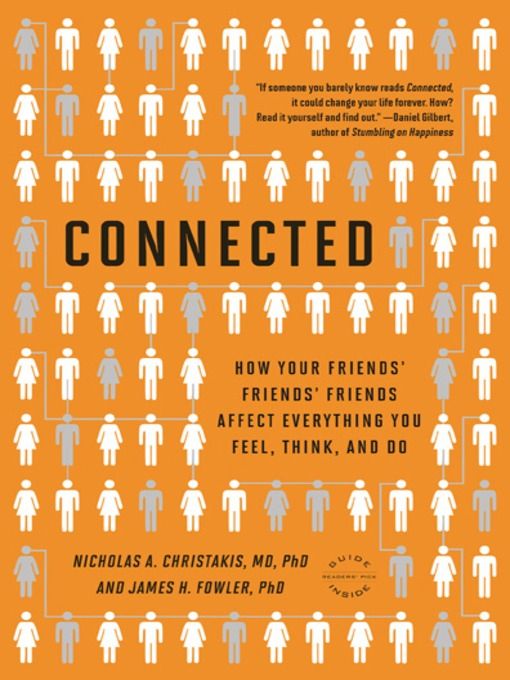
Nova: Absolutely not a puppet, Atlas, but definitely part of a much larger, incredibly intricate dance. Today, we're pulling back the curtain on that dance, diving into the groundbreaking work of Nicholas Christakis and James Fowler, authors of "Connected," and then we'll pivot to Malcolm Gladwell’s iconic "The Tipping Point." What’s fascinating is that Christakis, a physician and sociologist, and Fowler, a political scientist, blended their fields to show just how medically and socially intertwined we all are. Their interdisciplinary approach really opened up a whole new way of seeing our world.
Atlas: That's interesting, because as someone who's always focused on building trust and strong relationships, I often feel like I'm actively shaping my environment. But you're suggesting there's a deeper, almost invisible current at play that we're mostly unaware of?
Nova: Precisely. Their work, which has been widely influential in social science, reveals this profound, often unconscious influence. It's about understanding the architecture of your relationships, not just for networking, but for mastering the underlying currents of influence and collective behavior.
Atlas: Okay, so how does this "invisible hand" actually work? Give me the mechanics.
Deep Dive into Core Topic 1: The Invisible Architecture of Influence: How Networks Shape Us
SECTION
Nova: Alright, let's dive into Christakis and Fowler's insights. They essentially proved that our social networks have a measurable structure and a profound logic that impacts everything from our happiness to our health, and even our financial decisions. It's not just about who you know; it's about the patterns of connection.
Atlas: So, it's not just a vague feeling that our friends affect us? They’ve actually mapped this?
Nova: They have, with stunning precision. Think of it like a ripple effect. If your friend gains weight, you're more likely to gain weight. If your friend quits smoking, you're more likely to quit. It’s not just about direct influence; it's about the hidden patterns of connection.
Atlas: That sounds rough, but how does it spread? Is it just imitation, or something deeper? For our listeners who are managing high-pressure teams, this concept might feel impossible to implement if it's just about mimicking behavior.
Nova: It's far deeper than imitation. It's what they call "social contagion." Imagine a study on happiness. They found that if a friend of yours becomes happy, your chances of being happy increase by 15%. If a friend of friend becomes happy, your chances increase by 9%. And even if a friend of friend's friend becomes happy, your chances still go up by 6%.
Atlas: Wait, so my friend's friend's friend can influence my happiness? That's incredible! So it's like a chain reaction, but with feelings?
Nova: Exactly! It's the "three degrees of influence" rule. Your influence extends up to three degrees of separation. Beyond that, the effect tends to dissipate. This isn't just about feelings either; it's been observed with voting patterns, health behaviors, even the adoption of new technologies. It means that the seemingly independent choices of individuals are often deeply embedded in the choices of others around them.
Atlas: That's a bit out there, but also kind of liberating. If I'm trying to foster a positive change, say, a new work methodology in a company, does this mean I only need to convince a few key people, and then trust the ripple? But wait, looking at this from a strategic persuader's perspective, isn't that risky if the influence diminishes after three degrees? How does that apply to globalized or online networks, where connections seem endless?
Nova: That's a brilliant question, Atlas. While the three degrees rule holds true for many face-to-face social phenomena, online networks introduce new complexities. The of information spread can be much faster online, but the of influence might still follow similar patterns. The key insight is that our social networks are not random collections of individuals; they have a structure, and understanding that structure is crucial. It’s about leveraging the density and centrality of certain nodes. For example, if you want to spread an idea, you're better off focusing on people who are well-connected and central to many groups, rather than just broadcasting to everyone.
Atlas: So, it's less about the sheer volume of connections and more about strategically identifying and influencing the connections. That’s a practical framework.
Deep Dive into Core Topic 2: The Mechanics of Spread: Tipping Points and Social Catalysts
SECTION
Nova: Precisely. And that naturally leads us to the second key idea we need to talk about, which often acts as a counterpoint to what we just discussed: if influence spreads, what makes some things 'tip' and others fizzle? This is where Malcolm Gladwell’s "The Tipping Point" comes in. Gladwell, a master storyteller, makes complex social phenomena accessible through compelling narratives, and his work became a widely acclaimed exploration of how ideas and trends spread.
Atlas: I've heard of "the tipping point," but I've always thought of it as this almost magical moment where something suddenly takes off. Can it really be broken down into mechanics?
Nova: Absolutely. Gladwell argues that social epidemics, just like biological ones, have three key rules. The first is. This states that a small number of exceptional people are responsible for the spread of an idea. He identifies three types:, who know vast numbers of people across diverse social circles;, who are information specialists, hoarders of knowledge; and, who are charismatic persuaders.
Atlas: So, for someone trying to spread a positive message or an innovative idea, how do you these Connectors or Mavens? Is it just luck? I imagine a lot of our listeners struggle with identifying the real influencers versus just the loudest voices.
Nova: It's definitely not just luck. Connectors are often those people you know who seem to know. They're the social glue. Mavens are the ones you go to for advice – they love to share what they know. Salesmen are the ones who can make you believe anything. For example, Gladwell recounts the story of Paul Revere, who was a Connector. His contemporary, William Dawes, also rode to warn colonists, but Revere’s network was so much broader and more diverse that his message tipped into an epidemic, while Dawes's did not.
Atlas: That’s a perfect example. So, it’s not just about having a great idea, it's about who carries it. What are the other rules?
Nova: The second rule is the. This is about making your message memorable and impactful enough to cause someone to act on it. It’s not just about receiving information; it’s about internalizing it. Think about Sesame Street – its creators rigorously tested and refined segments to make them incredibly "sticky" for children, ensuring the educational messages resonated.
Atlas: So, it’s about crafting the message in a way that truly lands and compels action. That’s going to resonate with anyone who focuses on strategic communication. What about the third rule?
Nova: The third is. This states that human behavior is sensitive to its environment. Small details in the immediate environment can radically alter outcomes. Gladwell uses the example of the dramatic drop in crime in New York City in the 1990s. One theory suggests it wasn't grand strategies but the "broken windows theory" – fixing small problems like graffiti and fare-beating created an environment where people were less likely to commit larger crimes. The context shifted, and behavior followed.
Atlas: That gives me chills. That’s such a hopeful way to look at it – that small changes in context can have such a profound impact. But wait, could this actually backfire? Could intentionally trying to engineer a "tipping point" feel inauthentic or manipulative, especially for someone who values relationship-driven approaches?
Nova: It's a valid concern, Atlas. The intention behind using these insights is crucial. It’s not about manipulation, but about understanding the levers of influence to achieve positive outcomes. If your goal is to spread a beneficial idea or foster genuine collaboration, understanding Connectors, creating sticky messages, and optimizing the context simply makes your efforts more effective and efficient. It's about being a conscious architect of positive change, rather than a passive observer.
Synthesis & Takeaways
SECTION
Nova: So, bringing it all together, we've gone from the invisible architecture of influence that Christakis and Fowler revealed – how our networks subtly shape every decision – to Gladwell’s mechanics of how ideas actually spread, uncovering the catalysts that create those tipping points. It's a powerful one-two punch in understanding the dynamics of human connection.
Atlas: Absolutely. It makes me think about the deep question from our content: "Consider a recent challenge you faced. How might mapping the social connections involved have offered a different path to resolution or a deeper understanding of the dynamics at play?" Nova, what's one guiding principle you'd offer our listeners for navigating complex challenges using these insights?
Nova: My guiding principle would be this: shift your perspective from individual action to network orchestration. Instead of just focusing on your own efforts, consciously map out your network. Identify the Connectors who can amplify your message, the Mavens who hold crucial information, and the Salesmen who can persuade. Then, craft your message to be sticky, and consider how you can subtly adjust the context to encourage the desired outcome. It's about seeing the world not as isolated dots, but as an intricate, living web where every strand matters.
Atlas: That’s actually really inspiring. It means we're not just at the mercy of these invisible forces; we can actively participate in shaping them. For our listeners who are all about growth and strategic persuasion, I want to leave you with this thought: Consider your own biggest challenge right now. Who are the Connectors, the Mavens, the Salesmen in network related to that challenge? And how can you make your message stickier within context?
Nova: That's a fantastic challenge, Atlas. We'd love to hear your insights. Share your thoughts and engage with the Aibrary community on social media.
Nova: This is Aibrary. Congratulations on your growth!