

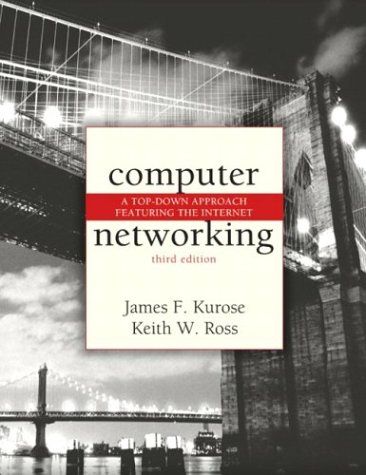
Computer networking
a top-down approach featuring the internet
Introduction
Nova: Have you ever stopped to think about what actually happens in the split second between you clicking a link and a webpage appearing on your screen? It feels like magic, right?
Nova: It is! And for decades, the way we taught that complexity was almost as daunting as the technology itself. We used to start with the physics—the copper wires and the radio waves—and work our way up. But then came James Kurose and Keith Ross with their book, Computer Networking: A Top-Down Approach.
Nova: Exactly. They flipped the script. Instead of starting with how a bit of data is encoded into an electrical pulse, they start with why you want to send that data in the first place. It turned the entire field of networking education on its head.
Nova: This isn't just any textbook, Leo. It is basically the bible of modern networking. It has been through eight editions, it is used in almost every major university, and it explains the internet in a way that makes you realize it is the most complex machine humans have ever built. Today, we are going to peel back the layers of this book and, by extension, the internet itself.
Key Insight 1
The Top-Down Revolution
Nova: To understand why Kurose and Ross are such big deals, you have to understand the Bottom-Up approach that came before them. Imagine trying to learn how to use a smartphone by first learning how to mine the silicon for the chips.
Nova: That was the problem! Students were getting bogged down in signal processing and hardware before they ever understood what an IP address was. Kurose and Ross argued that for a computer science student, the most interesting part of networking is the software. The applications.
Nova: They start with things you use every day: HTTP for web browsing, SMTP for email, and DNS—the phonebook of the internet. By starting there, you immediately see the value. You learn how your browser talks to a server before you worry about how that server is physically connected to the wall.
Nova: Not at all. They just save it for later. They use this brilliant analogy of the airline system to explain how these layers work together. Think about a flight. You have the ticket purchase, the baggage check, the gate, the takeoff, and then the actual flight.
Nova: Right. And the person at the ticket counter doesn't need to know how the jet engine works. They just need to know how to issue a ticket. That is layering. Each layer provides a service to the layer above it, without needing to know the messy details of how the layers below it are doing their jobs.
Nova: That would be the Transport Layer. If the Application Layer is the ticket, the Transport Layer is the contract between you and the airline that says, we promise to get you and your bags to the destination in one piece.
Nova: Precisely! In networking, that is where we get into the famous debate of TCP versus UDP. It is one of the most important concepts Kurose and Ross cover early on.
Key Insight 2
The Transport Layer Handshake
Nova: Kurose and Ross describe it as a choice between reliability and speed. TCP, or Transmission Control Protocol, is the reliable one. It is like a certified letter. Before it sends any data, it does what is called a three-way handshake.
Nova: Almost! Computer A says, I want to talk. Computer B says, I heard you, I am ready. And then Computer A says, Great, here comes the data. It ensures that every single packet of data arrives in the correct order. If a packet gets lost, TCP notices and sends it again.
Nova: Because that reliability comes with a cost: delay. Imagine you are playing a fast-paced video game or having a video call. If one tiny packet of data—maybe a single pixel or a millisecond of audio—gets lost, do you really want the whole stream to stop and wait for that one packet to be resent?
Nova: Exactly! That is where UDP, or User Datagram Protocol, comes in. Kurose and Ross call it a no-frills, best-effort service. It just blasts the data out there. If it gets there, great. If not, oh well. It is much faster because there is no handshake and no checking for lost packets.
Nova: You got it. And the book does a great job of showing how these protocols actually look in code. They even include these interactive Java applets and Wireshark labs where you can actually see these handshakes happening in real-time on your own computer.
Nova: That is a perfect analogy! It lets you capture and inspect the traffic going in and out of your computer. Kurose and Ross were pioneers in integrating these hands-on labs. They didn't want you to just read about the handshake; they wanted you to see the packets actually shaking hands.
Key Insight 3
The Hourglass and the Network Layer
Nova: Not yet! We have to hit the Network Layer. This is the heart of the internet. This is where IP—Internet Protocol—lives. Kurose and Ross describe the internet architecture as an hourglass.
Nova: Yes! At the top, you have hundreds of different applications—web, email, streaming, gaming. At the bottom, you have dozens of different physical technologies—fiber optics, Wi-Fi, satellite, Ethernet. But in the very middle, there is only one thing: IP.
Nova: Exactly. It is the universal language of the internet. Every device on the planet, whether it is your smart fridge or a supercomputer, has to understand IP. This is where routing happens. The book explains how a packet finds its way from your house in New York to a server in Tokyo.
Nova: It is like the postal service. The Network Layer doesn't care what is inside the envelope—that is the Transport Layer's job. The Network Layer only cares about the address on the outside. It uses routing algorithms to determine the best next hop for the packet.
Nova: That is a great way to put it. And Kurose and Ross dive deep into the difference between the data plane and the control plane. The data plane is the local action of moving a packet from an input to an output within a single router. The control plane is the global logic that determines how those routers work together to form a path.
Nova: Constantly. They are sharing information about traffic jams and broken links. In the newer editions of the book, they spend a lot of time on SDN, or Software-Defined Networking. It is a huge shift where the brains of the network are moved out of the individual routers and into a centralized software controller.
Nova: It is more about efficiency. It allows big companies like Google or Amazon to manage their massive data centers much more easily. It is one of the biggest changes in the 8th edition of the book.
Key Insight 4
The Modern Frontier
Nova: That is the challenge! Kurose and Ross are famous for their frequent updates. The 8th edition is a massive overhaul. They added deep dives into 4G and 5G cellular networks, which are fundamentally different from traditional wired networks because the users are moving.
Nova: Exactly. They explain the handoff process—how one cell tower passes you to the next without dropping your call. They also added a lot about the cloud. In the old days, we thought of the internet as a web of equal computers. Now, so much of it is just us connecting to giant data centers owned by a few companies.
Nova: Very much so. And they have updated the security sections. They use these classic characters, Alice and Bob, to explain cryptography. Alice wants to send a secret message to Bob, but Trudy—the intruder—is trying to listen in.
Nova: They really have! But through them, the book explains how things like HTTPS and firewalls actually work. It makes abstract math feel like a spy novel.
Nova: They do! That is where you learn about things like Ethernet and Wi-Fi. The book explains the chaos of the airwaves. When you use Wi-Fi, you are basically shouting into a crowded room. If two people shout at the same time, the messages collide and no one hears anything.
Nova: They use a protocol called CSMA/CA. It stands for Carrier Sense Multiple Access with Collision Avoidance. Basically, the device listens to see if anyone else is talking. If it is quiet, it waits a random amount of time and then starts talking. It is like a very polite dinner party where everyone is trying not to interrupt each other.
Conclusion
Nova: We have traveled from the top of the stack—your web browser—all the way down to the polite dinner party of the Wi-Fi airwaves. And that is the beauty of the Kurose and Ross approach. It takes this incomprehensible web of billions of devices and breaks it down into logical, manageable layers.
Nova: That is the perfect way to see it. The key takeaway from the book is that the internet isn't just a collection of wires; it is a collection of agreements—protocols—that allow different systems to talk to each other. Whether it is the three-way handshake of TCP or the routing tables of the Network Layer, it is all about cooperation.
Nova: Definitely. And if you ever get the chance to crack open the book, look for those Wireshark labs. There is nothing quite like seeing the heartbeat of the internet for yourself.
Nova: It really is. Networking is the foundation of our modern world, and understanding it is like having the blueprint to the digital age. Thank you for joining us on this deep dive into the architecture of the internet.
Nova: This is Aibrary. Congratulations on your growth!