

The 'Chaos Theory' Playbook: Embrace Unpredictability in Agent Architecture.
Golden Hook & Introduction
SECTION
Nova: Atlas, I have a quick game for you. Five words. Give me your five-word review of 'perfect control' in complex systems. Go.
Atlas: Oh, easy. "An expensive, fragile, beautiful illusion."
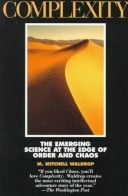
Nova: . I love that! And you know, you've perfectly captured the essence of what we're unraveling today. We’re diving into a book that fundamentally shifted how many scientists and thinkers view the world, especially when it comes to systems that are, well, anything but perfectly controlled. We're talking about "Complexity: The Emerging Science at the Edge of Order and Chaos" by M. Mitchell Waldrop.
Atlas: Ah, Waldrop! The name itself sounds like something out of a sci-fi novel.
Nova: It does, doesn't it? But his work is pure, groundbreaking science. Waldrop, a brilliant science journalist, truly brought the pioneering work of the Santa Fe Institute to the mainstream. He painted vivid portraits of the scientists there, wrestling with ideas that defied traditional physics – how self-organization and adaptation emerge in everything from ant colonies to economies. It was a massive undertaking, making these incredibly complex, often counter-intuitive ideas, accessible to a wide audience. It showed us that the messy, unpredictable bits aren't just noise; they're the engine.
Atlas: That's a great way to put it. "Messy, unpredictable bits are the engine." Because as architects, especially future architects in the agent space, our instinct is often to eliminate the messy, right? We crave elegant, predictable solutions. That's the holy grail.
The Blind Spot - The Illusion of Predictable Control in Agent Architecture
SECTION
Nova: Exactly! And that, my friend, is what we're calling "The Blind Spot." It's this deep-seated belief that we impose rigid, top-down control to ensure stability and efficiency. We design these intricate blueprints, these perfect little boxes for our agents to live in, expecting them to behave exactly as programmed.
Atlas: That makes perfect sense, though! I mean, you build a system, you want it to be reliable. You don't want agents just... doing their own thing, spontaneously deciding to optimize for something you didn't intend. That sounds like a recipe for disaster, not robustness.
Nova: Well, here's the kicker: often, that very attempt to force rigid control actually their evolution and adaptability. Picture a city's traffic system. If you try to program every single car's route, every turn, every speed down to the millisecond from a central command center, what do you think would happen?
Atlas: Gridlock. Instant, catastrophic gridlock. There's just too much information, too many variables.
Nova: Precisely. Now, think about a real city's traffic. It's messy, it's chaotic, but there's an emergent flow. Cars generally get to where they're going. Small local rules – like "don't hit the car in front of you," "follow the lights," "yield to pedestrians" – lead to a complex, adaptive system that, most of the time, works.
Atlas: So you’re saying our perfectly designed agent system, the one where we meticulously define every state, every transition, every outcome, is actually more prone to failure when faced with the real world?
Nova: In many cases, yes. Imagine a hypothetical scenario: we build an agent system for a smart city's emergency response. We design it with absolute, rigid protocols for every conceivable emergency. If a fire breaks out, Agent A does X, Agent B does Y. Sounds robust, right?
Atlas: Super robust. Optimal, even.
Nova: Until an event occurs. A fire a cyberattack on the city's infrastructure. Our rigidly controlled agents, designed only for pre-programmed scenarios, might freeze, or worse, execute conflicting, non-optimal actions because their perfect logic can't handle the novel combination. The system designed for absolute control becomes brittle.
Atlas: Wow. That's kind of terrifying. So, the very thing we think makes it stable, makes it fragile instead. It reminds me of that deep question in the prompt: "Where in your current agent project are you trying to impose order that might be better left to self-organization and emergent behavior?" That hits home.
Nova: It should. Because our architectural intuition, while valuable for complicated systems, can be a blind spot for truly complex ones. The desire for perfect predictability is often an illusion, leading us to build systems that might look elegant on paper but crumble under the weight of real-world messiness.
The Shift - Embracing Chaos as a Feature, Not a Bug
SECTION
Atlas: Okay, so if trying to impose maximum order is the blind spot, how do we shift? How do we move from seeing this chaos as a bug to understanding it as a feature? Are we just supposed to throw our hands up and let agents run wild?
Nova: Not at all! This is where Waldrop’s "Complexity" becomes incredibly illuminating. He explores how complex adaptive systems – like our ant colonies, or even the human brain – aren't designed from the top down with a master plan. They self-organize. They adapt. They thrive not despite their unpredictability, but of it.
Atlas: So, are we saying our agents should be more like an ant colony than a meticulously planned skyscraper? That sounds a bit out there.
Nova: It's a fantastic analogy, actually! Think about an ant colony. No single ant has a blueprint for the entire colony. There's no "chief ant" dictating every dig, every food forage. Yet, through simple, local rules – "if you find food, leave a pheromone trail," "if you encounter a pheromone trail, follow it" – incredibly complex, efficient, and adaptive behaviors emerge. The colony finds the shortest paths to food, defends itself, builds intricate nests, all without a central command.
Atlas: That's incredible. So the intelligence isn't in a single ant, but in the collective, emergent behavior of all of them following simple rules.
Nova: Exactly. And the same principles apply to agent systems. Instead of trying to define every single possible state and transition, we can design agents with simple, well-defined local rules and interaction protocols. The "chaos" or unpredictability then isn't random noise; it's the space within which novel, adaptive behaviors can emerge. It allows the system to discover solutions we might not have even conceived of.
Atlas: So, for a future architect, this means moving from trying to the outcome to trying to for desirable outcomes to emerge. Like building a playground with certain rules, but letting the kids invent their own games.
Nova: You've got it. It's about designing for robustness through resilience, not just rigidity. A decentralized agent network, where individual agents can fail or adapt independently, is often far more robust than a highly centralized system with a single point of failure. The Santa Fe Institute, which Waldrop chronicled, was filled with physicists, economists, biologists, all realizing that these principles of emergence, self-organization, and adaptation were universal. They were seeing intelligence and resilience.
Atlas: That's a profound shift. It’s about building systems that can learn and evolve in the wild, instead of just executing pre-programmed instructions in a sterile environment. It makes me wonder what kind of specific local rules we could implement in an agent system to foster useful emergent behavior, rather than just random noise.
Nova: That's the million-dollar question, and it's where the art and science of agent architecture truly meet. It's about carefully crafting those simple interaction rules, designing the environment, and then trusting the system to find its own optimal pathways. It opens up a whole new paradigm for building truly intelligent and adaptive systems.
Synthesis & Takeaways
SECTION
Atlas: So, to bring it all together, it sounds like the path to truly advanced, adaptive agent architectures isn't about eliminating unpredictability, but about understanding and designing it. It's about letting go of the illusion of perfect control to embrace the power of emergence.
Nova: Absolutely. It's a fundamental re-think for any architect. The real value in Waldrop's work for us today is the realization that the most robust, intelligent systems – whether natural or artificial – don't fight the edge of chaos; they thrive there. They leverage the "messy, non-linear ways" not as problems to be solved, but as the very mechanism for their adaptability and evolution.
Atlas: That’s actually really inspiring. It means our future agent systems can be far more powerful and resilient than our current, often brittle, attempts at perfect control. It's like unlocking a secret level of design.
Nova: Exactly. So, for all our listeners out there, especially those future architects wrestling with complex agent projects: take a moment and reflect. Where might you be trying to impose order that could be better served by fostering self-organization? What small, local rules could you design to allow for grand, emergent behaviors?
Atlas: Yeah, think about it. What if your most elegant solution is actually the one that embraces a little bit of beautiful chaos? Share your thoughts with us on social media! We'd love to hear how you're rethinking control in your own projects.
Nova: This is Aibrary. Congratulations on your growth!