

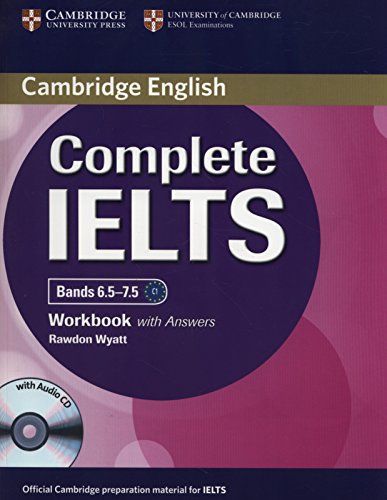
Complete IELTS Bands 6.5-7.5 Workbook with Answers with Audio CD
Introduction
Nova: Picture this. You have been studying English for years. You can hold a conversation, you can read the news, you can even write a decent email. But then you sit down to take the IELTS exam, and you score a 6.0. Not bad, but not enough. The university you are dreaming of wants a 7.0. That gap between "competent user" and "good user" — between B2 and C1 on the European framework — is where millions of test-takers get stuck. And that is exactly where one book comes in.
Nova: : And that book is the Complete IELTS Bands 6.5 to 7.5 Workbook with Answers with Audio CD, by an author named Rawdon Wyatt. Published by Cambridge University Press. But here is what I want to know right at the start — what makes this one workbook different from the dozen other IELTS prep books on the shelf?
Nova: Great question. The short answer is that this is not a standalone cram guide. It is a companion workbook designed to work hand-in-hand with the Complete IELTS Student's Book, which was authored by Guy Brook-Hart and Vanessa Jakeman. Rawdon Wyatt's workbook extends every single unit with additional reading, writing, and listening exercises. It also comes with an audio CD for the listening sections. But the real secret sauce is something called the Cambridge English Corpus.
Nova: : The Cambridge English Corpus? That sounds intimidating.
Nova: It is actually the opposite of intimidating — it is empowering. Cambridge has collected over 220,000 real exam scripts from actual IELTS candidates around the world. They have analyzed every single one to identify the exact grammar mistakes, the vocabulary gaps, the writing patterns that keep students stuck at band 6.0. And this workbook deliberately targets those problem areas. So today we are going to unpack this book inside and out. Who wrote it, what is inside it, how to use it, and whether it can genuinely help you cross that mysterious threshold from 6.0 to 7.0 and beyond.
Nova: : I am ready. Let us dive in.
Who Is Rawdon Wyatt?
The Author Behind the Workbook
Nova: Before we crack open the workbook itself, let us talk about the person who wrote it. Rawdon Wyatt is not just any ELT author. He has over sixty-five books listed on Goodreads, with more than four thousand ratings. His most famous title is "Check Your English Vocabulary for IELTS," which has gone through multiple editions since it first appeared in 2001. He is essentially a vocabulary specialist — someone who has spent decades figuring out exactly which words and phrases unlock higher band scores.
Nova: : Sixty-five books. That is an entire library. So he is deeply embedded in the IELTS ecosystem.
Nova: Absolutely. And here is what is interesting — while the Student's Book in the Complete IELTS series was written by Brook-Hart and Jakeman, Cambridge brought in Wyatt specifically for the workbook. Think of it this way: Brook-Hart and Jakeman built the house — the core curriculum, the eight thematic units, the overall architecture. And then Wyatt came in and furnished every room, adding layers of reinforcement. He is the person who asks, "Okay, you learned this skill in the Student's Book — now let me give you five more ways to practice it until it is automatic."
Nova: : So his specialty is the repetition and reinforcement side of learning.
Nova: Exactly. And that is critical for IELTS, because the exam does not just test whether you know something — it tests whether you can perform it under time pressure. His vocabulary books are built around the same principle: you do not just memorize a word list; you work through gap-fill exercises, matching tasks, collocation drills, until the vocabulary becomes active rather than passive. The workbook applies that same philosophy to all four skills.
Nova: : That is a useful lens. So what does that actually look like when you open the book?
Architecture of the Workbook
Inside the Eight Thematic Units
Nova: The workbook is organized around eight thematic units that mirror exactly what is in the Student's Book. Unit one is called Getting Higher Qualifications, covering education, degrees, academic pathways. Unit two is Colour My World, which sounds whimsical but is really about perception, design, and sensory description. Unit three is A Healthy Life, tackling health, lifestyle, and public well-being. Unit four dives into Art and the Artist. Unit five is Stepping Back in Time, all about history and heritage. Unit six is IT Society — technology, the internet, artificial intelligence. Unit seven is Our Relationship with Nature, and unit eight is Across the Universe, covering space and science.
Nova: : That is a really broad range. Education, art, technology, environment, space. These are not random topics, are they?
Nova: Not at all. These eight themes were deliberately chosen because they map almost perfectly onto the most common IELTS Writing Task 2 and Speaking Part 3 question categories. Think about it — how many IELTS essays ask about technology's impact on society, or the value of arts funding, or environmental responsibility? By weaving all the skill practice through these themes, the workbook ensures you are simultaneously building content knowledge and exam skills.
Nova: : So you are killing two birds with one stone — learning about the topic while practicing the exam format.
Nova: Precisely. And each unit in the workbook provides extra reading passages with question types you will actually see on test day: True, False, Not Given; matching headings; summary completion; multiple choice. The listening section covers form completion, table completion, diagram labeling, short-answer questions. The writing exercises walk you through Writing Task 1 chart descriptions and Writing Task 2 essay structures. It is about sixty-two pages, which sounds short, but it is densely packed.
Nova: : Sixty-two pages does sound quite slim. Does that mean it is not comprehensive enough?
Nova: That is the right instinct to question it, but here is the thing — remember this is a workbook, not the full course. It is designed to complement the much thicker Student's Book. The workbook assumes you have already covered the core instruction, and now it is giving you targeted practice. Think of it like a gym supplement — you do not eat only protein powder, but it makes your workout far more effective when used alongside real meals.
Data-Driven Exam Preparation
The Cambridge Corpus Advantage
Nova: Let me go deeper on the Cambridge English Corpus, because this is the feature that separates this book from generic IELTS prep materials. Cambridge University Press has built a massive database of real exam responses — over 220,000 scripts — written by actual candidates from around the world. They have analyzed patterns in error-making across different language backgrounds, different skill levels, different question types.
Nova: : So they literally know what Chinese-speaking candidates tend to get wrong versus Arabic-speaking candidates? That granular?
Nova: Yes. And they use that data to design exercises that tackle the most common problem areas. For example, if the corpus shows that candidates at the 6.0 level consistently struggle with article usage in academic writing — "a," "an," "the" — then the workbook will include reinforcement exercises targeting exactly that. Same for collocation errors, preposition mistakes, and the classic IELTS reading trap: distinguishing between False and Not Given.
Nova: : That False versus Not Given distinction is famously brutal. Even native speakers get tripped up on it.
Nova: Exactly. And a generic prep book will just give you more practice questions. But a corpus-informed book knows which specific types of False/Not Given distinctions cause the most confusion, and it can design practice that targets those pattern-recognition skills. It is the difference between a doctor saying "you are sick, take medicine" versus "your blood work shows a specific deficiency, here is the targeted supplement."
Nova: : I love that analogy. So the corpus essentially provides a diagnostic precision that other books lack.
Nova: And it is not just error correction. The corpus also reveals what high-scoring candidates do right — the vocabulary range they use, the sentence structures they deploy, the way they organize paragraphs. So the exercises are not just fixing weaknesses; they are modeling excellence. This is why Cambridge markets the Complete IELTS series as "the most authoritative IELTS exam preparation course available." That is a bold claim, but the corpus data backs it up.
Why Bands 6.5–7.5 Is the Hardest Leap
From B2 to C1 — Crossing the Threshold
Nova: Now let us talk about why bands 6.5 to 7.5 is such a psychologically and linguistically significant range. On the CEFR scale, IELTS 6.5 corresponds to a high B2 — the upper end of "independent user." You can function in most situations, you can understand complex texts, you can produce clear writing. But 7.0 and 7.5 cross into C1 territory — "proficient user." That means you can understand implicit meaning, you can use language flexibly for social, academic, and professional purposes, and you can produce well-structured, detailed texts on complex subjects.
Nova: : So the gap between 6.5 and 7.0 is not just a matter of knowing a few more vocabulary words. It is a qualitative shift in how you use the language.
Nova: That is exactly right. And this is why many students plateau. They keep doing more practice tests, but they do not change how they approach the language. A 6.5 writer can answer the question and be mostly coherent. A 7.5 writer can do that while also showing lexical range, grammatical flexibility, and coherent paragraph development with clear topic sentences and logical progression.
Nova: : So this workbook specifically targets that shift.
Nova: Yes. Let me give you a concrete example from the book. In the Writing section, you are not just given essay prompts. The exercises break down the process: analyze the question, brainstorm ideas, outline your argument, write a clear thesis, use reasons and examples, link paragraphs, write conclusions. And the Speaking section is particularly strong — it teaches you how to extend answers, how to handle abstract discussion topics in Part 3, how to express assumptions and compare advantages and disadvantages. These are exactly the skills that differentiate a 6.5 speaker from a 7.5 speaker.
Nova: : What about the listening component? The audio CD.
Nova: The listening exercises expose you to a range of accents — British, Australian, North American — which mirrors the real test. And the question types match what you will encounter: form completion, table completion, matching, flow-chart completion, diagram labeling, multiple choice. The key insight is that the listening sections are contextualized within the unit themes, so when you are practicing for the IT Society unit, you might hear a lecture about social media trends or a conversation about online privacy. Everything is interconnected.
Practical Strategies for Self-Study
How to Actually Use This Workbook
Nova: So you have bought the workbook. Now what? The single biggest mistake people make is treating it like a novel — they work through it sequentially from page one to page sixty-two and then wonder why their score has not improved.
Nova: : Guilty. I have absolutely done that with prep books.
Nova: Most people have. But effective use of this workbook requires a different approach. First, you need the version with answers. Cambridge publishes two editions — one with answers and one without. For self-study, the one without answers is nearly useless because you cannot check your work or learn from your mistakes. The version with answers includes a full answer key, so you can self-correct and analyze where you went wrong.
Nova: : That seems obvious, but I can imagine people buying the cheaper version and then regretting it.
Nova: Absolutely. Second, you should use the workbook in tandem with the Student's Book, not as a standalone resource. Complete a unit in the Student's Book, then immediately do the corresponding workbook unit. The reinforcement happens best when the material is fresh. Third, keep an error log. Every time you get a question wrong, write down why. Was it a vocabulary gap? A grammar mistake? A misunderstanding of the question type? Over time, patterns will emerge and you will know exactly what to focus on.
Nova: : That error log idea is gold. It turns every mistake into a learning opportunity rather than just a disappointing mark on the page.
Nova: Exactly. Fourth, use the audio CD actively, not passively. Do not just listen while doing dishes. Sit down, simulate test conditions, and replay sections you struggled with. Transcribe short segments to train your ear. And fifth — and this is perhaps most important — do the speaking exercises out loud, even if you are alone. Record yourself. Listen back. Compare your responses to the model answers. The workbook provides speaking prompts and frameworks; use them.
Nova: : So discipline and active engagement are the keys, not just time spent with the book open.
Nova: Precisely. The book is a tool, and like any tool, its effectiveness depends entirely on how you wield it. A hammer does not build a house by itself.
Conclusion
Nova: So let us bring this together. The Complete IELTS Bands 6.5 to 7.5 Workbook by Rawdon Wyatt is not a magic bullet, and it was never designed to be. It is a precision instrument — a sixty-two-page companion workbook built on the foundation of the Cambridge English Corpus, which draws from over 220,000 real exam scripts to identify exactly where students stumble between the B2 and C1 thresholds.
Nova: : What I am taking away is that this book's real value lies in three things. First, the author — Rawdon Wyatt — is a vocabulary and reinforcement specialist with decades of experience and over sixty-five published ELT titles. He knows how to design exercises that move knowledge from passive to active. Second, the eight thematic units are carefully chosen to mirror real IELTS topics, from education and health to technology and the environment, so you are building content knowledge alongside exam skills. And third, the corpus-informed approach means the exercises are targeting real, documented error patterns, not just guesswork about what students get wrong.
Nova: Beautifully summarized. And I would add a fourth takeaway: this is a workbook, not a textbook. It works best when paired with the Student's Book, when used with the answer key, when accompanied by an error log, and when treated as active practice rather than passive reading. It is for disciplined self-learners who are already at around band 6.0 and are serious about making the leap to 7.0 and beyond.
Nova: : And that leap — from B2 to C1, from "competent" to "good" user — is the one that unlocks university admissions, professional registration, visa requirements, and a world of opportunity. It is worth the effort.
Nova: It absolutely is. The gap between 6.0 and 7.0 might be the most expensive half-point on the entire IELTS scale, in terms of what it costs candidates in time, money, and missed opportunities. But with the right tools and the right approach, it is entirely bridgeable. Rawdon Wyatt's workbook is one of those tools. Use it wisely.
Nova: : This is Aibrary. Congratulations on your growth!