The Invisible Hand: Mastering Market Dynamics Without Guesswork.
Golden Hook & Introduction
SECTION
Nova: Most strategic plans are absolute garbage.
Atlas: Whoa, that's a bold claim, Nova! I imagine a lot of our listeners just felt a sudden chill, maybe even a little personal attack. Are we really going there right out of the gate?
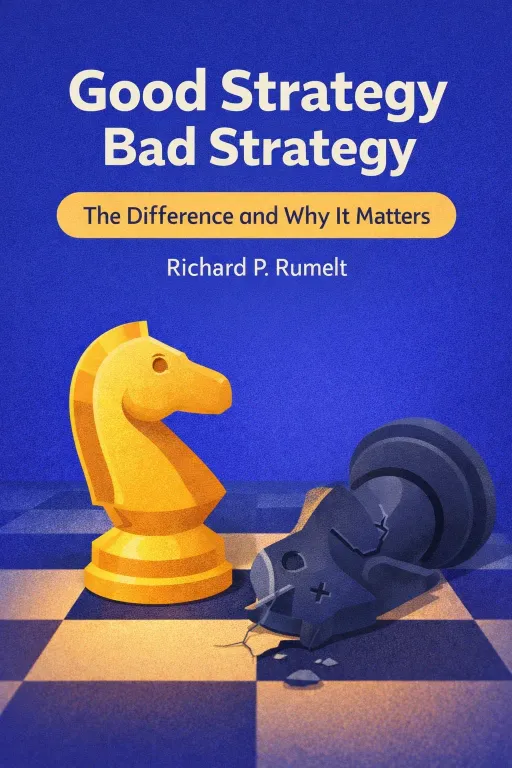
Nova: We absolutely are, Atlas. It sounds harsh, I know, but it’s a core insight from someone who truly understood strategy, Richard Rumelt. He’s the author of "Good Strategy/Bad Strategy: How to Think and Win Like a Great Strategist." What's fascinating is that Rumelt actually started his career as an engineer before becoming one of the most influential thinkers on strategy. He brought this incredibly practical, problem-solving, almost diagnostic approach to a field often bogged down in vague aspirations and corporate jargon.
Atlas: An engineer's mind tackling strategy – that’s intriguing. So he's cutting through the fluff and getting to the mechanics? Because I think a lot of our listeners, especially those balancing complex demands and trying to build something lasting, feel like they're constantly swimming in strategic fluff. They need to move from reactive decisions to proactive, impactful moves.
Nova: Exactly. He reveals that true strategy isn't just about setting ambitious goals or having a vision board. It's about coherent action guided by a clear diagnosis of a challenge. It's about focusing power where it matters most, not just listing things you want to achieve. Today, we're going to unpack why 'good strategy' is surprisingly rare, how to identify its core components, and then, how to understand the competitive landscape your strategy has to operate within.
The Anatomy of Good Strategy: Beyond Buzzwords
SECTION
Atlas: So, when you say 'good strategy' is rare, what does that actually mean? Because every company, every product team, has a strategy, right? Or at least, they they do.
Nova: They absolutely say they do. But Rumelt argues that most 'strategies' are actually just goal-setting, or a list of things to do, or even just marketing hype. A strategy, he says, has three fundamental elements: first, a clear of the critical challenge; second, a that outlines how to tackle that challenge; and third, a set of designed to implement that policy.
Atlas: Okay, so you’re saying it’s not just about setting ambitious goals, but really understanding the problem first? That sounds like foundational work, which aligns with 'The Builder' persona we often talk about. But isn't 'diagnosis' just another fancy word for analysis?
Nova: It’s deeper than just analysis, Atlas. A diagnosis isn't just gathering data; it's identifying the or the in a complex situation. Think of Apple in the late 90s, when Steve Jobs returned. The common wisdom was that Apple was just a PC company losing market share. But Jobs' diagnosis was different: the critical challenge wasn't just losing market share in PCs, it was that Apple had lost its soul, its focus, and its ability to innovate in a way that resonated with customers. It was paralyzed by too many mediocre products.
Atlas: Wow, that’s actually really inspiring. So the diagnosis wasn't just a business problem, it was almost a cultural and identity crisis for the company.
Nova: Precisely. From that diagnosis came the guiding policy: 'Simplify and focus.' Get rid of the bloat, concentrate on a few truly exceptional products that integrate hardware and software seamlessly, and re-establish Apple as a creative, design-led innovator.
Atlas: Okay, I can see that. That makes sense. And the coherent actions then flowed from that? Like the iMac, then the iPod, then iTunes, the iPhone?
Nova: Exactly. Every product launch, every marketing campaign, every decision about their retail stores – they all coherently supported that guiding policy of 'simplify and focus' and addressed the original diagnosis of a company adrift. The actions weren't random; they were tightly coupled, amplifying each other. For someone balancing many demands, like our listeners, this idea of coherence is vital. It means saying no to a thousand good ideas to focus on the few great ones that truly move the needle.
Atlas: That makes perfect sense for 'The Strategist' who's trying to build foundations, not just manage tasks. It’s about focusing power, as you said earlier, which is much harder than just having a long to-do list.
Unmasking the Invisible Hand: Porter's Five Forces in Action
SECTION
Nova: And once you have that clear diagnosis and coherent plan, you need to understand the battlefield you're playing on. Because even the best strategy can fail if you don't account for the competitive landscape. That brings us to another titan of strategy, Michael E. Porter, and his incredibly powerful framework, the Five Forces.
Atlas: Ah, Porter. I've heard the name. Sounds a bit academic, though. Are these forces still relevant in today's super-fast, digital-first markets? For our listeners diving deep into market dynamics, this can sometimes feel overwhelming.
Nova: Oh, absolutely, Atlas. Porter's work, particularly his book "Competitive Strategy," published decades ago, is as relevant today as ever because it describes the fundamental economic forces that shape industry's profitability. These aren't fads; they're the underlying currents. He identifies five forces: the, the, the, the, and.
Atlas: So these aren't just academic ideas, these are like the fundamental laws of business gravity? Can you give an example of how one of these forces, say, the bargaining power of buyers, really plays out and impacts a product today? For someone building product-market fit, understanding this feels critical.
Nova: Let’s take the airline industry, a classic example. The bargaining power of buyers – us, the passengers – is incredibly high. Why? Because switching costs are low; we can easily compare prices across airlines. The product is largely undifferentiated – a seat from point A to point B. This means airlines are constantly under pressure to lower prices, which crushes their profitability.
Atlas: Ah, I’ve been there! Clicking between different travel sites, always looking for the cheapest fare. I guess that makes sense. We, as customers, have the power there.
Nova: Conversely, consider the pharmaceutical industry. The bargaining power of buyers is often much lower, especially for patented, life-saving drugs. There are fewer substitutes, and switching costs can be high if a patient relies on a specific medication. This allows pharmaceutical companies to command higher prices and generate significant profits. It's the same force, but with dramatically different impacts depending on the industry structure.
Atlas: That’s a perfect example. So, for our listeners who are trying to anchor their product's future and achieve product-market fit, how do they even begin to assess these five forces without getting overwhelmed? Because it sounds like a lot to analyze.
Nova: It starts with asking the right questions for your specific product and industry. For instance, for the threat of new entrants: How easy or expensive is it for a new competitor to jump into your market? Are there high capital costs, regulatory hurdles, or strong brand loyalties? If it’s easy, you’re in a tough spot. For the bargaining power of suppliers: If there's only one supplier for a crucial component you need, they hold a lot of power over your costs and even your ability to produce. Understanding these forces helps you anticipate challenges and proactively build defenses into your strategy. It allows you to build foundations that are actually resilient.
Synthesis & Takeaways
SECTION
Atlas: This is fascinating. It’s like Rumelt gives you the internal compass for good strategy, and Porter gives you the map of the terrain you’re navigating. Bringing them together, it's about diagnosing your specific challenge with Rumelt's clarity, and then understanding the competitive landscape with Porter's depth. That's how you move from guessing to truly mastering market dynamics.
Nova: Absolutely. It's about shifting from merely reacting to market shifts to actively shaping your competitive position with clear, defensible strategies. It answers that deep question we posed earlier: "What is the single biggest competitive force impacting your product today, and how does your current strategy directly address it?" This isn't theoretical; it's the bedrock of sustainable growth and impact.
Atlas: That makes so much sense. It's about moving from reacting to actively shaping your future, from just setting goals to building a truly defensible position. For our listeners, the 'Balancers' and 'Builders' who are driven by impact, this is about making their efforts count. It’s about seeing the whole picture and ensuring their strategies are grounded and truly effective. What's one thing you hope our listeners take away from this, Nova?
Nova: I hope they recognize that strategy isn't a mystical art, but a disciplined, analytical process. It requires rigorous diagnosis and a clear understanding of the forces at play. When you combine those, you gain an incredible power to influence your own destiny in the market.
Atlas: Powerful stuff. So, for everyone out there balancing demands, strategizing for growth, and building foundations, take a moment to reflect: What is that one competitive force you need to truly understand, and how can you build a more coherent strategy to address it?
Nova: This is Aibrary. Congratulations on your growth!