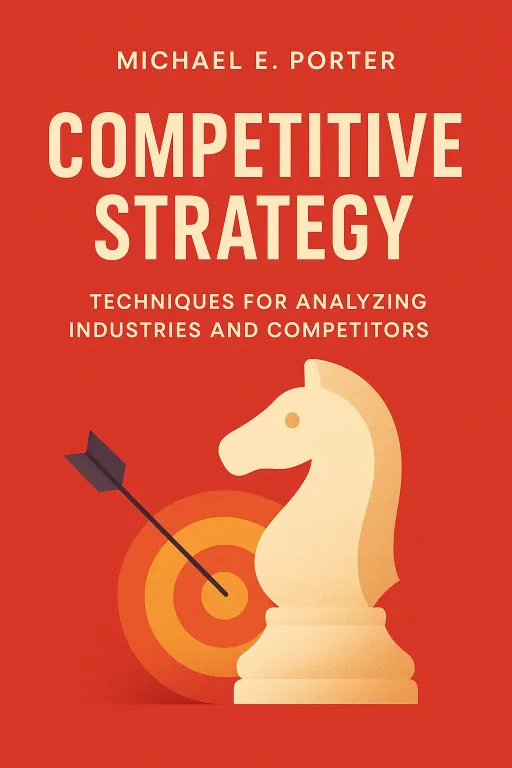
Dominating the Market: Classic vs. Disruptive Strategy
Golden Hook & Introduction
SECTION
Nova: Alright, Atlas, quick game. I'll throw out a word, you hit me with the first thing that comes to mind, no overthinking. Ready?
Atlas: Ooh, I love a good mental sprint! Hit me.
Nova: Strategy.
Atlas: Chess. Or… a really complicated recipe. Definitely a plan, right?
Nova: Nice. Now, Market.
Atlas: Sharks. Definitely sharks. Or a bustling, slightly terrifying bazaar.
Nova: Perfect. And finally, Competition.
Atlas: Exhaustion. Also, those sharks again. Maybe a slightly bloody bazaar?
Nova: You're not wrong! Because today, we're diving headfirst into the very heart of those concepts, the strategies that define how businesses, brands, even individuals, navigate those shark-infested waters. We're talking about two titans of strategic thinking: Michael E. Porter’s foundational work, specifically "Competitive Strategy," and then the groundbreaking counterpoint, "Blue Ocean Strategy" by W. Chan Kim and Renée Mauborgne.
Atlas: Ah, the classics versus the challengers! Porter's work, it’s like the bedrock of understanding how industries actually function, isn't it? It’s been shaping business school thinking for decades. And then Blue Ocean came along and said, "What if we just… don't play that game?" For anyone who’s ever felt caught in a relentless grind, trying to outmaneuver competitors, that "don't play" idea sounds like pure magic.
Nova: Exactly! Porter, who's often seen as the father of modern competitive strategy, gave us the analytical tools to dissect existing industries. His work is revered for its rigorous framework, though some critics might say it keeps you focused on the existing battle. Blue Ocean, on the other hand, arrived with widespread acclaim, offering a radically different lens, a way to escape that very battle. It's truly a testament to the journey of continuous learning in business.
Atlas: That’s fascinating. It really highlights that drive for deep understanding. So, the core of our podcast today is really an exploration of how businesses can both fiercely compete in existing markets boldly create entirely new ones. Today we'll dive deep into this from two perspectives. First, we'll explore how to master the competitive landscape, then we'll discuss how to escape it entirely by creating new market spaces, and finally, we'll focus on how to combine these powerful strategies for robust growth.
Mastering the Red Ocean with Porter's Competitive Strategy
SECTION
Nova: So, let's start with Michael Porter. Imagine you're a general looking at a battlefield. Porter's "Competitive Strategy" is your reconnaissance report, your strategic manual for winning the existing war. He essentially says, "Look, competition isn't just about your direct rivals."
Atlas: Hold on, so it’s not just about who sells the same thing? That’s a common misconception, I think. Many people just focus on their direct competitors.
Nova: Absolutely. Porter introduced his famous "Five Forces" that shape industry competition. Think of them as the five major pressures that determine how profitable and attractive an industry is.
Atlas: Okay, five forces. Lay them on me. For someone trying to build sustainable solutions, understanding these external pressures is critical for long-term survival.
Nova: First, you have the. How easy is it for someone new to jump into your market? If it's super easy, like setting up a lemonade stand, profits get squeezed.
Atlas: Right, low barriers to entry mean more competitors, more pressure.
Nova: Then there's the. If your customers have a lot of choices, they can demand lower prices. Think about how much power an individual buyer has when buying a single coffee versus a large corporation buying thousands of computers.
Atlas: That makes sense. The bigger the buyer, the more leverage they have over you.
Nova: Next, the. If there are only a few suppliers for a critical component you need, they can charge you more. Imagine if only one company made the microchips for all smartphones.
Atlas: Wow, that would definitely put manufacturers in a tough spot. So, both buyers and suppliers can really eat into your margins.
Nova: Exactly. Fourth, the. This isn't direct competition, but something that fulfills the. Like streaming services substituting traditional cable TV, or even a bicycle substituting a car for short commutes.
Atlas: Oh, I see! So, it’s about understanding the underlying need you're fulfilling, not just the product you’re selling. That's a deeper level of analysis.
Nova: And finally, the fifth force, the one everyone thinks of first:. This is the intensity of the fight among existing players. Price wars, advertising battles, new product introductions. The more intense, the harder it is to make money.
Atlas: So, it's a holistic view of the battlefield. But once you understand these forces, what do you with that information? How does a resilient analyst actually their position using this framework?
Nova: That's where Porter's "generic strategies" come in. He argues that to succeed, you need to choose one of two paths: or.
Atlas: So, is it just about being cheaper or fancier? What if you try to do both?
Nova: Well, Porter famously argued against trying to do both simultaneously, calling it "stuck in the middle." He said you risk being neither the lowest cost the most differentiated, and you end up with no clear competitive advantage. Think of a budget airline like Ryanair or Southwest. Their entire strategy is built around ruthlessly cutting costs to offer the lowest fares. Every operational decision, from seating to baggage fees, serves that cost leadership.
Atlas: Right, they own that "cheap and cheerful" space.
Nova: On the other side, you have differentiation. Think Apple. They don't compete on price. They differentiate through design, user experience, brand prestige, and ecosystem. They create a product that is perceived as unique and superior, allowing them to command premium prices.
Atlas: That's a clear choice. So, Porter is essentially saying, pick your weapon, understand your battlefield, and commit to a strategy within the existing market. It’s about winning the current game.
Navigating to Uncontested Waters with Blue Ocean Strategy
SECTION
Nova: But what if you don't to fight in that bloody, red ocean of competition? What if you want to find entirely new, uncontested waters where you can swim freely? That's precisely the question W. Chan Kim and Renée Mauborgne tackle in "Blue Ocean Strategy."
Atlas: Making competition irrelevant? That sounds like a dream for anyone trying to build sustainable solutions and find meaningful contribution without constantly battling. But how is that even possible? It feels almost counterintuitive to everything Porter laid out.
Nova: It’s a paradigm shift, really. They argue that instead of fighting over existing demand, companies should focus on creating demand in uncontested market spaces. The key is what they call "Value Innovation."
Atlas: Value Innovation. Okay, that sounds promising. What does it mean to innovate value in a way that avoids competition?
Nova: It means simultaneously pursuing differentiation low cost. Porter said you couldn't do both, but Blue Ocean Strategy says you do both to create a truly new market space. The classic example, the one that really brought this idea to life, is Cirque du Soleil.
Atlas: Cirque du Soleil! Wow, that’s a perfect case study. I’ve seen their shows; they’re incredible. Very different from a traditional circus.
Nova: Exactly. Traditional circuses were in a red ocean – declining audiences, rising costs for animal acts, expensive star performers. Cirque du Soleil didn't try to compete with Ringling Bros. They asked, "What if we take elements of theatre and opera, eliminate the expensive and controversial animal acts, get rid of the star performers, but the artistic quality, the storytelling, the music, the unique venue experience?"
Atlas: So, they eliminated what was expected of a circus, like the animals, and reduced other costs, but then they an entirely new experience, a blend of circus and sophisticated theater, that appealed to an adult audience willing to pay premium prices. That’s genius! They weren't just improving the circus; they it. That’s the kind of ethical innovation that seeks new value.
Nova: Precisely. They created a new market space by identifying "non-customers" – adults who wouldn't go to a traditional circus but were willing to pay for a sophisticated theatrical experience. They used a tool called the "Strategy Canvas" to visualize this, and the "Four Actions Framework": Eliminate, Reduce, Raise, Create.
Atlas: Eliminate, Reduce, Raise, Create. That's a powerful framework. So, for a company, it’s about systematically challenging industry assumptions. What can we eliminate that the industry takes for granted? What can we reduce below industry standards? What can we raise above industry standards? And what can we create that the industry has never offered?
Nova: Exactly. Another example, often cited from its early days, is Southwest Airlines. While we mentioned them for cost leadership earlier, their initial strategy of point-to-point flights, no meals, no assigned seats, and fun flight attendants was a blue ocean move against the hub-and-spoke model of traditional airlines. They simultaneously offered lower costs and a unique, convenient experience for short-haul travelers who previously might have driven.
Atlas: This sounds like a much more optimistic and expansive approach, especially for someone looking for meaningful contribution and foresight. But is it always possible to find these blue oceans? Or is there a risk of chasing a mirage?
Nova: That’s a very fair question. True blue oceans are rare and difficult to achieve, and they don't stay blue forever. Competitors will eventually try to enter. The challenge is in the execution, the willingness to break from industry norms, and the deep understanding of what non-customers truly value. It takes a lot of strategic foresight.
Synthesis & Takeaways
SECTION
Nova: So, Atlas, we’ve looked at Porter, who teaches us how to win in the existing, competitive "red ocean," and Blue Ocean Strategy, which inspires us to create entirely new, uncontested "blue oceans." The deep question for us, and for our listeners, is: how do you apply the principles of both defending your current market position actively seeking new, uncontested spaces to develop a truly robust marketing strategy for your brand? Is it Porter Blue Ocean?
Atlas: That’s the million-dollar question, isn't it? For someone who values a holistic approach, it feels like it can't be an either/or. It’s about knowing when to apply which lens, or even how to blend them. How do you balance defending your current value with seeking entirely new, perhaps more impactful, value?
Nova: The answer, for true strategic mastery, is often. You need Porter's framework to understand the game you're currently in, to analyze your industry's profitability, and to choose a clear competitive position within it. You can't ignore the competitive realities. But you also need the Blue Ocean mindset to prevent stagnation, to innovate, and to imagine the game you be playing.
Atlas: So, it's about having that dual vision. The resilient analyst needs to see the immediate threats and opportunities within the existing market, while the ethical innovator needs the foresight to spot the potential for entirely new value creation.
Nova: Exactly. And this isn't just theory. For our listeners who are keen to connect theory to real-world application, here’s a tiny step you can take: First, analyze a current market you're interested in using Porter's Five Forces. Really dissect those pressures. Then, with that understanding, brainstorm potential 'blue oceans' within that market by identifying non-customers and value innovation opportunities using the ERRC framework.
Atlas: That's brilliant. It's about having the strategic foresight to see both the battles you must win and the new worlds you can create. It's not about being stuck in one mindset, but continuously learning and adapting your strategic lens. This holistic view is crucial for building trust and innovation, especially when thinking about things like ethical AI in marketing or global brand narratives. You need to understand the existing landscape before you can ethically reshape it.
Nova: Absolutely. It’s about leveraging the best of both worlds, understanding that strategy isn't static. It's a dynamic interplay between rigorous analysis and bold imagination. The market is always shifting, and our strategies must evolve with it.
Atlas: A truly powerful combination. Thanks for illuminating these complex ideas, Nova. This has been incredibly insightful.
Nova: My pleasure, Atlas. And to all our listeners, we'd love to hear your thoughts. What "red oceans" are you currently navigating, and where do you see potential "blue oceans" emerging? Share your insights with us.
Nova: This is Aibrary. Congratulations on your growth!