

Stop Guessing, Start Measuring: The Guide to Data-Driven Marketing
Golden Hook & Introduction
SECTION
Nova: Most marketers believe their gut instinct is their superpower. What if that gut instinct is actually your kryptonite?
Atlas: Whoa, Nova, that's a bold statement right out of the gate. Are you saying we should just ignore all experience and intuition in marketing? That feels… almost heretical.
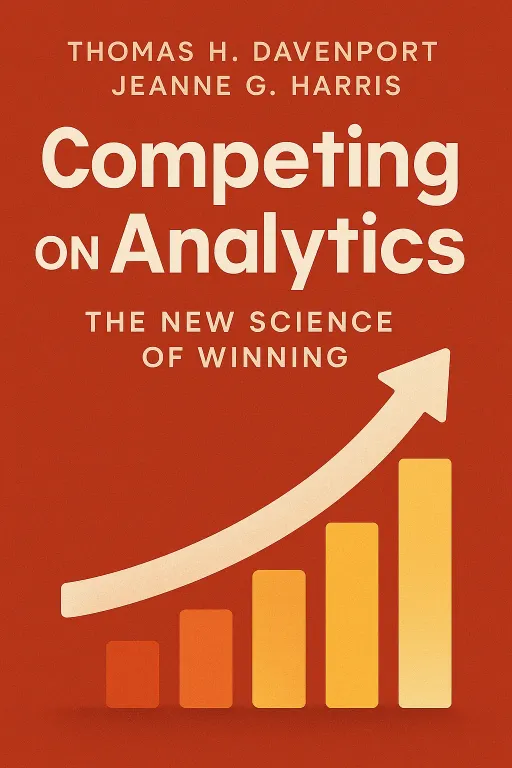
Nova: Not ignore, Atlas, but elevate. Today, we're diving deep into the world of data-driven marketing, a realm where intuition gets a powerful upgrade with precision and proof. We're drawing insights from essential reads like "Competing on Analytics" by Thomas H. Davenport and Jeanne G. Harris, and "Lean Analytics" by Alistair Croll and Benjamin Yoskovitz. These aren't just business books; their principles have become foundational in competitive strategy, taught in business schools worldwide, showing just how critical this shift is across industries.
Atlas: Okay, so this isn't just a trend; it's a fundamental change in how businesses operate. So, essentially, we're talking about moving beyond "feeling" successful to actually "knowing" what works. I like that. For anyone who's ever launched a campaign and crossed their fingers, this is going to resonate. Where do we even begin with this paradigm shift?
Nova: Exactly. And that brings us to our first core topic: The Paradigm Shift from Intuition to Data-Driven Marketing.
The Paradigm Shift: From Intuition to Data-Driven Marketing
SECTION
Nova: Think about it, Atlas. For decades, marketing was often about big-picture campaigns, creative flair, and a heavy dose of gut feeling. You'd launch a massive TV ad or a billboard, and then... hope. You'd track brand awareness surveys, maybe sales, but the direct link between effort and outcome was often fuzzy.
Atlas: Oh, I know that feeling. It's like launching a message in a bottle and just hoping someone finds it on the other side of the ocean. It's exhilarating, but also a little terrifying when you're accountable for results.
Nova: Precisely. But in the digital age, that bottle isn't just floating; it's got a GPS tracker, a microchip recording every interaction, and a sensor telling you exactly who picks it up and what they do next. The cold fact is, intuition alone is no longer enough. You need concrete data to drive decisions, not just guess. This allows you to optimize campaigns and prove real impact.
Atlas: So, what does that look like in practice? Give me a vivid example of a company making this shift.
Nova: Let's imagine two hypothetical marketing teams. Team A is launching a new product. They've got a fantastic creative director who believes in a bold, abstract campaign that "feels" right for their target audience. They spend months developing it, pour millions into traditional media buys—print, TV, a few static online banners. Their success metric is vague: "increased brand perception." After a quarter, they see a small bump in overall sales, but can't definitively link it back to the campaign. They're guessing.
Atlas: That sounds like a lot of marketing departments I've encountered, honestly. A lot of hope, a bit of prayer, and a very expensive mood board.
Nova: Now, Team B, inspired by the principles in "Competing on Analytics," takes a different approach. For their new product, they start with clear, measurable goals. They segment their audience meticulously based on actual online behavior. They launch smaller, targeted digital campaigns across various platforms, each with different ad copy and visuals. Every single click, every website visit, every form submission is tracked. They're A/B testing headlines, call-to-actions, even the colors of their buttons. Within weeks, they see that one ad variation on a specific platform is outperforming all others by 300%. They immediately reallocate budget, scale up what's working, and kill what isn't.
Atlas: Wow. The difference in clarity there is night and day. It's not just about having data; it's about embedding that analytical capability into every single part of their strategy, from concept to execution. That's a profound insight, really. But how do you even begin to integrate this across an entire organization? For our listeners who are managing high-pressure teams, or are trying to lead this change, that sounds like a massive undertaking.
Nova: It is. Davenport and Harris highlight that it's not just about hiring data scientists; it's about fostering a data-driven culture. It starts with leadership demanding evidence, empowering teams with tools, and training everyone to ask "why?" backed by numbers. It's about transforming data from a mere report into a powerful engine for growth and innovation. The cause is clear: the need for competitive advantage. The process is embedding analytics. The outcome: optimized campaigns, proven impact, and a significant edge.
Atlas: Okay, I get the vision. But as someone who likes practical application, I can easily see how you could get completely overwhelmed by the sheer volume of data, even with all those tools. It's like having a firehose of information pointed at you. How do you avoid drowning?
The Actionable Metric: Focusing Your Analytical Firepower
SECTION
Nova: That's a brilliant question, Atlas, and it naturally leads us to our second core topic: The Actionable Metric: Focusing Your Analytical Firepower. Once you accept the paradigm shift, the next challenge emerges: a tidal wave of data. How do you not drown in it? This is where "Lean Analytics" really shines, showing how to identify the one metric that matters most at each stage of your business.
Atlas: So, it's about strategic simplification? Because I imagine many listeners, especially those who seek depth and want to understand human behavior, could easily get lost trying to track.
Nova: Exactly. Think of it like this: You're a doctor. In an emergency, you don't start by reviewing the patient's entire 50-page medical history. You focus on the one or two vital signs that tell you if they're stable or crashing: heart rate, blood pressure, oxygen saturation. That's your "one metric that matters" in that moment.
Atlas: That's a great analogy. It makes so much sense. So, how do you that one metric in the chaotic world of marketing? Is there a magic formula? What if your business has multiple goals?
Nova: There's no magic formula, but there's a disciplined approach. Croll and Yoskovitz emphasize understanding your business model and its current stage. For a new e-commerce startup, it might be "customer acquisition cost" or "conversion rate from first visit." For a mature SaaS company, it might be "customer churn rate" or "monthly recurring revenue." The key is that this metric should be: actionable, understandable, and tied directly to your business's core value proposition at that specific time.
Atlas: So, for a strategic analyst driving impact, this is about cutting through the noise and saying, "This is the signal we need to amplify right now." Can you give me a contrasting example, perhaps of a team that failed to identify their one metric?
Nova: Absolutely. Let's imagine a startup building a new social media app. Their team is tracking everything: daily active users, monthly active users, time spent in app, number of posts, number of likes, shares, comments, profile views, direct messages, friend requests... They have dashboards with dozens of graphs. The CEO asks, "Are we growing?" And the marketing lead says, "Well, our likes are up 5%, but time in app is down 2% and comments are flat." They're paralyzed by data, unable to make clear decisions because everything is a priority, which means nothing is.
Atlas: That sounds like analysis paralysis, pure and simple. Data overload leading to decision underload.
Nova: Precisely. Now, another app startup, same stage, decides their one metric that matters is "weekly active users who complete at least one 'core activity'." They align every team—product, engineering, marketing—around pushing that single number. If it goes down, everyone knows exactly what problem they need to solve. If it goes up, they know they're on the right track. This focus allows them to iterate rapidly and avoid getting lost in a sea of data, making their analysis truly actionable.
Atlas: That's incredibly powerful. It transforms data from a reporting burden into a clear directive. For our listeners who are trying to future-proof their organizations, choosing that one metric feels like a critical step in building a resilient, adaptable strategy. It's about focusing your analytical firepower where it will have the most impact.
Synthesis & Takeaways
SECTION
Nova: Absolutely, Atlas. What we've discussed today isn't just about tweaking marketing tactics; it's about a fundamental shift in mindset. It's about moving from the art of guessing to the science of measuring, empowering intuition with concrete evidence. The deep insight here is that data-driven marketing isn't about removing the human element, but rather about enhancing it, allowing us to make more informed, impactful, and ultimately, more human-centric decisions. It's about transforming uncertainty into informed action, leading to true impact and future-proofing an organization.
Atlas: That's actually really inspiring. It feels like a pathway to genuine leadership and making a significant mark, which I know many of our listeners are driven by. So, for anyone listening right now, wanting to take a tiny step into this world, what's one thing they can do today?
Nova: Here's your action for today: Choose one current marketing campaign you're running. Just one. Then, identify the single most important metric for its success. How will you track it daily? Don't just pick something easy; pick the metric that, if it moves, tells you definitively if that campaign is working or not.
Atlas: I love that. It's practical, it's actionable, and it starts building that data-driven muscle. For anyone who identifies their North Star Metric for a campaign, we'd love to hear about it. Share it with us.
Nova: This is Aibrary. Congratulations on your growth!