

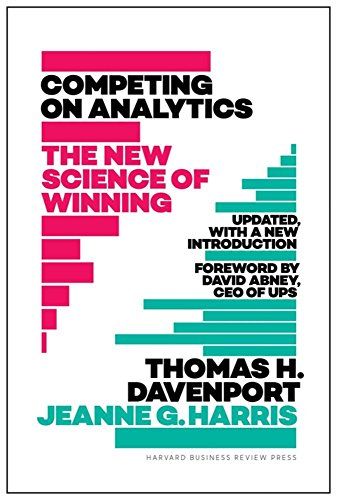
Competing on Analytics
Introduction
The Data Revolution: From IT Project to Competitive Edge
Nova: Welcome to the show. Imagine a world where your competitor doesn't just more data than you, but they use it to predict your next move, optimize their pricing in real-time, and personalize every customer interaction so perfectly that you simply can't keep up. That world wasn't science fiction when Thomas Davenport and Jeanne Harris published "Competing on Analytics" back in 2007.
Nova: : That book, Nova, was a genuine lightning rod. It wasn't just another business book; it was a declaration that data analysis was moving from the back office IT department to the front lines of strategic warfare. It essentially told CEOs, 'If you aren't using sophisticated analytics to drive your core business, you are already losing.'
Nova: Exactly. It was a landmark work that unleashed a worldwide movement. Before this, analytics was often seen as descriptive—what happened last quarter? Davenport argued that the new science of winning was about being and —what happen, and what we do about it? Today, we're diving deep into the frameworks they laid out to turn data into a sustainable competitive advantage.
Nova: : I'm ready to be schooled. I want to know who the true 'analytical competitors' are and how the rest of us can climb that ladder. Let's start with the roadmap they provided.
Key Insight 1: The Maturity Roadmap
Climbing the Ladder: The Five Stages of Analytical Maturity
Nova: Davenport and Harris didn't just preach the gospel; they provided a diagnostic tool. They mapped out five distinct stages of analytical maturity that an organization moves through. It’s a fantastic way for any listener to immediately benchmark where their own company stands.
Nova: : Let's hear the stages. I suspect most listeners are stuck somewhere in the middle, or maybe even lower.
Nova: You're probably right. Stage one is the dreaded 'Analytically Impaired.' These are organizations flying blind, relying on gut instinct, and reacting slowly to market shifts. They might have data, but it's siloed, messy, or simply ignored.
Nova: : So, the classic 'We've always done it this way' culture, but with spreadsheets?
Nova: Precisely. Then you move to Stage Two: 'Localized Analytics.' Here, pockets of brilliance exist. Maybe Marketing has a great segmentation model, or Finance has excellent forecasting, but these insights don't talk to each other. They are islands of analytical capability.
Nova: : That sounds familiar. We have a great dashboard in Sales, but when I ask Operations about their key drivers, they look at me blankly. What's Stage Three?
Nova: Stage Three is 'Analytical Aspirants.' This is where the ambition kicks in. They realize they analytics to compete, they hire data scientists, they invest in new tools, but they haven't yet integrated it into the culture or the core decision-making processes. They are trying, but the results are inconsistent.
Nova: : The classic pilot project purgatory. You build a beautiful model, show it works, and then it dies because the business unit won't adopt it. What separates the aspirants from the true players?
Nova: That leap is massive, and it takes you to Stage Four: 'Analytical Companies.' These organizations have successfully embedded analytics into their operations. They use data systematically across multiple functions. They are data-driven, but perhaps not yet by their data prowess.
Nova: : Okay, so they are using it well. But Davenport and Harris reserve Stage Five for the elite. What is that final destination?
Nova: Stage Five: 'Analytical Competitors.' These are the firms whose entire business model, strategy, and competitive advantage their analytical capability. They don't just analytics; they on it. They are constantly experimenting, innovating their analytical models, and using them to create barriers to entry for others.
Nova: : So, the difference between Stage Four and Five isn't just better reporting; it's about using analytics to fundamentally change the rules of the game in their industry. It’s proactive disruption, not just optimized reaction.
Nova: Exactly. It’s the difference between knowing your customer is likely to churn and building a dynamic pricing and retention engine that prevents the churn before the customer even considers leaving. It’s a complete organizational transformation.
Deep Dive: What Makes Them Different?
The DNA of the Elite: Characteristics of Stage Five Competitors
Nova: Let's zoom in on those Stage Five Analytical Competitors. What are the non-negotiable traits they possess that allow them to wring every last drop of value from their processes, as the research suggests?
Nova: : I imagine they have the best technology, right? The fastest servers and the fanciest machine learning algorithms.
Nova: That's a common misconception. While technology is necessary, Davenport stresses that it's not the differentiator. The true DNA is organizational and cultural. First, they have a highly centralized, sophisticated analytical team, often reporting high up in the organization, sometimes even to the CEO or COO.
Nova: : So, the analytics team isn't buried under the CIO, reporting on server uptime. They are strategic partners.
Nova: Precisely. Second, they treat analytics as a core competency, not a support function. They are constantly conducting experiments across many aspects of their business—a continuous cycle of hypothesis, test, measure, and learn. They institutionalize failure as part of the learning process.
Nova: : That requires serious leadership buy-in. If a CEO is afraid of a failed experiment, they'll never reach Stage Five. What about the data itself?
Nova: Their data management is world-class. They don't just data; they have integrated, high-quality, easily accessible data about their businesses and markets. They’ve solved the messy data problem that keeps Stage One and Two companies stuck.
Nova: : It sounds like they've built an internal R&D lab dedicated solely to business optimization.
Nova: That's a perfect analogy. Furthermore, they focus their analytical efforts on the most critical business targets. They don't waste time optimizing trivial processes. They target areas that directly impact revenue, cost, or customer lifetime value. They are ruthlessly focused on ROI from their analytical efforts.
Nova: : So, it’s not just about analytics; it’s about analytics to the most valuable levers of the business. It’s strategic deployment, not just technical capability.
Nova: Absolutely. And one final, crucial point: they hire and cultivate 'analytical thinkers' across the entire organization, not just in the dedicated team. They train their managers to ask 'What does the data say?' before making major decisions. That cultural shift is the hardest part to replicate.
Case Study: Analytics in Action
From Theory to Triumph: Harrah's and Marriott
Nova: The theory is compelling, but the proof is in the pudding. Davenport and Harris highlighted several companies that had achieved this elite status. Two of the most famous examples are Harrah's Entertainment and Marriott International.
Nova: : Harrah's, the casino giant. I assume their analytics focused on gambling odds, but I heard it was much deeper than that.
Nova: It was revolutionary. Harrah's built an analytical system focused entirely on customer loyalty and lifetime value, long before most companies even knew what 'Customer Lifetime Value' meant. They used their data to understand which customers were most profitable and how to keep them happy and gambling.
Nova: : So, they weren't just tracking comps; they were predicting behavior?
Nova: Exactly. They could analyze a customer's play history, hotel stays, dining habits, and then tailor offers in real-time to maximize that specific individual's spending potential. They essentially weaponized personalization to create an almost unbreakable loyalty loop. This system became their primary competitive moat against rivals like MGM.
Nova: : That’s incredible strategic leverage. Now, what about Marriott? They are in a completely different industry—hospitality.
Nova: Marriott’s journey, as detailed in the research, was about honing their operational systems to a science. They used analytics to optimize everything from staffing levels based on predicted occupancy rates to dynamic pricing for rooms based on local events and competitor availability.
Nova: : So, they are using analytics to manage the physical assets more efficiently, driving up margins?
Nova: Yes, but also enhancing the customer experience. By predicting demand accurately, they could ensure staffing was perfect, reducing wait times at check-in and ensuring amenities were available when needed. Their analytical capability allowed them to deliver a consistently high-quality experience at scale, which is incredibly hard to do in hospitality.
Nova: : It’s fascinating how the application differs—Harrah’s focused on maximizing the value of the, while Marriott focused on optimizing the of the service. But the underlying principle is the same: data-driven decision-making at every touchpoint.
Nova: It is. They moved beyond simple reporting to build analytical systems that were deeply embedded in their revenue management and customer relationship processes. They became analytical competitors by making their core business processes analytically superior.
Key Insight 2: The Foundational Elements
The Blueprint: Understanding the DELTA Model
Nova: So, if a company wants to move from Stage Two to Stage Five, they need a blueprint. Davenport and his colleagues later formalized this blueprint into the DELTA Model, which acts as a checklist for building analytical capability.
Nova: : I've heard of DELTA. It sounds like the necessary ingredients list for a successful analytical kitchen, right?
Nova: That’s a great way to put it. The original DELTA model has five core elements. The first, and most obvious, is. This isn't just about having data; it’s about having clean, integrated, and easily accessible data that is trusted by the business users.
Nova: : If the data isn't trustworthy, the whole house of cards collapses. What’s the 'E' in DELTA?
Nova: That’s. This speaks directly to the culture we discussed earlier. It means the entire organization, from the top down, is oriented toward using data to make decisions. It’s not just the data team's job; it’s everyone’s job.
Nova: : Leadership must be visibly committed to this, or it stalls. What about 'L'?
Nova: . This is the executive sponsorship that champions the analytical agenda, secures the necessary funding, and, crucially, rewards analytical thinking and punishes decisions made purely on gut feeling when data contradicts them.
Nova: : That’s where the rubber meets the road. Then we have 'T' for Targets. That seems straightforward—setting goals.
Nova: It is, but with a twist. Targets must be specific, measurable analytical goals tied directly to business outcomes. Not 'Improve customer satisfaction,' but 'Reduce churn among high-value segment X by 15% using predictive model Y within six months.' It demands precision.
Nova: : And finally, the 'A'—Analysts. The people.
Nova: Yes, the talent. This covers hiring the right mix of quantitative experts—the data scientists and statisticians—but also ensuring they are paired with 'translators'—people who understand both the math and the business context. The best analytical companies have both deep technical skill and deep domain knowledge.
Nova: : And I recall reading that this model was later expanded to DELTA Plus, adding Technology and Analytical Techniques?
Nova: Correct. The Plus elements acknowledge the explosion in Big Data and advanced methods. Technology covers the necessary infrastructure—cloud platforms, data lakes, etc.—and Analytical Techniques covers ensuring the team is using the right statistical methods, from basic regression to advanced AI. But the core five—Data, Enterprise, Leadership, Targets, Analysts—remain the foundation for moving up the maturity ladder.
Conclusion and Reflection
The Next Frontier: Analytics in the Age of AI
Nova: We’ve covered a lot of ground today, tracing the journey from being 'Analytically Impaired' to becoming a true 'Analytical Competitor' using Davenport and Harris's frameworks.
Nova: : The key takeaway for me is that this isn't a technology race; it’s a cultural and strategic one. The five stages give us the diagnosis, and the DELTA model gives us the prescription: clean data, committed leadership, focused targets, and the right people.
Nova: Absolutely. The book, even years after its initial publication, remains incredibly relevant because the principles of embedding data into decision-making haven't changed, even as the tools—like modern AI and machine learning—have become exponentially more powerful. The analytical competitor of today is simply a Stage Five company that has successfully integrated Generative AI into their prescriptive models.
Nova: : So, the challenge for our listeners isn't just to buy a new tool, but to honestly assess where they sit on that five-stage ladder. Are you flying blind, or are you using data to rewrite the rules of your industry?
Nova: That self-assessment is the first, most critical step. If you find yourself at Stage Two or Three, start by focusing on the 'L' and the 'A' in DELTA—Leadership commitment and hiring the right analytical translators. That's where the real transformation begins.
Nova: : Fantastic roadmap, Nova. It’s clear that competing on analytics isn't a fad; it’s the fundamental operating system for modern business success.
Nova: Indeed. Keep questioning your assumptions, keep testing your hypotheses, and always ask: What does the data say? This is Aibrary. Congratulations on your growth!