The AI Strategy Playbook: Stop Guessing, Start Predicting for Competitive Edge
Golden Hook & Introduction
SECTION
Nova: What if I told you that your gut feeling, that strategic intuition you pride yourself on, is actually becoming your biggest competitive liability? In today's lightning-fast world, relying solely on instinct is a recipe for being left behind.
Atlas: Whoa, that's a bold claim, Nova. I imagine a lot of our listeners, especially those in strategic roles, pride themselves on their intuition. Are you saying we should just throw out decades of experience and gut wisdom?
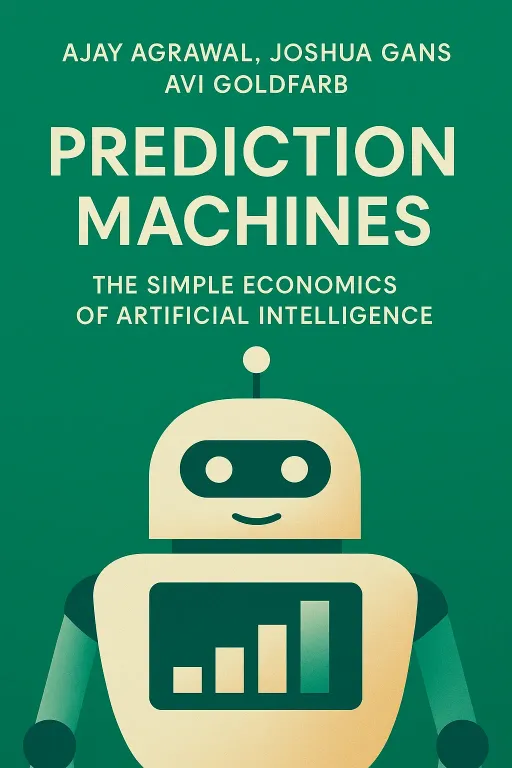
Nova: Not throw it out entirely, Atlas, but definitely re-evaluate its primacy. Today, we're diving into the profound implications of AI for strategy, drawing heavily from two groundbreaking books: Prediction Machines by Ajay Agrawal, Joshua Gans, and Avi Goldfarb, and Competing in the Age of AI by Marco Iansiti and Karim R. Lakhani. These authors aren't just academics; they're economists and business strategists who've been at the forefront of understanding how AI isn't just a new tool, but a fundamental economic transformation. It's much like electricity was a century ago. They argue that AI's real power lies in making prediction incredibly cheap, and that's changing everything.
Atlas: Okay, so it's not just a fancy new gadget, it's a foundational shift. That makes me wonder, what exactly do you mean by 'prediction' in this context? Are we talking about predicting the stock market, or something more fundamental to everyday business?
AI as the New Prediction Machine: The Fundamental Shift
SECTION
Nova: Exactly, Atlas, it's far more fundamental. Think of it this way: for most of human history, prediction has been expensive. It required human expertise, data analysis, and often, a lot of guesswork. What these authors call 'prediction machines'—AI systems—drastically lower that cost. They make previously impossible or uneconomical predictions now completely feasible.
Atlas: So you're saying AI isn't just making our old forecasting models faster, it's creating entirely new capabilities for prediction?
Nova: Precisely. Imagine Amazon's recommendation engine. It's constantly predicting what products you might want next based on your past behavior and millions of other users. Or Google's search algorithm, predicting which information is most relevant to your query. These aren't just minor efficiencies; they're entirely new services built around incredibly cheap, accurate predictions. The cost of predicting what you might like, or what information you need, has dropped to near zero.
Atlas: That's a great example. I can see how that changes the game for consumer-facing businesses. But how does this translate into a tangible competitive edge for, say, a strategic architect in a B2B space, where relationships and complex deals are paramount? How does cheap prediction give an advantage?
Nova: For a strategic architect, it means shifting focus from human-intensive prediction tasks to leveraging AI for insights that inform strategy. Instead of spending weeks trying to forecast market trends with limited data, AI can sift through vast datasets to predict emerging customer needs, potential supply chain disruptions, or even the likelihood of a competitor launching a similar product. This frees up human intelligence to focus on judgment—on what to with those predictions, how to innovate, how to build relationships, and how to execute. The competitive edge comes from being able to on insights no one else can see, or see with such speed and accuracy.
Atlas: That makes sense. It's about augmenting human judgment, not replacing it. So, if prediction becomes cheap, then the value shifts. What else changes when prediction is no longer a bottleneck?
Re-architecting Business Models for the Age of AI
SECTION
Nova: And that leads us perfectly into the next layer of this transformation: how businesses aren't just AI, but are being by it. The authors of Competing in the Age of AI emphasize that AI-driven companies operate on a fundamentally different model. They don't just bolt AI onto existing processes; they integrate prediction and data at every level of their organization.
Atlas: Okay, but wait, looking at this from a large enterprise perspective, isn't that incredibly difficult to implement? It sounds like you're suggesting a complete overhaul, which can be risky and expensive for established companies.
Nova: It is a profound shift, but it's where the sustainable competitive advantage lies. Think of a modern logistics company. It's not just about having trucks and warehouses anymore. It's about AI predicting optimal routes, anticipating traffic, forecasting demand for specific items, and even predicting maintenance needs for vehicles. Every piece of data from every delivery feeds back into the AI, making the predictions even better, creating a continuous learning loop. This leads to network effects: the more users, the more data, the better the predictions, the better the service, which attracts more users. It creates a defensible moat that traditional operational efficiencies can't match.
Atlas: That's a great analogy. It's like the system gets smarter the more it's used. So, for our listeners who are striving for strategic growth and building defensible positions, what are the key principles for re-architecting their business models? Is it just about collecting more data, or is there a deeper philosophy at play?
Nova: It's definitely a deeper philosophy. It's about designing your business around three core elements: data, prediction, and action. First, you need to identify what data is relevant to your core business predictions. Second, you must have the AI systems to make those predictions effectively. And third, and most crucially, you need to to act on those predictions. Many companies gather data and make predictions, but then they get stuck because their existing operational model can't actually those predictions to create value. They're still acting on old assumptions.
Atlas: So it's not just about the tech, it's about the entire organizational design. I imagine a lot of our listeners are wrestling with how to make that leap from theoretical understanding to practical implementation in their own roles. It sounds like a mindset shift is as important as the technology itself.
Synthesis & Takeaways
SECTION
Nova: Absolutely. The deep insight here is that AI isn't just about better predictions; it's about fundamentally rethinking your business does and it creates value. The competitive edge comes from re-imagining processes around cheap prediction, creating feedback loops that make your system smarter with every interaction, making it exponentially harder for competitors to catch up. It's a race not just to predict, but to build an organization that learns and adapts at machine speed.
Atlas: That's actually really inspiring, Nova. It almost feels like a new frontier for strategic thinking. So, for a strategic leader or growth seeker listening right now, what's one tiny step they can take this week to start moving in this direction? What's the immediate action item?
Nova: Great question, Atlas. Here's a tiny step: identify one key business process in your current role that could be significantly improved by better prediction. It could be anything from sales forecasting to project risk assessment, or even talent acquisition. Then, outline what specific data you would need to feed into an AI system to make that prediction better. Just that initial mapping of a process to potential data sources can be incredibly illuminating.
Atlas: That's a perfectly actionable step. It grounds the abstract into something concrete. I imagine that exercise alone will spark a lot of "aha!" moments for our listeners.
Nova: That's the hope. It's about moving from guessing to predicting, and ultimately, to truly strategic growth.
Atlas: Fantastic.
Nova: This is Aibrary. Congratulations on your growth!