

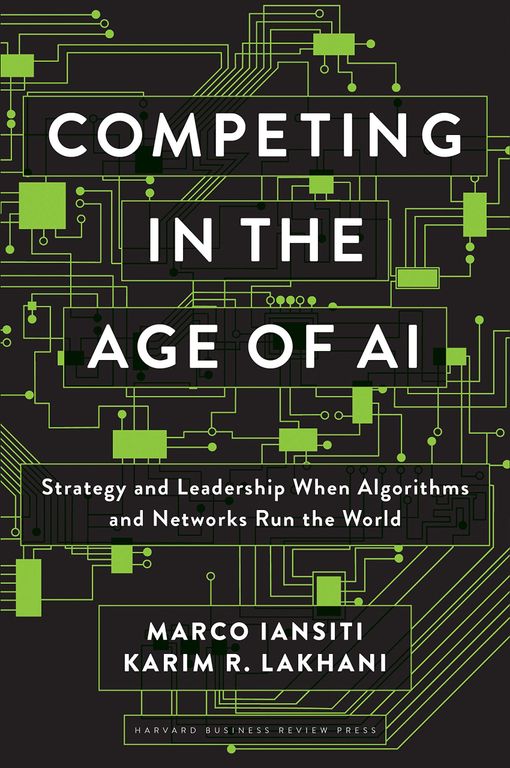
Competing in the Age of AI
Introduction: Beyond Optimization, Towards Reinvention
Introduction: Beyond Optimization, Towards Reinvention
Nova: Welcome back to The Strategy Synthesis. Today, we are diving deep into a book that argues the rules of competition haven't just bent—they've shattered. We're talking about Marco Iansiti and Karim Lakhani's seminal work, "Competing in the Age of AI."
Nova: : That title is bold, Nova. Most business books promise a new framework, but Iansiti and Lakhani suggest AI isn't just another tool for efficiency. What's the core thesis that sets this book apart from the thousands of others on digital transformation?
Nova: Exactly. The biggest takeaway is that AI is not about incremental improvement; it's about around data, analytics, and algorithms. They argue that this reinvention removes traditional, centuries-old constraints on scale, scope, and learning that have always capped business growth.
Nova: : Constraints on scale? That sounds huge. For decades, scaling meant building more factories, hiring more people, opening more physical locations. Are they saying AI makes that obsolete?
Nova: In many ways, yes. Think about Ant Financial, one of their key examples. They launched and scaled to over a billion consumers in just five years. A traditional bank, even a massive one, cannot achieve that kind of global scale that fast. That speed and reach come from a fundamentally different architecture, which they call the AI Operating Model.
Nova: : A billion users in five years. That's staggering. It makes you realize that if your strategy is still based on linear growth projections, you're already playing a different, slower game than your competitors.
Nova: Precisely. This isn't about adding an AI department. It's about recognizing that the very DNA of the successful company is changing. We need to understand this new DNA if we want to survive the coming collisions between the old guard and the new AI-first entities.
Nova: : So, let's start there. Before we get into the nuts and bolts of the operating model, what is the fundamental difference they draw between what most companies call 'Digital Transformation' and what they define as true 'AI Competition'?
Nova: That’s the perfect place to start. Digital transformation, as most executives understand it, is often about digitizing existing processes—moving paper to PDFs, using cloud storage. It’s optimization. AI competition, however, is about that were previously impossible, driven by the ability to learn from massive data flows.
Nova: : So, digitization is making the old engine run slightly cleaner, but AI competition is building a jet engine in its place?
Nova: That’s a fantastic analogy. Digitization makes the analog firm better at what it already does. AI competition creates an entirely new class of firm where the product itself is constantly learning and improving based on user interaction, creating a self-reinforcing advantage. It’s a shift from static assets to dynamic, learning systems.
Nova: : I see. It’s the difference between automating a spreadsheet and building a system that predicts market shifts before they happen based on real-time global data. This sounds like the core of their argument.
Nova: It is. And this leads us directly into the architecture of these new winners. Let's break down what this AI Operating Model actually looks like, because it's the blueprint for survival.
Nova: : I'm ready. I suspect it involves a lot more than just hiring data scientists.
Nova: Much more. It involves a complete restructuring of how value is created and delivered. Let's move into our first core chapter.
Key Insight 1: The Three Pillars of AI Advantage
The AI Operating Model: Scale, Scope, and Learning Redefined
Nova: Chapter one is all about the AI Operating Model. Iansiti and Lakhani break down the advantages of these new firms into three interconnected pillars: Scale, Scope, and Learning. Traditional firms are constrained by physical assets; AI firms are constrained only by data and algorithms.
Nova: : Let's tackle Scale first. How does AI fundamentally change the economics of scaling a business? I'm thinking about marginal cost.
Nova: In the old world, scaling meant increasing marginal cost—every new customer, every new product, required more labor or more physical infrastructure. With an AI-driven model, the marginal cost of serving an additional user or transaction approaches zero. Think about software updates or algorithmic recommendations; once the system is built, serving the billionth user costs virtually nothing compared to the first.
Nova: : That’s the network effect on steroids. If the product gets better with every new user, and the cost to serve that new user is negligible, you create a runaway advantage. It’s a winner-take-most scenario.
Nova: Exactly. And this feeds directly into the second pillar: Scope. Because the core engine is software and data, AI firms can expand their scope—the range of services they offer—with incredible agility. They aren't tied down by specialized physical assets.
Nova: : Can you give us a concrete example of that scope expansion? Maybe something that wasn't obvious when they started?
Nova: Look at Amazon. They started with books, leveraging their logistics and data infrastructure. But that same infrastructure, once digitized and AI-optimized, allowed them to pivot into cloud computing with AWS, then streaming, then groceries. The core operating model is fungible. It’s a platform that can host countless different services.
Nova: : Whereas a traditional retailer, say, a specialized furniture chain, has a massive sunk cost in showrooms and supply chains that makes pivoting to cloud services nearly impossible.
Nova: Precisely. The physical world imposes friction. The digital world, governed by the AI operating model, thrives on frictionless expansion. But the most crucial pillar, the one that locks in the advantage, is Learning.
Nova: : Ah, the feedback loop. This is where the magic happens, right? The data generated by the scale and scope feeds back into the algorithms.
Nova: It’s the engine of competitive advantage. Every interaction, every click, every transaction becomes a new data point that trains the model, making the service smarter, more personalized, and thus, more valuable to the next user. This creates a virtuous cycle that traditional firms simply cannot replicate.
Nova: : So, if a traditional company tries to copy an AI firm's feature, they don't just need the code; they need the five years of proprietary, massive-scale user data that trained the model to be effective in the first place.
Nova: That's the moat. The data moat. Iansiti emphasizes that the AI operating model is characterized by this continuous, automated learning. It’s not a one-time investment; it’s an ongoing, self-improving process. This is why they say AI removes the traditional constraints on learning.
Nova: : It sounds almost biological—the firm evolves based on environmental feedback, rather than just following a static five-year plan.
Nova: That’s a great way to put it. The organization itself becomes an adaptive organism. Now, the question for established companies is: how do you inject this learning mechanism into an organization built for stability and predictability? That’s where the 'collision' comes in.
Nova: : Right. The established players aren't just competing against startups; they are competing against a fundamentally different a company. Let's explore those collisions next.
Nova: Excellent transition. Let's look at the battlefield.
Case Study: Exponential Growth vs. Linear Constraints
The Collision Course: Analog vs. AI-First Encounters
Nova: In Chapter three, the authors detail what they call 'collisions'—the moments where an AI-first company directly challenges an established, analog incumbent. These aren't just market share battles; they are structural conflicts.
Nova: : I recall reading about Airbnb as a prime example. They didn't build a single hotel, yet they became one of the world's largest accommodation providers. What was their AI operating model advantage there?
Nova: Airbnb’s advantage wasn't physical inventory; it was the platform's ability to manage and optimize decentralized supply and demand using algorithms for pricing, matching, and trust—reviews and ratings. Their scale was the network of hosts and guests, not bricks and mortar.
Nova: : And the traditional hotel industry, bound by real estate acquisition, zoning laws, and physical labor costs, simply couldn't match that rate of expansion. The marginal cost of adding one more room to Airbnb’s inventory was near zero; for Marriott, it was millions.
Nova: Exactly. And the learning loop is key here too. Every successful booking, every review, refined their matching algorithms, making the platform better for the next transaction. Traditional hotels rely on brand reputation built over decades; Airbnb built reputation algorithmically, in real-time, across millions of interactions.
Nova: : What about a case where an incumbent manage to transform, or at least survive the initial shock? Iansiti must have looked at companies that adapted.
Nova: Microsoft is often cited as a successful transformation story, moving from a packaged software model—selling Windows licenses, which is very linear—to a cloud and subscription model with Azure and Office 365. They had to fundamentally change their internal metrics and incentives.
Nova: : That shift from selling a product to selling a service, underpinned by continuous data flow, is the essence of adopting the AI operating model, isn't it?
Nova: It is. And the authors stress that this transformation is painful because it requires dismantling old revenue streams and organizational structures that were successful for decades. They point out that the leadership must be willing to cannibalize the old business to build the new one.
Nova: : It’s a classic innovator's dilemma, but amplified by the speed of AI. If you wait until the collision is happening, you’ve already lost the war for scale and learning.
Nova: Absolutely. They note that the incumbent's strength—deep domain expertise and existing customer relationships—can become a liability if it prevents them from embracing the new data-centric logic. The old expertise doesn't translate directly into AI expertise.
Nova: : So, the key lesson from these collisions isn't just 'adopt AI,' it's 're-architect your entire value chain around data feedback loops.'
Nova: Precisely. And this re-architecture isn't just operational; it’s strategic and cultural. It requires a different kind of leadership, which brings us to the final, critical piece: governance and strategy.
Nova: : Let's explore that. How do you govern a company whose primary asset is intangible data flowing through complex algorithms?
Nova: That’s the focus of our next segment. It’s where strategy meets ethics and structure.
Key Insight 3: The Mandate for Reinvention
Strategy and Governance: Becoming an AI-First Organization
Nova: We've established the 'what'—the AI Operating Model—and the 'why'—the existential threat of collision. Now we tackle the 'how' of leadership, specifically strategy and governance. Iansiti and Lakhani are clear: you must become an 'AI-first company.'
Nova: : What does 'AI-first' actually mean in practice, beyond just having a Chief AI Officer? Is it about budget allocation, or something deeper?
Nova: It's deeper. It means that every major strategic decision must be filtered through the lens of how it impacts the data feedback loop. If a decision doesn't generate valuable data or improve the core learning mechanism, it's a distraction from the true competitive mandate.
Nova: : That implies a radical shift in how capital is allocated. Instead of funding the next big physical expansion, you fund the next big data acquisition or model improvement project.
Nova: Exactly. They discuss how traditional financial metrics, which favor short-term returns on tangible assets, actively punish the long-term, often intangible investments required for AI scale. Leaders need to adopt new metrics that value data assets and learning velocity.
Nova: : And what about governance? With algorithms making decisions that affect millions—pricing, hiring, loan approvals—the ethical and regulatory stakes are enormous. How does the book address this?
Nova: Governance is treated as a critical component of the operating model, not an afterthought. They stress the need for transparency, explainability, and robust oversight mechanisms for the algorithms themselves. Since the AI is the core engine, its integrity is the integrity of the firm.
Nova: : So, if the algorithm starts exhibiting bias, that's not just a PR problem; it's a fundamental failure of the operating model, akin to a factory producing faulty products at scale.
Nova: Precisely. And the authors suggest that governance must be embedded in the design process—'governance by design'—rather than bolted on later. This requires collaboration between technical experts, legal teams, and executive leadership from the very beginning of any AI initiative.
Nova: : It sounds like the CEO in the Age of AI needs to be as fluent in data ethics and network topology as they are in finance.
Nova: They absolutely do. The book argues that leadership must evolve from being managers of physical resources to being architects of digital systems and stewards of data ecosystems. It’s a massive cognitive load shift for the C-suite.
Nova: : I’m thinking about the organizational structure again. If the core value is in the data loop, do you centralize the AI function, or distribute it across business units?
Nova: The research suggests a hybrid approach is often necessary. You need a centralized AI core—the platform, the infrastructure, the governance framework—to ensure consistency and shared learning across the enterprise. But you also need decentralized application teams embedded within business units to ensure the AI is solving real, high-value problems relevant to that scope.
Nova: : So, a central nervous system for the algorithms, but specialized limbs for application and interaction. That makes sense for balancing standardization with agility.
Nova: It does. And this entire framework—the operating model, the collision dynamics, the governance—all points toward one inescapable conclusion for any established company.
Nova: : Which is?
Nova: That incremental change is a death sentence. You must commit to a fundamental reinvention, or you will be structurally outcompeted. That's what we need to wrap up with.
Conclusion: The Stakes of the AI Era
Conclusion: The Stakes of the AI Era
Nova: We've covered a lot of ground today, moving from the abstract concept of reinvention to the concrete mechanics of the AI Operating Model. Let's synthesize the three biggest takeaways from Iansiti and Lakhani's work.
Nova: : First, I think it's the clarity on the difference between digitization and AI competition. Digitization is about efficiency; AI competition is about creating fundamentally new, exponentially scalable capabilities through data feedback loops.
Nova: Absolutely. Takeaway number one: Stop optimizing the old model. Start architecting the new one. The goal isn't to make your current processes 10% faster; it’s to build a system where the marginal cost of serving the next customer approaches zero while the product simultaneously gets smarter.
Nova: : My second major takeaway is the concept of the 'collision.' Established firms are not just facing new competitors; they are facing a different of competition. The speed of scale achieved by AI-first firms like Ant Financial or Amazon is simply unattainable for organizations constrained by physical assets and linear growth.
Nova: That speed is the killer. And the third, perhaps most actionable point for our listeners in leadership roles, is the mandate for governance and strategy. You cannot delegate AI strategy to the IT department. It must be the central focus of the C-suite, demanding new metrics that value data assets and learning velocity over traditional short-term ROI.
Nova: : It’s a call for organizational courage. It requires leaders to be willing to disrupt their own successful structures before an outside force does it for them.
Nova: Indeed. The authors leave us with a sobering thought: the age of AI is not just about technology; it’s about the concentration of wealth and power in the hands of those who master this new operating model. The gap between the AI-first firms and the rest is widening rapidly.
Nova: : So, the actionable takeaway is clear: Assess your organization today. Are you digitizing, or are you reinventing? Are your metrics rewarding the creation of data moats, or just quarterly profits from legacy systems?
Nova: That’s the challenge. The age of AI demands a new kind of firm, built on algorithms and networks, capable of infinite learning. It’s a fascinating, and frankly, terrifying time to be in business.
Nova: : Terrifying, perhaps, but also full of opportunity for those who embrace the architectural shift. Thank you, Nova, for breaking down this essential text.
Nova: My pleasure. Keep learning, keep questioning, and keep building those feedback loops.
Nova: This is Aibrary. Congratulations on your growth!