Stop Guessing, Start Shaping: The Guide to Market Creation.
Golden Hook & Introduction
SECTION
Nova: Atlas, five words. 'Stop Guessing, Start Shaping.' What comes to mind?
Atlas: Future-proof innovation, no more wasted effort.
Nova: Ah, that's incredibly succinct and hits right at the heart of our discussion today. Because for too long, many brilliant innovators, with all the best intentions, have focused on creating better products. But the cold, hard fact is, true disruption doesn't just come from a better product. It comes from understanding the deeper 'job to be done' that customers are truly hiring products for. Ignoring that leads to solutions searching for problems, particularly in dynamic markets.
Atlas: That resonates deeply. I’ve seen so many incredibly engineered solutions that just… didn’t land. It feels like a fundamental disconnect between what's built and what's truly needed.
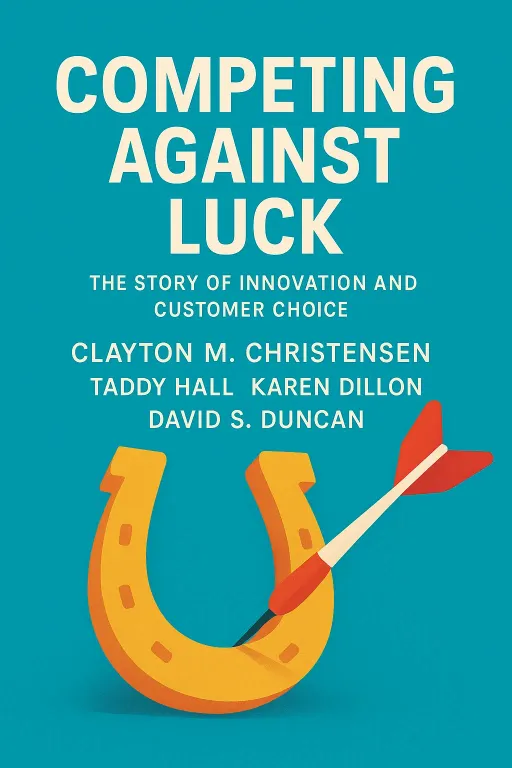
Nova: Exactly. And that's why we're diving into the brilliant minds of two giants today: Clayton M. Christensen and Steve Blank. Christensen, a Harvard Business School professor whose work on disruptive innovation reshaped how we think about markets, gives us the theoretical foundation in his book, "Competing Against Luck." And then, Steve Blank, a seasoned Silicon Valley entrepreneur, gives us the practical roadmap, particularly through his "Four-Step Method for the Epiphany." Together, they offer a powerful guide to market creation.
Atlas: So basically, we’re talking about moving beyond assumptions and into a space where innovation isn't just a shot in the dark, but a guided, validated journey.
The 'Jobs to Be Done' Revolution: Why Customers 'Hire' Your Product
SECTION
Nova: Precisely. Let's start with Christensen and this revolutionary idea of 'Jobs to Be Done.' It sounds simple, but it flips product development on its head. The core idea is that customers don't just buy products; they 'hire' them to solve a problem or fulfill a need in their lives. Think about a classic example: the milkshake.
Atlas: The milkshake? I’m intrigued. What 'job' does a milkshake get hired for? My immediate thought is 'sweet treat' or 'dessert.'
Nova: That’s what most companies assumed. But Christensen's team found something fascinating. People 'hired' milkshakes for different 'jobs' at different times of day. Morning commuters, for instance, often 'hired' them for a long, satisfying, one-handed breakfast that felt substantial but wasn't messy in the car. It wasn't about the sweetness; it was about the commute, the hunger, and the need for something that lasted.
Atlas: Oh, I see! So it wasn't competing against other sweet treats, but against a banana, a bagel, or even boredom on the drive. That’s a fundamentally different competitive landscape.
Nova: Absolutely. And this isn't just for fast food. Imagine a company developing a new AI-powered project management tool. They might think they’re competing on features like Gantt charts or task automation. But the real 'job' a busy executive is hiring that tool for might be 'reducing anxiety about project oversight' or 'freeing up mental space to focus on strategic vision.'
Atlas: But wait, for our listeners who are building disruptive technologies or working on complex, sustainable development projects, isn't it just about having the best features? How does 'Jobs to Be Done' apply to something as intricate as, say, a smart city infrastructure project, rather than a milkshake?
Nova: That’s a brilliant challenge, Atlas. Because it applies even more profoundly there. A city council isn't 'hiring' a smart city infrastructure for faster traffic lights. They're 'hiring' it to 'create a more livable, efficient, and sustainable urban environment for their citizens,' or 'attract new businesses and talent,' or even 'reduce long-term operational costs.' The smart traffic lights are just a feature. The underlying 'job' is about urban flourishing, economic growth, and citizen well-being.
Atlas: That makes so much sense. It shifts the focus from the technical specifications of the product to the ultimate outcome the 'customer' – whether that's an individual or an entire city – is trying to achieve. It’s about building consensus and leading complex deals by truly understanding stakeholders' deeper motivations, not just their stated requirements.
Nova: Exactly. It's the difference between selling a drill and selling the ability to hang a picture frame. One focuses on the tool, the other on the desired outcome. And that difference is where new markets are created, not just competed in.
Validating Vision: Steve Blank's 'Four-Step Method' for Market Creation
SECTION
Nova: Understanding the 'job' is one thing, but how do we we're building the right solution for it? That’s where Steve Blank steps in with his relentless emphasis on getting 'outside the building.' He argues that no business plan survives first contact with customers, and that's not a bad thing. It's an opportunity. His 'Four-Step Method for the Epiphany' is all about customer development and validating assumptions iteratively.
Atlas: So it’s not just about having a great idea, but rigorously testing that idea against reality? I mean, for an innovator, that sounds a bit like being told your baby isn't perfect.
Nova: Oh, I know that feeling! But it’s about shaping that baby into a thriving adult. Blank's work comes from a very practical, entrepreneurial background in Silicon Valley, where he saw countless brilliant engineers build incredible products that nobody wanted because they never left the lab. They assumed they knew the 'job' and the solution.
Nova: Let me paint a picture. Imagine a startup, brimming with talent, developing a revolutionary new app for remote teams. They're convinced the 'job' is 'enhancing real-time collaboration.' They spend months, millions, building a feature-rich platform. They launch, and… crickets. Why? Because they never actually went outside and truly understood the 'job.' Maybe the real 'job' for remote teams wasn't more real-time collaboration, but 'reducing meeting fatigue and asynchronous decision-making.' They built a Ferrari when what people needed was a reliable, quiet electric bike.
Atlas: Wow. That’s kind of heartbreaking. All that effort, all that vision, wasted because they didn’t talk to their actual users.
Nova: Precisely. Blank’s method forces you to identify your core hypotheses – who your customer is, what problem you're solving, what your solution looks like – and then systematically test them through customer interviews and experiments, not just market research. It’s an iterative loop of hypothesis, test, learn, and iterate. It’s about pivoting when necessary, not stubbornly sticking to a flawed initial vision.
Atlas: But isn't there a risk of over-validating, of losing the 'innovator's vision' by listening too much to what customers they want, rather than what they? Especially for truly disruptive ideas that customers might not even be able to articulate yet?
Nova: That’s a really important distinction, and Blank addresses it. Validation isn't about letting customers design your product. It’s about uncovering their and. It’s about observing their behavior, not just taking their word for it. It's about finding the underlying 'job' they're struggling with, which they might describe imperfectly. A truly disruptive idea often meets a job that customers didn't even know could be done better. Your vision isn't compromised; it's and by real-world data, making it more resilient and impactful.
Atlas: I can see how that would be critical for securing your vision and leading complex deals. If you can articulate the deep 'job' you're solving, and you have validated evidence that your solution truly meets that job, your negotiation position becomes incredibly strong. It’s not just about selling a product; it’s about selling a validated solution to a fundamental problem.
Nova: Exactly. It's about building consensus not just on features, but on fundamental value.
Synthesis & Takeaways
SECTION
Nova: So, bringing it all together, Christensen gives us the profound insight into problem to solve – the 'job to be done.' And Blank gives us the rigorous – the iterative process of validating that we're indeed solving the right job with the right solution. True disruption, true market creation, doesn't happen by guessing. It happens by deeply understanding needs and then meticulously shaping solutions based on real-world feedback.
Atlas: It’s a powerful synergy. It moves you from just competing in existing markets to actually defining and creating entirely new ones, which is the ultimate goal for any strategist or innovator. For our listeners who are deep thinkers, innovators, and community builders, what's they can take today to apply this?
Nova: That's a great question, Atlas. It's actually a tiny step from our main content. Think about a recent project, a product, or even a service you offered where you you knew what your customers wanted. Now, ask yourself: what 'job' were they hiring your solution to do? Dig deeper than the surface features or the obvious benefits. Were they hiring it for convenience? For status? For peace of mind? For a sense of belonging?
Atlas: That’s a fantastic exercise. It’s about trusting your vision, yes, but also having the humility to test it and refine it. It’s cultivating that executive presence while practicing active listening, as our growth recommendations suggest. It's truly leading with empathy.
Nova: And that, Atlas, is how we move towards more sustainable development, building for the future, and creating lasting value that genuinely serves people and progress. It’s about shaping markets, not just following them.
Atlas: Absolutely. This is Aibrary. Congratulations on your growth!