Stop Building Features, Start Solving Problems: The Guide to Customer-Centered Innovation.
Golden Hook & Introduction
SECTION
Nova: Atlas, quick, what's your take on a product that promises everything but delivers... well, nothing you actually needed?
Atlas: Oh man, you mean my last attempt at a "smart" toaster? It can send me tweets about the weather, but still somehow manages to burn my bagels every single time. Pure genius, that.
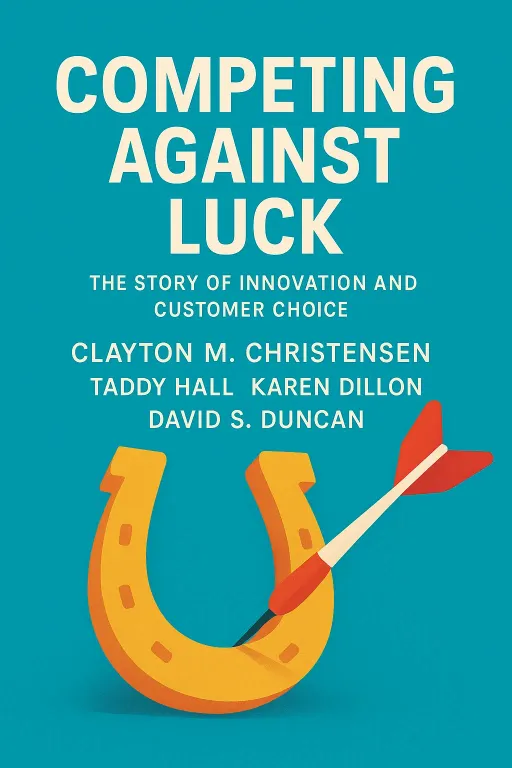
Nova: Absolutely hilarious, and also, exactly the kind of frustration we're dissecting today. We’re inspired by a truly insightful book: "Stop Building Features, Start Solving Problems: The Guide to Customer-Centered Innovation." It's a title that cuts straight to the chase, echoing the groundbreaking work of thinkers like Clayton M. Christensen, who famously introduced the "Jobs to Be Done" framework in his highly acclaimed book, "Competing Against Luck."
Atlas: Oh, Christensen! I remember reading about him. He was that Harvard Business School professor, right? The one who really dug into disruptive innovation. His ideas always felt like a splash of cold water on conventional thinking.
Nova: Exactly! Christensen was renowned for his theories, and his work consistently challenged conventional wisdom, pushing us to look beyond the obvious. He didn't just analyze disruption; he helped us understand the underlying mechanisms. So, today we're talking about products that are all sizzle and no steak, as you put it.
Atlas: Right. Sounds like a much-needed reality check for anyone building anything.
Deep Dive into Core Topic 1: The Feature Fallacy
SECTION
Nova: It really is. Because the cold, hard fact is this: many products fail not because they lack features, but because they don't truly solve a customer's underlying problem. Companies often become so focused on what customers they want—which often translates into a list of features—rather than the actual "job" those customers are trying to get done.
Atlas: Hold on. Isn't choice good? Don't customers they want more options, more functionalities? For our listeners who are constantly trying to innovate in their own fields, it feels almost counter-intuitive to add more.
Nova: I know, it feels that way, doesn't it? It's a deeply ingrained belief in product development: more features equal more value. But let me paint a picture for you. Imagine a company that decides to build the ultimate "super-app." It's going to be everything to everyone: social media, banking, fitness tracking, grocery delivery, even a built-in meditation guide. They pour millions into development, adding every possible bell and whistle.
Atlas: Sounds… ambitious.
Nova: Massively so. Initially, it gets some buzz. People download it because, hey, who wouldn't want one app to rule them all? But then, the user experience starts to fray. The banking interface is clunky because it’s trying to integrate with the social feed. The fitness tracker drains your battery because it's constantly syncing with the grocery list. The meditation guide keeps sending notifications about your credit card bill.
Atlas: Oh, I know that feeling. It’s like trying to have five conversations at once and none of them are going well.
Nova: Precisely! The app becomes bloated, slow, and frustrating. It has the features, but it doesn't do any particularly well. Users quickly realize it's not actually making their lives easier; it's making them more complicated. They stop using it, not because it lacks features, but because it fails to elegantly solve of the core problems they have. They were trying to manage their finances efficiently, connect with friends meaningfully, or track their workouts effectively. This super-app did none of those jobs well.
Atlas: So basically, they built a Swiss Army knife that’s so big and unwieldy, you can’t actually cut anything with it.
Nova: That’s a perfect analogy! It’s the "feature fallacy" in action. We assume that if we just add enough options, one of them will stick. But often, it just creates noise and complexity, leading to what the book calls "bloated products nobody truly needs." The company focused on what customers they wanted in isolation – "I want to bank on my phone," "I want to connect with friends" – without understanding the and the of those desires.
Atlas: That makes me wonder, then, how do you even begin to untangle what customers want from what they they want? It feels like a subtle distinction, but a crucial one.
Deep Dive into Core Topic 2: Jobs to Be Done (JTBD)
SECTION
Nova: That’s the million-dollar question, and it's where the "Jobs to Be Done" framework, made famous by Christensen and his co-authors, completely changes the game. If adding more features is often a trap, the actual path to innovation lies in understanding the "job" a customer is trying to get done.
Atlas: What exactly do you mean by "job"? Is it just about convenience, or is there more to it? Like how do you define a "job" when someone is buying, say, a new pair of running shoes? Is the job "to run"?
Nova: That’s a great question, and it gets to the heart of the insight. A "job" isn't just a functional task. It has functional, emotional, and social dimensions. Think of it this way: customers don't buy products; they "hire" them to do a job. For your running shoes example, the functional job is "to run." But the emotional job might be "to feel confident and energized" or "to alleviate stress." The social job could be "to look good to my running group" or "to signal my commitment to fitness."
Atlas: Oh, I see. So it's not just about the shoes enabling me to run, but about the and the I get from that run, and how others perceive it.
Nova: Exactly. Let's use the classic "milkshake" example to make it even clearer. A fast-food chain wanted to sell more milkshakes. They asked customers what features they wanted: more flavors, cheaper prices, bigger sizes. They added these, but sales didn't budge.
Atlas: That sounds exactly like our super-app problem. More features, no real impact.
Nova: Right. Then, they hired researchers who observed customers. They found that a significant portion of milkshakes were sold early in the morning to commuters. These commuters weren't buying a milkshake as a breakfast drink. They were "hiring" it to do a very specific job: a long, boring commute. The milkshake was thick enough to last the whole drive, satisfying enough to stave off hunger until lunch, and easy to consume with one hand in the car. It was better than a bagel, a banana, or coffee.
Atlas: Wow, that’s actually incredible! So the job wasn't "to have a sweet drink with breakfast." The job was "to make this tedious commute more tolerable and feel satisfied until lunch." That’s a completely different problem.
Nova: Completely different! And once they understood that job, they didn't add more flavors; they made the milkshake even thicker, put the fruit at the bottom to make it more interesting to sip, and moved the dispenser to the front of the counter so commuters could grab it faster. Sales soared. The product didn't change dramatically, but its alignment with the true job—the customer's desired outcome—was perfected.
Atlas: That’s such a powerful shift in perspective. For someone in a complex industry, like say, software development, how do they even begin to identify these "jobs" when customers might not even articulate them as clearly as "make my commute less boring"?
Nova: That’s where the deep empathy and observational research come in. It’s about asking "why?" repeatedly, observing behavior, and looking for recurring patterns of struggle or aspiration. It's about understanding the situations people find themselves in, the forces pushing them towards a new solution, and the forces holding them back. It's about listening for the underlying narrative, not just the bullet points.
Synthesis & Takeaways
SECTION
Nova: So, what we're really talking about here is a profound shift from a product-out perspective—"what can we build?"—to a customer-in perspective—"what problem is our customer truly trying to solve, and how can we help them achieve their desired outcome?" It’s about understanding that people don't buy drills because they want drills; they buy them because they want a hole. But even deeper, they want to hang a picture, or build a shelf, or create a beautiful home.
Atlas: That’s a fundamentally different way of thinking about value. It’s not about the physical object or the digital feature, it’s about the transformation it enables in someone’s life. And it really puts the onus on understanding that human element.
Nova: Exactly. This is why estimates suggest that up to 80% of new products ultimately fail. They're often brilliant solutions to problems nobody actually has, or they're overloaded with features that distract from the core job. By focusing on the "job to be done," companies can drastically improve their chances of success, creating products that truly resonate and deliver lasting value.
Atlas: That gives me chills, honestly. It’s such a simple concept, but so incredibly powerful when you realize its implications. So, Nova, for our listeners who are now looking at differently, what's one small step they can take this week to apply this "Jobs to Be Done" mindset to something they use every day?
Nova: That's a brilliant question, Atlas. Here’s your tiny step: Think of a product you use regularly. It could be your coffee maker, your favorite app, or even your car. Now, beyond its obvious function, what "job" are you truly hiring it to do? And once you identify that core job, brainstorm how that product could do that job even better, not by adding features, but by improving its ability to deliver on that specific job.
Atlas: I love that. It’s like a little mind experiment for true innovation.
Nova: Indeed. It's about sparking that critical thinking.
Nova: This is Aibrary. Congratulations on your growth!