Beyond the Product: How Connecting with Your Users' Deep Needs Unlocks Unstoppable Growth.
Golden Hook & Introduction
SECTION
Nova: Okay, Atlas, quick game. I say a word, you give me the first thing that pops into your head. Ready?
Atlas: Always. Hit me.
Nova: Growth.
Atlas: Numbers. Scale. Stress.
Nova: Customers.
Atlas: Feedback. Demands. Confusion.
Nova: Products.
Atlas: Features. Roadmaps. Headaches.
Nova: Exactly! And that last one, 'headaches,' is what we're tackling today. Because many companies believe they know their customers, but real, unstoppable growth often comes from understanding something much deeper.
Atlas: Headaches for founders, headaches for users... it sounds like a universal problem waiting for a universal solution. What's the magic trick?
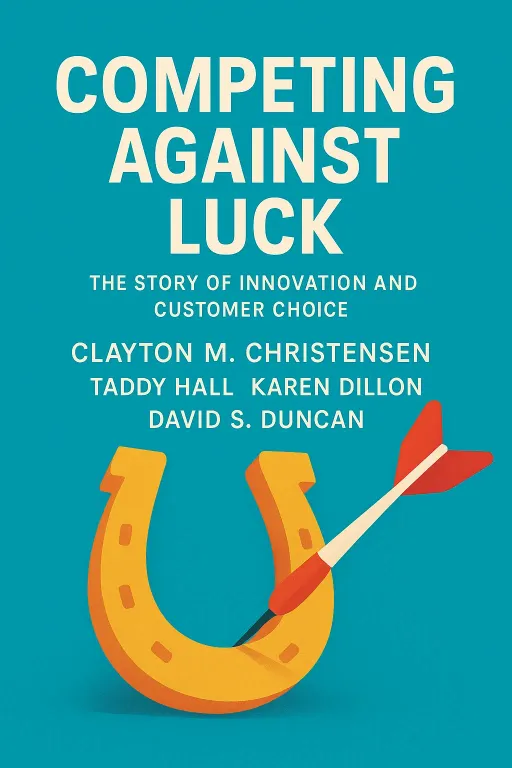
Nova: Well, it’s less magic, more profound insight. Today, we're diving into two foundational texts that, when combined, offer exactly that: a strategic roadmap and a tactical toolkit. We're talking about "Competing Against Luck" by Clayton M. Christensen, Karen Dillon, Taddy Hall, and David S. Duncan, and "The Mom Test" by Rob Fitzpatrick.
Atlas: Oh, I like that pairing. Christensen, the Harvard Business School titan, famous for his work on disruptive innovation, giving us the big picture. And Fitzpatrick, the startup guru, providing the boots-on-the-ground how-to.
Nova: Precisely. Christensen, a towering figure in innovation theory, distilled decades of research into the 'Jobs to Be Done' framework in 'Competing Against Luck.' It's almost a bible for product managers. And then you have Rob Fitzpatrick, coming from that hands-on startup world, giving us the street-smart guide to talking to customers. The contrast between academic depth and practical application makes these books a truly powerful duo.
Atlas: That’s a great way to put it. So, we're not just getting theory; we're getting theory that's been put into practice.
Nova: Exactly. We're going beyond features, beyond what customers they want, to what they truly your product to do. It’s about understanding the deep, often unspoken needs of your users.
The 'Jobs to Be Done' Framework: Beyond Features to Deep Needs
SECTION
Atlas: Okay, so you mentioned 'hiring' a product. That's a fascinating way to frame it. What does Christensen mean by that? Because to me, I 'buy' a product, I don't usually think of 'hiring' it.
Nova: That’s the key distinction, Atlas, and it’s why this framework is so revolutionary. Christensen argued that customers don't just buy products; they 'hire' them to get a specific 'job' done in their lives. And this 'job' often goes far beyond the surface-level features.
Atlas: So it's not about the product itself, but what the product in a particular context?
Nova: Precisely. Let me give you the classic example from Christensen’s work: the milkshake. A fast-food chain wanted to improve its milkshake sales. Their initial approach was typical: ask customers what they wanted – thicker, sweeter, different flavors. They made changes, but sales barely budged.
Atlas: Right. Sounds like a lot of product development meetings I’ve been in. Everyone has an opinion about the features.
Nova: But then, Christensen and his team took a different approach. Instead of asking customers what they wanted, they them. They spent hours in the restaurant, watching people buy and consume milkshakes. And what they found was eye-opening.
Atlas: What did they see?
Nova: They realized people were 'hiring' milkshakes for two very distinct 'jobs.' One group bought milkshakes early in the morning, often alone, on their commute. They needed something long-lasting, filling, and easy to consume with one hand while driving. The milkshake was 'hired' to make their long, boring commute more tolerable, to stave off hunger until lunch.
Atlas: Whoa. So it was a breakfast substitute, a productivity hack, and a boredom killer all rolled into one. Not just a drink.
Nova: Exactly! For that job, thickness was good, it took a long time to drink, and it kept their hands busy. The other 'job' was in the afternoon, often for parents buying for their kids. Here, the milkshake was 'hired' as a treat, something to make the kids happy, not necessarily filling or long-lasting.
Atlas: That makes so much sense! The needs for those two 'jobs' are completely different. If you just focus on making a 'better' milkshake without understanding the context, you're missing the point entirely.
Nova: And that’s the power of 'Jobs to Be Done.' The cause of their initial failure was not understanding the. The process of observing and understanding the 'job' led to distinct solutions for each. The outcome? They could optimize the milkshake for the morning commuter and market it differently for the afternoon treat. Sales soared.
Atlas: That’s incredible. And it really resonates, especially for someone in an AI native edtech startup. We could build the most advanced AI tutor with a million features, but if it's not 'hired' to solve a real, underlying 'job' for a student or parent – like reducing homework stress, or making learning genuinely engaging – then all those features are just noise.
Nova: Absolutely. Many companies fall into the trap of 'feature bloat' because they're not clear on the job. They're just adding more bells and whistles, hoping something sticks, instead of deeply empathizing with the problem their users are trying to solve. It's about progress, not just product.
The Art of Asking: Validating Ideas Through Customer Conversations
SECTION
Atlas: Okay, so we've established the 'what' – we need to understand the 'job.' But that brings me to the 'how.' How do we actually get customers to tell us their true jobs, their deep needs, instead of just what they think we want to hear or polite affirmations? Because I imagine just asking, "What job do you hire my edtech product for?" might not get you very far.
Nova: You're absolutely right, Atlas. And that’s where Rob Fitzpatrick’s "The Mom Test" comes in. It’s a brilliant, no-nonsense guide on how to talk to customers and validate ideas without screwing it up.
Atlas: The Mom Test. Is it because your mom will always tell you your idea is brilliant, even if it's terrible?
Nova: Precisely! The core premise is: even your mom will lie to you, not out of malice, but out of politeness or a desire to be supportive. So, if you can get unbiased, valuable feedback from your mom, you can get it from anyone. The book teaches you how to ask questions that reveal their true needs, not just polite affirmations.
Atlas: So, how does that translate into actual conversation? What does a "Mom Test" question look like for, say, an edtech product trying to help with math homework?
Nova: Great question. Let's imagine you're an edtech founder. A bad question, a "Mom Test fail," would be: "Would you use an AI tutor for your child to help with math?"
Atlas: I'd probably say yes, because it sounds good, it's AI, it's modern... but I might not actually use it.
Nova: Exactly! You're projecting into the future, and you're talking about my idea. A "Mom Test success" question, on the other hand, would be: "Tell me about the last time your child struggled with a math homework problem. What did you do? How did you feel? What solutions did you try? Did they work?"
Atlas: Oh, I see the difference! That shifts the focus entirely. It’s about past behavior and existing struggles, not my hypothetical solution. As a new mom, I can tell you, if someone asked me about my child's struggles, I'd probably launch into a 20-minute monologue about the nuances of 3rd-grade fractions and my own parental anxieties.
Nova: And that’s gold! You’re revealing actual pain points, existing coping mechanisms, and emotional investment. Fitzpatrick gives a few simple but powerful rules: Talk about their life, not your idea. Ask about the past, not the future. Listen more than you talk. And focus on specifics, not hypotheticals.
Atlas: That sounds incredibly practical. It's like you're trying to be a detective, uncovering the real story, not a salesperson trying to get a commitment.
Nova: It's all about gathering evidence, not compliments. You're looking for truths about their problems, not praise for your imagined solution. For an edtech startup, this means instead of asking, "Do you think an AI-powered personalized learning path would be helpful?" you ask, "Describe a time your child felt truly stuck or disengaged with learning. What happened? What did you wish you had in that moment?"
Atlas: That makes perfect sense. It uncovers the actual "job" they're trying to get done – whether it's boosting confidence, reducing frustration, or just getting through the evening without a homework battle. It’s amazing how a simple shift in questioning can unlock so much.
Synthesis & Takeaways
SECTION
Nova: So, bringing it all together, we have Christensen and the 'Jobs to Be Done' framework giving us the strategic 'what' – understand the deep, contextual 'job' your users are hiring your product for. And then we have Fitzpatrick and 'The Mom Test' giving us the tactical 'how' – the specific, empathetic way to actually get those genuine insights from your users.
Atlas: It’s a powerful one-two punch. It means we stop building in the dark, and instead, we start building with genuine empathy and a clear understanding of the real problems we’re solving. It’s the difference between guessing and knowing.
Nova: And that knowing is what unlocks unstoppable growth. Because when you truly solve a 'job' better than any alternative, customers don't just buy your product; they become fiercely loyal to it. It’s about building solutions that become indispensable parts of their lives.
Atlas: That’s actually really inspiring. It frames growth not just as a numbers game, but as a deep act of service, of truly understanding and helping people. And for anyone building something, especially in a fast-paced environment like an AI native edtech startup, it means every feature, every design choice, every line of code, is aligned with a real need.
Nova: Absolutely. It transforms product development from a speculative venture into a mission-driven pursuit. So, for our listeners today, I want to leave you with a thought-provoking question: What 'job' are your users hiring your product for, and are you brave enough to ask them directly about their struggles, not just your solutions?
Atlas: And we'd love to hear your experiences! Have you ever had a "milkshake moment" where understanding the 'job' changed everything? Or a "Mom Test" conversation that completely shifted your perspective? Share your insights with us on social media.
Nova: This is Aibrary. Congratulations on your growth!