

The Age of Revolutions: Shaping Modern Democratic Thought
Golden Hook & Introduction
SECTION
Nova: Most people think wars are started by armies, by declarations, by kings. But what if I told you that some of the most profound revolutions in history, the ones that truly reshaped the world, were actually sparked by something far more unassuming? Something quieter, yet infinitely more explosive: words on a page.
Atlas: Oh, I like that. That’s a bit out there, isn't it? We're talking about cannons and muskets, and you're suggesting a quill and inkwell were the real weapons of mass change? I’m curious, what kind of words are we talking about here? Not just any words, I assume.
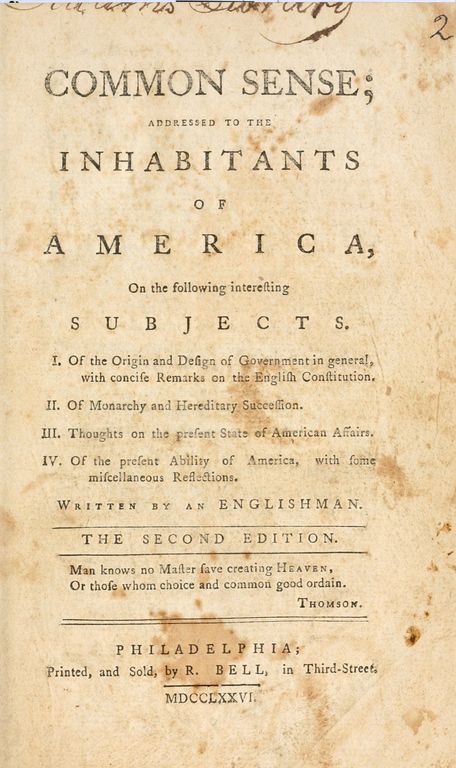
Nova: Absolutely not just any words, Atlas. We're talking about words so potent, so perfectly timed, that they became the rallying cry for an entire continent. Today, we're diving into the extraordinary impact of "Common Sense" by Thomas Paine.
Atlas: Ah, Paine! The name rings a bell, of course, but I confess, the details often blur with other historical figures. What always fascinated me was how someone, seemingly from nowhere, could wield such influence.
Nova: That’s the beauty of it. Paine was an English corset-maker, a tax collector who failed twice, and a radical political theorist who only arrived in America in late 1774, just two years before publishing "Common Sense." He was an outsider, a nobody in the colonial elite, yet his pamphlet became arguably the most influential political document in American history, selling an unprecedented number of copies. It wasn't just read; it was devoured, discussed, and it fundamentally shifted the conversation from reconciliation with Britain to outright independence.
Atlas: Wow, that’s incredible. So, this isn't just about a good argument; it's about an argument that completely rewired the collective consciousness. How did an “outsider” with a pamphlet manage to do what seasoned politicians and fiery sermons couldn't?
Nova: Exactly. And that naturally leads us into the heart of our discussion today: the incendiary power of ideas. How pamphlets like "Common Sense" didn't just inform but revolutions, transforming abstract philosophical ideals into a visceral, undeniable call to action.
The Incendiary Power of Ideas: How Pamphlets Sparked Revolutions
SECTION
Nova: To truly understand Paine's genius, we have to rewind to pre-revolutionary America. The colonies were simmering with discontent – taxes, lack of representation, grievances galore. But there was also immense hesitation. Loyalty to the Crown was deeply ingrained, and the idea of outright separation felt radical, dangerous, even unthinkable for many.
Atlas: I imagine a lot of our listeners might think of it as a clear-cut good-versus-evil scenario in hindsight. But at the time, it must have been incredibly complex. What was the average colonist actually thinking? Were they caught between a rock and a hard place, or just confused?
Nova: They were absolutely caught in a quagmire of conflicting loyalties and fears. Many were simply loyal British subjects who felt their rights were being infringed upon, not that they needed a whole new nation. The intellectual arguments for independence existed, but they were often couched in dense, academic prose, understood by a learned few. This created a kind of language barrier between the Enlightenment philosophers and the everyday farmer or merchant. Paine, with "Common Sense," smashed through that barrier.
Atlas: So, he wasn't inventing new ideas necessarily, but he was translating them. But wait, what made translation so uniquely potent? I mean, plenty of people were writing pamphlets. Was it just timing, or was there something deeper about his philosophical approach that resonated with people who, let's be honest, probably weren't deep philosophical historians?
Nova: That’s the crux of it, Atlas. Paine's rhetorical genius lay in his ability to strip away the academic jargon and speak directly to the common person's experience. He used plain language, vivid metaphors, and biblical allusions that were instantly recognizable and deeply resonant to a largely Christian populace. He didn't just present arguments; he presented them as self-evident truths, as "common sense." He attacked the very legitimacy of monarchy itself, something few dared to do so openly, calling King George III a "royal brute."
Atlas: "Royal brute!" That’s certainly not subtle. It sounds less like a treatise and more like a direct punch to the gut. So, he wasn't just stating facts; he was evoking emotion, making it personal.
Nova: Precisely. He reframed the entire debate. Before Paine, many hoped for reconciliation, for a return to how things were. Paine argued that such a thing was not only impossible but undesirable. He systematically dismantled arguments for continued British rule, appealing to natural rights and the inherent absurdity of a continent being governed by an island. He argued for a government based on popular sovereignty, where the people, not a distant monarch, held power. He made the idea of independence feel not just achievable, but imperative, the only logical step forward for a free people.
Atlas: I see. So, he wasn't just simplifying complex ideas; he was packaging them with an emotional urgency and a moral clarity that was hard to ignore. It’s like he gave people permission to feel what they already suspected, and then gave them the vocabulary to articulate it.
Nova: Exactly. He gave voice to their unarticulated frustrations and, crucially, provided a clear, actionable path forward. He didn't just critique the old system; he offered a compelling vision for a new one: a republic where citizens were sovereign. This philosophical underpinning, drawing from Locke and Rousseau but without the academic pretense, was vital. He wasn't just saying 'we should be free'; he was saying 'here's we must be free, and here's a free society should be structured.'
Atlas: That makes me wonder about the "galvanizing public support" aspect. How did a pamphlet physically spread and create such a unified movement across disparate colonies? We’re talking about a time before social media, before mass communication as we know it. Was it more than just reading – was it a social phenomenon?
Nova: Absolutely, it was a profound social phenomenon. "Common Sense" wasn't just read in private; it was read aloud everywhere. In taverns, in churches after sermons, in town squares. People would gather, often illiterate, to hear its words. It became a shared experience, a collective awakening. It wasn't individual persuasion in isolation; it was community building around a radical, yet now "common sense," idea. It created a common language and a shared understanding of their grievances and their aspirations. The cultural impact was immense; it fundamentally shifted the entire public conversation.
Atlas: That’s a fascinating point. It sounds like it fostered a sense of shared identity and purpose, rather than just individual conviction. So, let’s talk about the "catalyzing political change" aspect. What were the immediate, tangible effects? Did it directly lead to specific declarations or actions? How does this historical example inform our understanding of how ideas still drive political change today, even with all our different media? This is where someone really trying to understand comparative political systems would lean in.
Nova: The impact was almost immediate and undeniably tangible. Within months of its publication in January 1776, "Common Sense" had sold an estimated 100,000 to 120,000 copies, in a population of only two and a half million. George Washington himself, initially hesitant about independence, ordered it to be read to his troops to bolster morale and clarify the cause. Many historians argue it was the single most important factor in swaying public opinion towards independence, paving the way for the Declaration of Independence just six months later. It laid the philosophical groundwork for a government based on popular sovereignty, not inherited power, and its influence extended far beyond America, inspiring democratic movements in France and elsewhere.
Atlas: That’s a powerful testament to the idea that the pen can indeed be mightier than the sword. It makes me think, if a corset-maker with a pamphlet could ignite such a massive shift, what does that say about the responsibility of those who articulate ideas today? Whether they're political leaders, social commentators, or even just individuals sharing their thoughts online, the power of words remains immense.
Synthesis & Takeaways
SECTION
Nova: It’s a profound thought, Atlas. Paine’s work reminds us that the ability to articulate complex truths in an accessible, compelling way is perhaps one of the most potent forces for change. He didn't invent the Enlightenment ideals, but he made them. He showed that profound philosophical meanings, when stripped of their academic encumbrances and presented with conviction, can inspire millions and fundamentally alter the course of nations. It's about empowering people not just with information, but with a shared vision and the courage to pursue it.
Atlas: Absolutely. For anyone who dives deep into history or seeks foundational understandings, Paine’s story is a masterclass in intellectual expansion and the power of communication. It's a reminder that truly impactful ideas aren't necessarily the most complex, but the ones that resonate most deeply with the human spirit, sparking both thought and action. It encourages us to critically examine the narratives around us, to question the status quo, and to understand the historical forces that shape our present.
Nova: And that, I think, is the enduring lesson from "Common Sense": the fundamental truth that clarity, conviction, and accessibility can transform abstract ideals into the driving force of revolution.
Atlas: So, for all our listeners, the next time you encounter a compelling idea, consider not just its content, but its capacity to move people. Ask yourself, how is this idea being communicated? And what change is it trying to ignite?
Nova: This is Aibrary. Congratulations on your growth!