

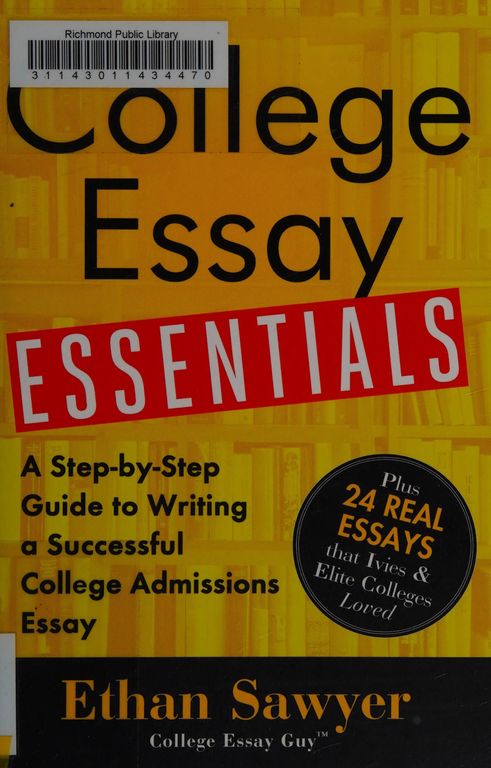
College essay essentials
Introduction
Nova: Welcome to Aibrary. I'm Nova, and today we're cracking open a book that has quite literally changed the game for hundreds of thousands of college applicants. It's called College Essay Essentials by Ethan Sawyer, better known as the College Essay Guy. Now, let me start with a question: what if I told you that the most terrifying, stress-inducing part of the college application process could actually become the most meaningful and even joyful part?
Nova: That is exactly the problem Ethan Sawyer set out to solve. His book, College Essay Essentials, published back in 2016, became an Amazon bestseller and has reached more than a million students and counselors every year through his website, courses, and this book. But here's what makes it different from every other essay guide out there: Sawyer doesn't just teach writing techniques. He frames the entire process as a journey of self-discovery.
Nova: It is, but stick with me. Sawyer himself was raised in Spain, Ecuador, and Colombia, studied at seventeen different schools before graduating from Northwestern, then got an MFA from UC Irvine. He's been a teacher, a curriculum writer, a voice actor, even a truck driver. And his core belief is that a great college essay doesn't just get you into college. It helps you understand yourself better. That philosophy runs through every page of this book, and it's why we're talking about it today.
Key Insight 1
The Two Questions That Unlock Everything
Nova: So here's the first big idea from College Essay Essentials, and it's beautifully simple. Sawyer says there are only four types of college admission essays. Only four. And to figure out which type fits you, you answer just two questions.
Nova: Question one: Have you experienced significant challenges in your life? And question two: Do you know what you want to be or do in the future? That's it. Based on your yes or no to each, you land in one of four categories.
Nova: Type A is for students who've faced significant challenges and have a clear career goal. Think of a student who overcame severe shyness through joining a debate club and discovered a passion for international affairs. That's a narrative essay. Type B: no significant challenges, but you do have a clear career direction. Like the student who writes about their lifelong fascination with meticulous detail work and how it led them to want to become an endodontist. That works best as a montage.
Nova: That's Type C and Type D. Type C students have faced challenges but don't have a clear career direction, and Type D students have neither significant challenges nor a clear career path. And here's the thing Sawyer emphasizes: you do not have to write about trauma to stand out. Many incredible essays that got students into top schools had no central challenge at all. He's very clear about that.
Nova: Exactly. Sawyer explicitly warns against picking the hardest thing you've been through and trying to make it sound worse than it was. That almost always backfires. The goal isn't drama. It's authenticity. And this simple two-question framework immediately removes so much of the overwhelm because suddenly you know what structural approach makes sense for your specific story.
Key Insight 2
Narrative vs. Montage: The Two Structures
Nova: Once you've answered those two questions, Sawyer introduces the two fundamental ways to structure a college essay: narrative and montage. He actually borrows this from screenwriting, which makes sense given his background in theater and film.
Nova: Absolutely. Narrative structure follows what's called the hero's journey. It goes like this: you start with the status quo, the normal life. Then an inciting incident disrupts everything. The stakes get raised. There's a turning point or moment of truth. Then a denouement where the character responds, and finally a new status quo, a different person than who started. This structure works beautifully for students who have overcome challenges, because it naturally builds tension and resolution.
Nova: That's exactly the reference Sawyer uses. A montage structure connects separate moments through a common thematic thread rather than chronologically. Remember the opening of the Pixar movie Up? In just a few minutes, we learn the entire history of Carl and Ellie's relationship. It communicates a lot of information fast and lets you share different kinds of information. Sawyer uses a beautiful metaphor: imagine each different part of who you are is a bead. The theme of your essay is the thread that connects all those beads.
Nova: Right. Sawyer gives examples like a student who used five different T-shirts to tell their story, or someone who connected everything through the lens of cooking, or pranks, or binary star systems as a metaphor for their relationship with their parents. One student wrote about how crassulaceae plants, which can reproduce through stem fragments, are a perfect analogy for how they make art and live their life. The possibilities are endless, but the key is finding an uncommon thread.
Deep Dive
The Brainstorming Toolbox
Nova: Now, before you ever start writing, Sawyer insists on five brainstorming exercises. And this is where the book really shines compared to generic writing advice like just use your authentic voice or write what you know.
Nova: Sawyer's approach is relentlessly practical. The first exercise is called Essence Objects. You find a quiet space for about fifteen minutes and list twenty physical objects that represent your core qualities. Not what they mean, just the objects themselves. A green pen that represents support and encouragement, a North Carolina basketball that represents family connection, a blue Bible that represents upbringing and community.
Nova: It is, but Sawyer provides twenty prompting questions to help, like what's a food that reminds you of your family, what object represents a secret not many people know about you, if your house was on fire and you could save just three non-technology objects, what would they be. He quotes T. S. Eliot, who said the only way to express emotion in art is through an objective correlative, an object to which you correlate emotions, memories, and complex meanings.
Nova: Exactly. Then comes the Values Exercise. You get a big list of values like accountability, adventure, compassion, creativity, wisdom. You pick ten in two minutes, then narrow to five in one minute, then your top three in thirty seconds, and finally, if you can, one core value. The insight here is profound: your essence objects represent where you've come from, your past. Your core values represent where you're going, your future aspirations. Sawyer emphasizes that a career isn't an endpoint. It's a means to express your values.
Nova: And that's why Sawyer says these exercises aren't just for crafting essays. They help you understand and find meaning in your life experiences. There are also the 21 Details Exercise, the Everything I Want Colleges to Know About Me exercise, and the Feelings and Needs exercise. Plus vulnerability warm-ups like If you really knew me and I love, where you just stream-of-consciousness list things you love for sixty seconds.
Key Insight 3
The Great College Essay Test
Nova: Once you've got a draft, Sawyer provides what he calls the Great College Essay Test. And this is where the rubber meets the road. He identifies four qualities that every great personal essay needs and five qualities colleges are looking for.
Nova: Number one: core values. Can a reader name at least four or five of your core values after reading? And are they varied? Sawyer warns against clustering around things like hard work, determination, perseverance, which all basically say the same thing. He wants to see range: autonomy, resourcefulness, healthy boundaries, diversity.
Nova: Right. Number two: vulnerability. Does the essay sound like it came from your head, all analytical, or from your heart and gut? After reading it, does the reader know more about you and feel closer to you? This is the personal in personal statement.
Nova: It is, and Sawyer acknowledges that. He even shares vulnerably in the book about his own tendency to emotionally distance himself from people he thinks won't really listen. But he believes vulnerability is the most efficient path to genuine connection with a reader who may never meet you.
Nova: Insight, what he calls so what moments. Can you identify at least three to five moments in your essay where you make an interesting, illuminating connection rather than just describing events? Are these moments predictable or truly surprising? And number four: craft. Do the ideas connect in a way that's logical but not boring? Can you tell the author revised carefully over multiple drafts? Is every word pulling its weight?
Nova: Sawyer's team researched over three hundred college and university websites and identified five admission nutrients: intellectual curiosity, service to others or community impact, leadership or initiative, collaboration, and consistent engagement. Not all five need to appear in the essay itself, some can show up in activities lists or recommendation letters, but the essay should demonstrate at least a few of them authentically.
Key Insight 4
From Cliché to Standout: The Uncommon Connection
Nova: One of my favorite frameworks in the book is Sawyer's breakdown of what makes an essay boring versus what makes it stand out.
Nova: It is. He says a boring personal statement chooses a common topic, makes common connections, and uses common language. For example: I want to be a doctor because I'm empathetic and I love helping people and I really want to make the world a better place. That's three layers of generic.
Nova: And admissions officers have read it thousands of times. Now contrast that with what Sawyer calls a stand-out essay. It chooses an uncommon topic or at least makes uncommon connections and uses uncommon language. His example: I want to run a tech startup because I value humor, leading from the battlefield, and stuff that makes me cry, and because my journey took me from being a scrawny twelve-year-old kid to a scrawny twelve-year-old man.
Nova: Exactly. And Sawyer offers a practical exercise: start with the cliché version of your essay. What are the three to five common values everyone associates with your topic? For an aspiring engineer, it might be collaboration, efficiency, hands-on work. Write those down. Then spend eight minutes brainstorming uncommon connections. How has engineering or whatever your thread is taught you about accountability or social change or humor?
Nova: Right. Some common values might genuinely be part of your story, and that's fine. But if you want to stand out, you need to say a few things others don't tend to say. Sawyer even points students to resources like O-Net Online, a government database of career skills, to find unexpected values associated with their chosen field.
Key Insight 5
Beyond the Application: Essay as Self-Discovery
Nova: Here's what I think truly elevates College Essay Essentials above other guides. Sawyer insists that this process could change your life. Not might help you get into a good school. Could change your life.
Nova: But hear his reasoning. He draws on narrative therapy, the idea that how we frame the events of our past shapes our identity. By going through these exercises, by honestly examining your essence objects and core values, by crafting a narrative or montage that makes sense of your experiences, you're actually re-authoring your identity. You're deciding what your story means.
Nova: That's exactly how Sawyer frames it. He writes in the book, and I'm paraphrasing, a great essay doesn't just get you into college, it helps you understand yourself better. He points out that reflecting on your own story gives you clarity about what truly matters, which in turn can shape decisions about majors, careers, and even how you show up in the world.
Nova: Great question. Sawyer sees the essay as an opportunity for families to walk through this together. Parents can help by setting reminders and giving gentle check-ins, by asking questions and listening, by encouraging reflection rather than rewriting. The book even includes a family timeline, starting in junior year spring with college research, through summer before senior year for drafting essays, into the fall for finalizing applications. But the parent's role is supporter, not editor-in-chief.
Nova: Absolutely. Sawyer's advice to parents is proofread for clarity, not for rewriting. And he emphasizes that when parents join in by asking questions and listening, it transforms into a family moment of discovery. Students gain not just stronger applications, but a clearer sense of direction for life beyond graduation.
Conclusion
Nova: So let's bring it all together. College Essay Essentials by Ethan Sawyer takes what might be the most intimidating writing task a teenager ever faces and transforms it into a structured, even joyful process of self-exploration. The core insights are these: there are only four types of college essays, and two questions determine yours. You can structure your story as a narrative with cause and effect or as a montage with thematic threads. Before you write a single word, you mine your life for essence objects and core values through concrete, timed exercises. Then you test your draft against four personal qualities, core values, vulnerability, insight, and craft, and five admission nutrients, intellectual curiosity, service, leadership, collaboration, and consistent engagement. And the secret to standing out is making uncommon connections rather than reaching for the cliché.
Nova: Beautifully said. And Sawyer would agree. He paraphrases Joseph Campbell: a good life is one hero journey after another. Each time, there is the same problem. Do I dare? Writing your personal statement is a hero's journey. There are dangers, and there is the possibility you might fail. But there's also the possibility that, if you stick with it, something amazing might happen.
Nova: This is Aibrary. Congratulations on your growth!