

The Long View: How Civilizations Rise and Fall
Golden Hook & Introduction
SECTION
Nova: What if I told you that the biggest threat to our future isn't some unforeseen catastrophe, but our stubborn refusal to look at the past? Not just it, but it, to see the patterns staring us right in the face.
Atlas: Whoa, Nova. That's a bold claim. Most people are probably thinking about their next meeting, or the latest news cycle. You're saying we're missing something much bigger?
Nova: Absolutely, Atlas. We're talking about "The Long View," understanding how civilizations rise and fall. It's a concept that sounds grand, almost academic, but it's fundamentally about how we make decisions today. Our blind spot for these grand historical cycles can lead to some incredibly short-sighted, even catastrophic, choices.
Atlas: I imagine a lot of our listeners, especially those who dedicate time to deep, uninterrupted study, might find that idea both compelling and a little unsettling. It’s like, if history is a recurring drama, are we just repeating the same mistakes without even realizing it?
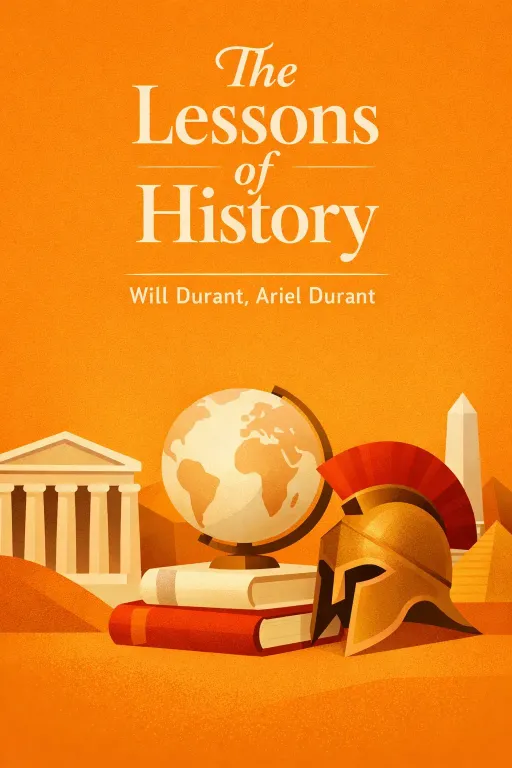
Nova: Precisely. And for those who seek depth and clarity, this is where the analytical rigor of historians truly shines. We're drawing insights today from monumental works like "The Lessons of History" by Will and Ariel Durant—a husband and wife duo who spent their entire lives, literally decades, distilling centuries of human experience into concise observations. And also, Jared Diamond's "Collapse: How Societies Choose to Fail or Succeed," a book that brilliantly weaves together environmental science, anthropology, and history to show us why some societies thrive and others vanish. Diamond's interdisciplinary approach really changed the game for understanding these patterns.
Atlas: So, we're not just looking at history as a collection of old stories, but as a kind of predictive framework. That makes a lot of sense for anyone driven by factual understanding. It’s like finding the operating manual for human civilization, isn’t it?
Nova: Exactly! It's about seeing history not as a random walk, but as this recurring drama with discernible patterns and consequences. And that brings us directly to our first core idea: The Blind Spot.
The Blind Spot: Why We Miss the Big Picture
SECTION
Nova: Imagine you're standing in a dense forest. All you can see are the trees immediately around you—the bark, the leaves, maybe a squirrel. You're completely focused on the immediate, tangible details. But you're missing the entire ecosystem, the mountain range, the weather patterns, the ancient river that carved the valley. That, in essence, is our "blind spot" when it comes to history. We get so caught up in the immediate challenges—the next quarter's earnings, the latest political scandal, the daily headlines—that we completely miss the grand, recurring cycles that are truly shaping our destiny.
Atlas: That makes me wonder, how much of our current geopolitical shifts, for example, are we misinterpreting because we're too focused on the individual trees? It feels like we're constantly reacting.
Nova: We are. And a classic, powerful example of this is the fall of the Roman Empire. For centuries, Rome was the undisputed superpower. But its collapse wasn't a sudden event. It was a slow, agonizing process, fueled by a relentless focus on the immediate. Leaders were constantly battling for power, dealing with barbarian incursions at the borders, or trying to manage the vast, sprawling bureaucracy.
Atlas: Hold on, so you're saying they were too busy fighting fires to realize the house was rotting from within?
Nova: Precisely. They expanded relentlessly, which brought them immense wealth and power in the short term, but also created unsustainable logistical and administrative burdens. They relied heavily on slave labor, which stifled innovation and created massive social inequality. Environmental degradation, like deforestation for building and heating, led to soil erosion and resource scarcity, but these were slow-moving problems, easily ignored when there were more pressing, immediate political rivals to contend with. Imagine a Roman senator arguing about long-term climate change when there's a barbarian horde threatening the frontier!
Atlas: That’s a bit like someone in a high-stakes tech environment focusing solely on the next product launch while the company culture is toxic, or the core technology is becoming obsolete. It’s hard to prioritize the slow burn over the urgent crisis.
Nova: It is, because the immediate crisis screams louder. The emperors and senators were preoccupied with consolidating their own power, funding their armies, and keeping the populace placated with bread and circuses. These were all immediate, tangible concerns. The long-term systemic vulnerabilities—the over-expansion, the environmental pressures, the internal social fissures—they festered, often out of sight, until they reached a tipping point. The leaders simply weren't incentivized, or perhaps even equipped, to think in terms of centuries, when their political survival depended on the next few months.
Atlas: That sounds rough, but isn’t it incredibly difficult for leaders, or even us, to step back and see those long-term patterns when we're drowning in daily crises? It feels almost impossible to gain that perspective in the moment. How do you even begin to cultivate that "long view" amidst all the noise?
Decoding the Cycles: Lessons from History's Rise and Fall
SECTION
Nova: It incredibly hard, Atlas, but that's precisely where the work of people like the Durants and Jared Diamond becomes invaluable. They don't just tell us happened; they provide frameworks for to see history as this recurring drama. The Durants, for instance, in their distillation of centuries, highlighted enduring themes: the cyclical nature of governance, the recurring challenges to morality, the ebb and flow of progress. They essentially said, "Look at these consistent threads woven through the tapestry of time."
Atlas: So you’re saying they give us a lens, or a mental model, to filter out the daily noise and actually see the underlying structure? Like, it’s not just stories, but more like predictive patterns?
Nova: Exactly. And Diamond takes it further, examining past societies that collapsed due to a combination of environmental factors and cultural choices. He provides these stark warnings, but also valuable lessons. Take the Norse settlement in Greenland, for example, which he explores in "Collapse." It's a gripping, almost tragic, case study.
Atlas: I'm curious, what happened there? We're talking Vikings in Greenland, right? That sounds like a tough place to begin with.
Nova: It was. Around the year 1000, the Norse established settlements in Greenland, lasting for about 450 years. They were farmers and herders, trying to replicate their European lifestyle in a harsh, unforgiving environment. What's fascinating is how they clung to their cultural identity and practices, even as their environment drastically changed. They cut down the sparse trees for timber and fuel, leading to deforestation and soil erosion. They overgrazed the delicate pastures.
Atlas: Oh man, it’s like they were actively undermining their own survival, but couldn’t see it?
Nova: They were. And here's the crucial part: the climate cooled significantly during the Little Ice Age. Their traditional farming became unsustainable. Meanwhile, the local Inuit people, who had adapted to the Arctic environment over millennia, thrived. The Inuit hunted seals, built insulated snow houses, and used kayaks—all things the Norse largely refused to adopt. Their European identity, their cultural choices, became a blind spot. They sent their most valuable resources, like walrus ivory, back to Europe for luxury goods and church tithes, instead of investing in local survival strategies.
Atlas: That’s actually really heartbreaking. It’s like they were so fixated on maintaining their identity and traditions that they ignored the very real, very urgent signals from their environment. And they had an example of adaptation right there with the Inuit! That makes me wonder, when you look at that, what historical pattern do you see repeating itself most clearly in today's world, especially with our current environmental and geopolitical shifts? It feels like we're facing similar dilemmas, but maybe with higher stakes.
Nova: Absolutely, Atlas. The most glaring pattern is the one Diamond illuminates: the failure to adapt to environmental change, exacerbated by cultural conservatism or a refusal to learn from others. We see it today in debates around climate change, resource depletion, and even the resistance to new technologies or social structures that could solve pressing problems. Just like the Norse prioritizing their European identity over survival, we sometimes prioritize short-term economic gains or entrenched political ideologies over long-term planetary health or societal well-being.
Atlas: So the lesson isn't just about environmental collapse, but about the rigidity of thought, the inability to pivot when the ground beneath you is shifting. It's about how societies to fail or succeed, as Diamond says.
Synthesis & Takeaways
SECTION
Nova: Exactly. History doesn't repeat itself exactly, but it certainly rhymes. The core insight here is that civilizations, much like individuals, often fall not just from external threats, but from internal failures to adapt, to acknowledge uncomfortable truths, and to look beyond the immediate. The "long view" isn't about predicting the future with a crystal ball; it's about understanding the underlying forces and patterns so we can make more informed, resilient choices today.
Atlas: For someone trying to navigate their own complex world, whether it's a personal challenge or a global issue like geopolitical shifts, what's one actionable mindset shift or practice we can take from these historical "long views"? How do we avoid our own blind spots?
Nova: I’d say it's about cultivating a habit of "pattern recognition" and "adaptive humility." Actively seek out historical parallels, even when they seem distant. Ask yourself: "Has something like this happened before? What were the long-term consequences then?" And pair that with humility – the willingness to question your own assumptions, your own cultural biases, and to learn from unexpected sources, just as the Norse might have learned from the Inuit. It’s about being open to the idea that your current way of doing things might not be sustainable in the long run.
Atlas: That's actually really inspiring. It means we're not doomed to repeat history if we're willing to actually look at it, and learn from it. It's about being a student of the past to become a better architect of the future.
Nova: A perfect description, Atlas. It's a profound understanding that offers both a stark warning and immense hope.
Atlas: This is Aibrary. Congratulations on your growth!