

Beyond the Battlefield: Uncovering the Hidden Layers of Culture
Golden Hook & Introduction
SECTION
Nova: I'll give you two words, Atlas: "Guns, Germs." What's the third word that completes one of the most influential, and yes, controversial, historical theories of the last century?
Atlas: Hmm, "Guns, Germs..." My first thought is "Zombies," but then I'm thinking, "Steel"? Sounds like a heavy metal band's greatest hits, but I'm guessing it's more profound than that.
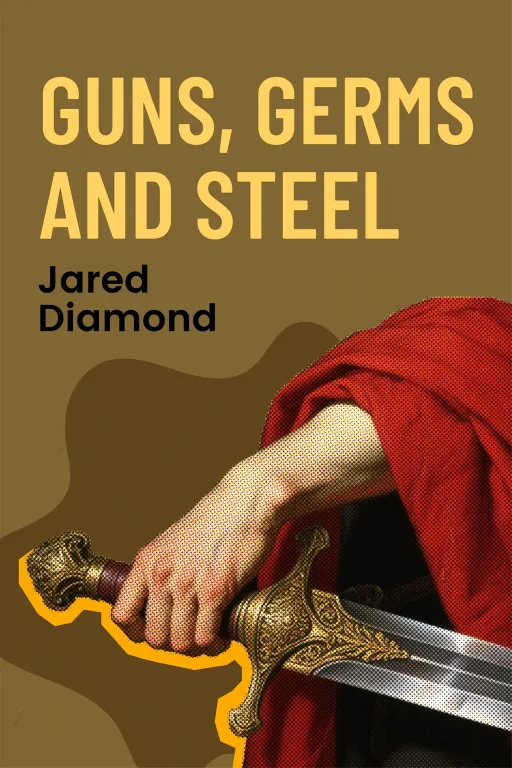
Nova: You nailed it, "Steel"! And it is profoundly more. Today, we're dissecting the groundbreaking ideas of Jared Diamond, the Pulitzer Prize-winning geographer and ornithologist, whose work, particularly and, completely reframed how we understand human history and culture. What's often overlooked about Diamond is his initial fieldwork as an ornithologist in New Guinea. That hands-on, boots-on-the-ground experience with diverse ecosystems and human societies profoundly shaped his unique, environmental-centric lens on human societies.
Atlas: An ornithologist writing about human civilizations? That's quite the career pivot. Does that mean he literally looked at us like fancy, featherless birds?
Nova: In a way, yes! He approached human societies with a scientist's eye, looking for ecological patterns. And what he found challenged centuries of assumptions. He argued that culture often feels like a purely human creation, a set of beliefs and practices we develop in a vacuum. But that perspective sometimes misses the powerful, underlying forces that shape how cultures emerge and thrive, or decline. We're talking about the silent hand of geography and environment.
The Environmental Determinants of Culture
SECTION
Nova: So, let's dive into. Before Diamond, many explanations for why some continents developed advanced civilizations and technologies before others often hinted at inherent differences among peoples. Diamond blew that out of the water. He said, "No, it's not about inherent superiority; it's about geographical luck."
Atlas: Geographical luck? You mean like winning the cosmic lottery just by being born on the 'right' patch of dirt? That sounds a bit… unfair.
Nova: Well, history often is, isn't it? Diamond's central argument is that the availability of domesticable plants and animals, and the ease with which innovations could spread, were the real game-changers. Take Eurasia, for instance. It stretches across a massive East-West axis. This meant that crops and domesticated animals, once developed in one region, could spread relatively easily to other areas along similar latitudes, which share similar climates and day lengths.
Atlas: So, if you figure out how to grow wheat in the Middle East, it's relatively easy to grow it in Europe or China because the conditions are similar?
Nova: Precisely! The Fertile Crescent, a cradle of early agriculture, had a bounty of wild cereals and large mammals ideal for domestication. When people there figured out farming, those innovations could hopscotch across Eurasia, leading to agricultural surpluses, which in turn supported denser populations, specialized labor, and eventually, complex societies, writing, and advanced technologies.
Atlas: And the 'germs' part? That's about immunity, right?
Nova: Yes, as people lived in closer proximity to domesticated animals, they developed immunities to diseases that then devastated populations that hadn't had that exposure. When Europeans arrived in the Americas, for example, their 'guns and steel' were certainly factors, but the 'germs' they carried, to which native populations had no immunity, were arguably the most devastating weapon. Measles, smallpox – these diseases wiped out up to 90% of some indigenous populations.
Atlas: Wow. So, the sheer biological advantage of having lived with certain animals for millennia just… decimated entire peoples. That's a brutal, almost accidental, form of conquest.
Nova: It's a stark reminder of the unintended consequences of environmental interactions. Now, compare that to the Americas. They primarily run on a North-South axis. This meant that a crop developed in, say, Mesoamerica, like corn, couldn't easily spread to the Andes or the Great Lakes region because the climate zones changed so drastically.
Atlas: Ah, so you can't just take a plant adapted to a tropical climate and expect it to thrive in a temperate one. That makes sense.
Nova: It drastically slowed the spread of agriculture and technology. Plus, the Americas had far fewer large animals suitable for domestication – no horses, no cows, no pigs in the same way Eurasia did. This meant less animal power for farming, less protein, and fewer disease immunities. This wasn't about the intelligence or ingenuity of the people; it was about the cards nature dealt them.
Atlas: So, it's not that some cultures were inherently more 'advanced,' it's that some had a massive environmental head start that allowed them to develop certain technologies and societal structures faster. That really flips the script on how we often think about history. It takes away the idea of racial superiority, which is often a nasty undercurrent in these discussions.
Nova: Exactly! Diamond explicitly rejects any notion of racial superiority. His whole point is that the environmental hand you're dealt shapes your cultural trajectory, not your genes. And that naturally leads us to the second key idea we need to talk about, which often acts as a counterpoint to what we just discussed. If geography gives some cultures a leg up, what happens when cultures respect their environment?
Cultural Sustainability and Environmental Collapse
SECTION
Nova: That's where Diamond's other seminal work,, comes in. It examines how societies throughout history have failed or succeeded based on their relationship with their environment. He looks at past civilizations that, despite their apparent sophistication, ultimately succumbed to environmental degradation.
Atlas: Sounds like a history lesson we desperately need right now.
Nova: It absolutely is. One of the most haunting examples he details is Easter Island. Imagine this tiny, isolated speck of land in the vast Pacific, once home to a thriving culture that managed to carve and erect those incredible statues. They were a testament to their ingenuity and social organization.
Atlas: Those giant heads, right? How on earth did they move those things?
Nova: Well, that's part of the story. They moved them using wooden sleds and rollers, which required an enormous amount of timber. The island was originally covered in a lush palm forest, including the largest palm tree species in the world. But the islanders, driven by cultural practices like statue building, competitive feasting, and the need for canoes to fish, gradually deforested their entire island.
Atlas: So, they literally cut down the very foundation of their survival? That's... surprisingly short-sighted for such an advanced culture.
Nova: It was a slow, incremental process. Each generation probably didn't notice the drastic change until it was too late. As the trees disappeared, so did the birds, a key food source. Soil erosion became rampant, ruining their agriculture. Without timber for canoes, they couldn't fish the open ocean. Without wood for shelter, their homes deteriorated. The island became a barren wasteland.
Atlas: And what happened to the people?
Nova: The population plummeted. Famine, warfare, and cannibalism became widespread as resources dwindled. The once-proud culture collapsed into chaos. They even started toppling each other's statues, symbols of their former glory, in acts of desperation and revenge. It's a stark, almost cartoonishly clear example of a society destroying itself by overexploiting its environment, driven by cultural practices that became unsustainable.
Atlas: That's chilling. You're saying their cultural focus on building bigger and bigger statues, or whatever their internal competitions were, literally led to their demise because they stopped seeing the forest for the trees, quite literally. What about other examples?
Nova: He also examines the Maya, though their collapse was more complex, involving a combination of prolonged drought, deforestation, and endemic warfare. But the core lesson remains: societies that ignore their ecological limits, or whose cultural values prioritize short-term gains or unsustainable practices, are vulnerable.
Atlas: So, the deep question from the book content really hammers home: "How might our current cultural practices be unknowingly shaped by deep environmental factors we rarely consider?" We're not building giant stone heads, but we're certainly consuming resources at an unprecedented rate. Are we making the same mistakes, just on a global scale?
Synthesis & Takeaways
SECTION
Nova: That's precisely the profound insight Diamond offers. He forces us to recognize that culture isn't just an abstract human construct; it's deeply, inextricably linked to the natural world. Our environment shapes what's possible, and in turn, our cultural choices determine the health of that environment. The silent forces that gave some cultures a head start are the same silent forces that can bring others to their knees if ignored.
Atlas: It's like we're still operating with a blind spot, thinking our cultural practices around consumption, energy, and growth are purely human inventions, detached from the planet's capacity. But those choices are deeply influenced by the resources available, and the consequences are very real.
Nova: Exactly. Understanding our deep environmental embeddedness is the first step towards sustainable cultural practices. We need to critically examine how our modern cultural practices – from our food systems to our energy consumption, our urbanization, and our globalized trade – are shaped by and impacting the environment. The lessons from Easter Island aren't just historical curiosities; they're urgent warnings. Our current cultural trajectory, if it continues to disregard ecological limits, could lead to a global-scale collapse. It's about shifting our cultural values to prioritize long-term ecological health over short-term material gain.
Atlas: That's a powerful and frankly, a bit sobering, thought. It makes you look at your everyday choices, and the larger societal systems, with a completely different lens. So, if you're listening, what cultural practices are seeing that might be unknowingly shaped by environmental factors we rarely consider, and what could we do differently?
Nova: Something to ponder deeply. This is Aibrary. Congratulations on your growth!